
Tag Archives: Greed

Explosion at government-run Amuay refinery, nationalized by Venezuela in 1976

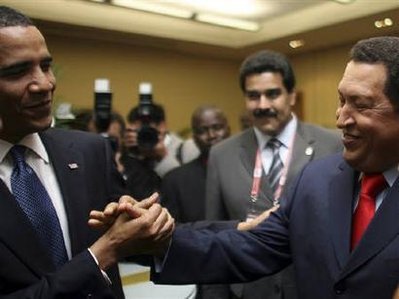
Are Barack Obama and Hugo Chavez very different?

In the United States, we’ve been seeing some efforts by the Marxist Obama administration to nationalize the auto industry and health care, too. This is what communists favor as the alternative to the free-market system. It makes sense, then, to look at how well the nationalization of assets, especially those owned by foreign-owned private companies, works out in the real world.

Let’s see:

The Creole Petroleum Corporation was an American oil company, formed in 1920 to produce fields on Lake Maracaibo, Venezuela.[1] The company was acquired by Standard Oil of New Jerseyin 1928. Until 1951 Creole Petroleum was the world’s number one oil producer.[2]

In 1950, Creole opened its refinery at Amuay.[3] This is now a part of the Paraguaná Refinery Complex.

The Venezuelan assets of Creole Petroleum Corporation were nationalized along with those of other foreign oil firms on January 1, 1976, becoming part of Lagoven, a Venezuelan government-owned operating company.[4]

And here is the latest triumph of Marxist economics in Venezuela:

A huge explosion rocked Venezuela’s biggest oil refinery early Saturday, killing at least 24 people and injuring more than 80 others in the deadliest disaster in memory for the country’s key oil industry.

Balls of fire rose over the Amuay refinery, one of the largest in the world, in video posted on the Internet by people who were nearby at the time.

At least 86 people were injured, nine of them seriously, Health Minister Eugenia Sader said at a hospital where the wounded were taken. She said 77 people suffered light injuries and were released from the hospital.

Officials said those killed included a 10-year-old boy, but that most of the victims were National Guard troops stationed at the refinery.

Filthy capitalist dogs! Making money on the backs of the poor workers! Making them work in filthy, unsafe – oh, wait. When workers are left free to take their skills to a number of private employers, then those employers are pressured to provide them with better working conditions, wages and benefits. Otherwise the employees leave for better companies. The only problem is that it doesn’t work if all the industries are state-run monopolies. Then, you just get KA-BOOM!

All you have to do to understand economic systems is to compare capitalist Chile with communist Venezuela. The people are the same, and both started out poor. One embraced free trade and privatization, and now that one is rich. The other one gets Chernobyl explosions because they elected a Marxist.

Venezuela’s economic policy is the same economic policy that Barack Obama wants to force on us with his takeover of General Motors, his frequent bailouts, his give-aways to campaign fundraisers, his blocking of free trade deals, his heavy-handed anti-business regulations, and his other intrusions into the private sector. Our entire economy is going KA-BOOM right now because of Marxism.

Related posts

Who really gets rich from gasoline? Big oil companies or big government?

Here’s a great article that will blow your mind from the Wall Street Journal. (H/T Tom)

Excerpt:

With the average price of gas in America hovering around $3.50 per gallon for regular unleaded, it costs more than $50 to fill a typical car’s 15-gallon tank this summer. Why does gas cost so much?

You may blame high gas prices on rich oil company executives or greedy gas station owners. The truth is that governments rake in a larger profit at the pump than anyone—and with gas taxes on the rise in many parts of the country, there’s no relief in sight.

The price of a gallon of gas is based on the combination of four costs: that of crude oil, of refining gas, of distribution and marketing, and of taxes.

Crude oil costs make up about 76% of the cost of gasoline, according to U.S. Energy Information Administration (EIA). Thus $2.66 of a $3.50 gallon of gasoline is set before the oil is even refined. Global markets, reacting to supply and demand, determine the cost of crude oil. Just like any commodity, from gold to corn, a shortage in supply or an increase in demand leads to a rise in prices.

Refining oil is the next step in the process—and the next expense for drivers. Gasoline is extracted from crude oil and additives, including lubricants and detergents to reduce engine deposits, are added. As of January 2012, the EIA found that refining was responsible for 6% of the cost of gasoline.

Distribution and marketing—the part of the process most apparent to consumers—constitutes another 6% of gas prices. That portion of the cost includes the shipping and transportation of the gasoline, a markup to cover retailers’ expenses, and any advertising created to appeal to customers.

The remaining 12%—or almost 50 cents per gallon today—goes directly to federal, state and local governments in an array of sales and excise taxes. The federal gas tax is 18.4 cents on every gallon of gasoline sold in America. State gas-tax rates vary from a low of eight cents per gallon in Alaska to a jarring 49 cents per gallon in New York. Other states where it’s steep to fill up include California and Connecticut—each with 48.6-cent-per-gallon gas taxes—and Hawaii, at 47.1 cents per gallon.

Some local governments have gotten in on the act, too. In California, local sales and excise taxes on gasoline average 3.1%, according to the Los Angeles Times. That works out to about 12 cents in local taxes for each gallon of gas, based on the state’s current average of $3.80 per gallon.

[…]Exxon, for example, made only seven cents per gallon of gasoline in 2011. That’s a drop in the bucket compared to the nearly 50 cents per gallon that federal, state and local governments rake in on an average gallon of gas pumped in the U.S.

That’s not going to stop the unproductive socialists in government for accusing oil companies of being greedy. Who’s really greedy? Government is greedy. They take more of your money in gas taxes than the oil companies do.

A closer look at the Obama administration’s $525 million loan to Solyndra

From the Manhattan Institute. (H/T Tom)

Here’s the first thing to note about this story:

Both Republican and Democratic administrations have practiced a “green” industrial policy by supporting ventures that promised to pursue renewable, non-carbon-based energy production or energy conservation.

The DOE’s authority to issue loan guarantees for innovative, clean energy technologies, the Energy Policy Act of 2005, was passed by a Republican House and Senate and signed into law by George W. Bush. Under the law, Congress authorized the issuance of $4 billion in loan guarantees in 2007, and $47 billion in 2009 with the objective of encouraging the development of new technologies. [2] [3]

However, no DOE loan guarantees were made during the Bush administration. The DOE wanted to make a loan to Solyndra, but career officials at the Office of Management and Budget (OMB) did not approve it, on the grounds that the project was not financially sound.

The Section 1705 Loan Program was created by the 2009 American Reinvestment and Recovery Act, which amended the Energy Policy Act of 2005.[4] The 2009 stimulus bill gave the DOE an additional $3.95 billion for loan guarantees.[5]

So that’s where the money came from. It was “stimulus” money. And now the shocking part:

By November 2008, Solyndra had raised $450 million from investors and was applying for a loan guarantee from the DOE under the Energy Policy Act of 2005. But the loan was turned down in January 2009 in the waning days of the Bush administration, on the grounds that “there is presently not an independent market study addressing long term prospects for this company” and “there is concern regarding the scale-up of production assumed in the plan for Fab 2,” a second factory.[7]

On January 13, 2009, Lachlan Seward, director of the loan program at the DOE, wrote, “After canvassing the Committee it was the unanimous decision not to engage in further discussions with Solyndra at this time.”[8] Lachlan was referring to the DOE Credit Committee, which was composed of DOE officials.

When President Obama took office days later, the DOE’s tone changed. In a March 10, 2009, e-mail to an unnamed official, a senior adviser to Energy Secretary Steven Chu wrote, “The solar co [sic] board approved the terms of the loan guarantee last night, setting us up for the first loan guarantee conditional commitment for the president’s visit to California on the 19th.”[9] As events soon revealed, March 19, 2009, was a wildly premature target date for a presidential visit. In fact, President Obama didn’t visit Solyndra until May 2010.

E-mails dated 2009 depict White House and DOE officials rushing to sign off on the project so that Vice President Joe Biden could appear at the Fremont plant in September 2009 to trumpet the administration’s support for green jobs. There was confusion about who would go and when, as well as a palpable sense of urgency. Within the OMB—historically the most fiscally conservative agency in any administration—there was anxiety about premature planning and precedent.

On March 10, 2009, an OMB official whose name was blacked out by the administration before the e-mails were released to Congress wrote, “DOE is trying to deliver the first loan guarantee within 60 days from inauguration (the prior administration could not get it done in four years). This deal is NOT [sic] ready for prime time.”[10]

[…]On August 31, 2009, an unidentified OMB official wrote to Terrell McSweeny, domestic policy adviser to Vice President Biden, saying “We have ended up in the situation of having to do rushed approvals on a couple of occasions (and we are worried about Solyndra at the end of this week). We would prefer to have sufficient time to do our due diligence reviews and have the approval set the date for the announcement rather than the other way around.”[12] Regardless of these concerns, the loan was approved on September 3, and Biden announced it via satellite at Solyndra’s plant on September 4.

[…]On May 24, 2010, Valerie Jarrett, senior adviser to the president, forwarded a Cleantech Blog post by Philip Smith to Ron Klain, chief of staff to Vice President Biden. The post outlined the doubts of Pricewaterhouse Coopers, Solyndra’s auditors, about the company. It stated, “On a pure business analysis you have to agree with the auditors—they are not a going concern.”[14] Jarrett said to Klain in an e-mail, “As you know, a Going Concern letter is not good. Thoughts?”[15]

Although Jarrett and Klain knew that Solyndra would go under, two days later, on May 26, 2010, the president visited the newly built Solyndra manufacturing plant in Fremont, California, and declared, “It is here that companies like Solyndra are leading the way toward a brighter, more prosperous future …. We can see the positive impacts right here at Solyndra.”

Fascinating. This is what the government does with the money that it is borrowing from your children. This is what the “stimulus” efforts of the Obama administration amounted to. Not only was the Solyndra loan an opportunity to pay back a Democrat campaign fundraiser, but we now learn that it was also rushed through to provide Obama with a publicity opportunity. Is that the main job of the President of the United States? To waste money on photo opportunities?