Tag Archives: Greece

Republicans pushing to rescind Democrats’ $100 billion EU bailout fund

Here’s a shocking story from Matthew Boyle of the Daily Caller.

Excerpt:

When California Democratic Rep. Nancy Pelosi was the Speaker of the House in 2009, President Barack Obama and congressional Democrats authorized $100 billion in spending as a line of credit for the International Monetary Fund to be used in times of emergency — funds that could now be used to bail out European banks.

As the Eurozone takes a turn for the worse and chatter heats up about more European Union and IMF bailouts across the continent, Republicans in Congress are pushing to rescind the $100 billion set-aside.

That $100 billion is an addition to the $64.4 billion the U.S. Treasury will provide in quotas to the IMF this year. That new funding has not been formally appropriated, but the IMF could request the money whenever it pleases.

[…]McMorris Rodgers is leading the charge, with more than 80 House Republicans, to rescind that line of credit before the IMF takes any more of it. She told TheDC that IMF officials confirmed to her that about $6 billion of the $100 billion has been used to help bail out Portugal, as well as St. Kitts and Nevis, a small Caribbean country.

[…]Europe has fallen into dire financial straits as of late. Just last week, the continent saw several of its countries hit with credit downgrades. Though Greece has received the most attention, McMorris Rodgers warns that Greece is just the beginning of what could be a larger and more out-of-control downward European spiral.

“I think it’s important to recognize that Greece — all the eyes have been on Greece — Greece is a relatively small country,” she said. “You’re talking two percent of the European Union, 11 million people, and yet there’s already been over $300 billion in bailout funds made available to Greece through the European Union and the IMF. That’s more than their entire GDP.

“So, if they [the EU and the IMF] were to continue down that trend, the amount of money we could be talking about is just off the charts.”

As vice chair of the House Republican Caucus, McMorris Rodgers is the highest-ranking Republican woman in Congress. She has sponsored a bill that would rescind the extra bailout funds and use them for deficit reduction. South Carolina Republican Sen. Jim DeMint has already gathered more than 20 co-sponsors for the Senate’s version of the legislation.

The U.S. Treasury ordinarily has about $65 billion set aside for international banking emergencies, an IMF credit line that’s already been tapped. Without any approval from Congress, Geithner promised the IMF in an official statement that he plans to double that $65 billion quota.

“Our current quota is about $65 billion and now, so, that raises the question: ‘How are you going to pay for that [doubled quota], Mr. Secretary?’” McMorris Rodgers said.

Bailing out the EU? But we have our own debts to worry about.

Thanks to Obama’s trillion-dollar deficits in 2009, 2010 and 2011, the United States’ gross debt is now more than our GDP. After Obama gets his $1.2 trillion debt limit extension approved, our new credit limit will be $16.3 trillion – which is 107% of our annual GDP. When Obama took office, our debt was at $8 trillion.

How bad is bad?

Greece’s debt to GDP ratio is about 160%, which is higher than America’s 107% ratio – but ours is rising. We can look at Greece and see what is in our future if we don’t fix things now.

USA Today explains how this debt crisis is affecting ordinary Greek citizens.

Excerpt:

Unable to pay off its loans, Greece has been forced to slash its spending and public benefits, raise taxes and rely on bailouts from the wealthier EU nations. Though its new prime minister says the country has a pathway to recovery, Greeks say they aren’t hopeful about a change in their lives anytime soon.

Higher taxes, high unemployment and little economic growth added to reductions in services and pensions that have been part of the attempted solution to Greece’s financial ills have forced people to the brink who have never been there. Greeks have been taking to the streets to protest the changes. The government this week said that 1,580 demonstrations had been held in Athens this year.

“After 34 years of work, I can’t get a pension; I need at least four more years of work,” Katsikadakos said. “Plus, I have to pay 450 euros every month to the state for health insurance and social security, just because I own a company, even when I have zero income.”

About 183,000 businesses will shut down by summer, according to a new study from the General Confederation of Professional Craftsmen. The study expects that 100,000 of those will close in the next month or two, leaving hundreds of thousands of people jobless.

One out of four small- and medium-size-business owners say it’s possible they’ll declare bankruptcy in the next year, according to a recent state survey. If true, it would mean 320,000 lost jobs.

[…]Taxes to pay for the public sector and an expensive pension system have been high. Three new taxes have been added since 2009: a self-employment tax of 300 to 500 euros, a solidarity tax of about 1% to 5% of one’s income and a real estate tax.

This is bad, but what is worse is the effect of this debt crisis on young people in Greece – they are the real victims of their parents’ pattern of voting for the Greek socialist party over and over and over again – with predictable results. Youth unemployment in Greece is now near 50%. The young people are the ones who are having their futures ruined because of the voting choices of their parents.
Standard and Poor’s cuts credit ratings for nine European Union countries

From CNBC.

Excerpt:

Standard & Poor’s downgraded the credit ratings of nine euro zone countries, stripping France and Austria of their coveted triple-A status but not EU paymaster Germany, in a Black Friday 13th for the troubled single currency area.

[…]S&P lowered its long-term rating on Cyprus, Italy, Portugal and Spain by two notches, and cut its rating on Austria, France, Malta, Slovakia and Slovenia by one notch.

The move puts highly indebted Italy on the same BBB+ level as Kazakhstan and pushes Portugal into junk status.

The credit-rating agency affirmed the current long-term ratings for Belgium, Estonia, Finland, Germany, Ireland, Luxembourg and the Netherlands.

[…]The credit-rating agency put all 14 euro-zone nations — Austria, Belgium, Cyprus, Estonia, Finland, France, Ireland, Italy, Luxembourg, Malta, the Netherlands, Portugal, Slovenia, and Spain — on “negative” outlook for a possible further downgrade.

Germany was the only country to emerge totally unscathed with its triple-A rating and a stable outlook.

A negative outlook indicates that S&P believes there is at least a one-in-three chance that a country’s rating will be lowered in 2012 or 2013.

It’s gotten so bad that Greek families are abandoning their children, and ordinary medicines like Aspirin are in short supply.

Greece is a socialist country

Why is this happening to Greece?

Well, Greece elected a socialist majority in 2009, and the socialist party was in power from 1981 to 1989, 1993 to 2004, and now 2009 to 2012.

Excerpt:

The Panhellenic Socialist Movement, better known as PASOK, is a Greek centre-left political party and the current majority party in the Greek Parliament. In 1981 PASOK formed the first socialist government in Greece’s history, and subsequently governed the country for most of the 1980s, 1990s and early 2000s. PASOK served as the main opposition party between 2004 and 2009. It is a member of the Party of European Socialists and the Socialist International. In the European Parliament it has 8 out of 22 Greek MEPs. On 31 January 2006, the party’s president, George Papandreou, was elected President of the Socialist International, the worldwide organisation of social democratic, socialist and labour parties. Following the 2009 legislative election, PASOK became the majority party and Papandreou became Prime Minister.

The Wall Street Journal explains what the socialists in Greece have been doing lately.

Excerpt:

“The present government has done absolutely nothing during the last 12 months to speed up privatizations, reduce the public sector or open up closed professions,” Athanasios Papandropoulos, a leading economic analyst, told me recently in an interview. “In these 12 months it has not fired even one civil servant. The only thing it is doing is trying to tax the private sector out of existence. Why should we believe that they will do something different now?”

One commentator writing in the newspaper Kathimerini this week made the point even more forcefully: “Whereas more than 1,000 Greeks were losing their jobs in the private sector every day in August, the government was assuring civil servants with lifetime tenure that their job privileges were not in danger.”

Structural reforms have been repeatedly announced by Greek officials during the past. Yet nothing has happened. Greece’s plans tend to resemble Soviet Five Year Plans: They look good on paper but have absolutely no bearing on reality. Anyone in the government who tries to point this out is forced to resign. Economist Stella Balfousia, the head of the Greek Parliament budget office, had to tender her resignation after her office published a report contradicting the government’s official forecasts on debt and deficit.

Privatization is a case in point. Greece will have to raise some €1.7 billion by the end of September from the privatization program and €5 billion by the end of the year from the medium-term fiscal strategy program. Yet in the past year and a half not a single privatization has taken place. The explanation given for this is the low share prices of the listed companies. The real reason is probably that Greek politicians are loath to give up the system of spoils that they have long run through these enterprises, which are staffed by the party faithful in exchange for votes.

I saw that Zero Hedge posted recently regarding the massive withdrawal of deposits from Greek banks.

Excerpt:

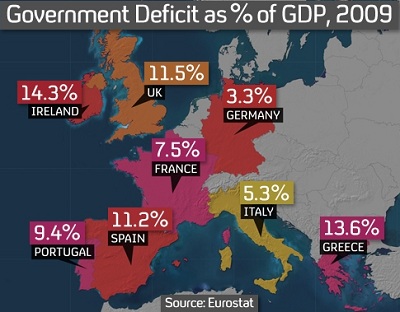
The year is not over yet, and already Greece’s banks have lost €36.7 billion of their deposit base in 2011, and a whopping €64.6 billion since the beginning of 2010, which is down from €233 billion to €173 billion in under two years. In October another €3.5 billion was withdrawn from Greek banks and likely either redeposited somewhere deep in the heart of Switzerland, or converted to various inert metals and buried somewhere in the back yard. The good news: the outflow is just over half of October’s record €6.8 billion. The bad news: at this rate of outflows, Greek banks will have zero deposits in around 4 years. Which at the end of the day is all the matters, because while the Troica can keep funding capital shortfalls indefinitely, all faith in the country’s banks has now been lost and Greece is officially a zombie economy. The fact that the country’s deficit as a % of GDP is about to be re-revised even higher is no longer even meaningful: the Greek economy and its banking sectors are now officially dead. We merely feel bad for anyone who still has cash in banks as, just like gold in 1930s America, any residual cash may soon be “sequestered” for national security purposes. After all there are bankers who need record bonuses, and Military sales from Europe and the US that have to proceed using what will likely soon be “commingled” deposit cash.

Greece is a socialist nation. And they are reaping the rewards of socialism. You cannot spend your way out of debt. You cannot create jobs by taxing job creators. You cannot create wealth by punishing those who create wealth.

Since Barack Obama was elected, we have been running deficits of about $1.3 trillion dollars each year. The last Republican deficit under Bush and Boehner was $160 billion dollars. We made a mistake and we elected a socialist, and now we are Greece – just a little less far down the road to serfdom.

Bank run in socialist Europe begins

Europe: Annual Budget Deficit as % of GDP

From CNBC.

Excerpt:

Money-market funds in the United States have quite dramatically slammed shut their lending windows to European banks. According to the Economist, Fitch estimates U.S. money market funds have withdrawn 42 percent of their money from European banks in general.

And for France that number is even higher — 69 percent. European money-market funds are also getting in on the act.

Bond issuance by banks has seized up because buyers have gone on strike.

From the Economist’s Free Exchange Blog:

In the third quarter bonds issues by European banks only reached 15 percent of the amount they raised over the same period in the past two years, reckon analysts at Citi Group. It is unlikely that European banks have sold many more bonds since.

Corporate depositors are also pulling their cash.

Free Exchange:

“We are starting to witness signs that corporates are withdrawing deposits from banks in Spain, Italy, France and Belgium,” an analyst at Citi Group wrote in a recent report. “This is a worrying development.”

And there are troubling signs that banks are even running out of collateral to back their borrowings from the European Central Bank .

So far the liquidity of the European Central Bank (ECB) has kept the system alive. Only one large European bank, Dexia, has collapsed because of a funding shortage. Yet what happens if banks run out of collateral to borrow against?

And from the leftist New York Times.

Excerpt:

The flight from European sovereign debt and banks has spanned the globe. European institutions like the Royal Bank of Scotland and pension funds in the Netherlands have been heavy sellers in recent days. And earlier this month, Kokusai Asset Management in Japan unloaded nearly $1 billion in Italian debt.

At the same time, American institutions are pulling back on loans to even the sturdiest banks in Europe. When a $300 million certificate of deposit held by Vanguard’s $114 billion Prime Money Market Fund from Rabobank in the Netherlands came due on Nov. 9, Vanguard decided to let the loan expire and move the money out of Europe. Rabobank enjoys a AAA-credit rating and is considered one of the strongest banks in the world.

American money market funds, long a key supplier of dollars to European banks through short-term loans, have also become nervous. Fund managers have cut their holdings of notes issued by euro zone banks by $261 billion from around its peak in May, a 54 percent drop, according to JPMorgan Chase research.

This is really disturbing. I wonder if any of my economics-minded commenters can explain to me what happens when there is a run on banks. I am guessing that there will be some rioting over benefits as austerity measures are imposed, and interest rates will go up.