In case you haven’t heard, the state of Hawaii, facing the same type of budget crunch as other state governments, has to cut more than $400 million from its education budget over the next two years. Logically, that would lead to some teacher layoffs in a number of school districts.
But the Hawaii State Teachers Association has a better idea. It wants to adopt a four-day school week, with unpaid “furlough Fridays,” to avoid any layoffs. In other words, the teachers are willing to sacrifice one-fifth of their students’ education to keep the paychecks rolling in.
The idea is apparently catching on in other states, as well.
The union’s perogative of “no lay-offs” is clearly self-serving. Our organization, Education Action Group Foundation, which is based in Michigan, has estimated that 2,500 school layoffs in Michigan equals about a $1 million hit to the Michigan Education Association in terms of dues. When a state is talking about significantly more than that, one can see why the union doesn’t want layoffs.
The union needs those dues to help elect Democrats, who will then turn around and block competition from homeschoolers and private schools. This way, parents are powerless to choose a better way to have their children educated the way they choose.
Private sector unions have a natural adversary in the owners of the companies with whom they negotiate. But public sector unions have no such natural counterweight. They are a classic case of “client politics,” where an interest group’s concentrated efforts to secure rewards impose diffused costs on the mass of unorganized taxpayers. Also unlike private sector unions, those in the public sector can achieve influence on both sides of the bargaining table by making campaign contributions and organizing get-out-the-vote drives to elect politicians who then control the negotiations over their pay, benefits, and work rules. The result is a nefarious cycle: Politicians agree to generous government worker contracts; those workers then pay higher union dues a portion of which are funneled back into those same politicians’ campaign war chests. It is a cycle that has driven California and New York to the edge of bankruptcy.
[…]Consider what happened in Washington State. After helping Democrats win full control of the legislature in 2002, the state affiliate of the Association of Federal, State, County, and Municipal Employees (AFSCME) and other unions persuaded lawmakers to lift the collective bargaining restrictions. Within three years the number of union members had doubled. With more state employees paying dues, the amount of union dollars flowing into the coffers of Democrats running in state elections also doubled. A prime beneficiary of such union generosity was Christine Gregoire, who became governor in 2004 after one of the closest elections in the state’s history. (AFSCME gave $250,000 to the state Democratic party to help pay for the recount that handed her the election by 129 votes). Once in office, Gregoire negotiated contracts with the unions that resulted in double-digit salary increases, some exceeding 25 percent, for thousands of state employees. In 2007, J. Vander Stoep, an adviser to Republican Dino Rossi, Gregoire’s 2004 opponent, prophetically remarked that the unions’ arrangement with the Democrats was “a perfect machine to generate millions of dollars for her reelection. . . . They are building something that conceivably can never be undone—at taxpayer expense.” In their 2008 rematch, Rossi lost again to Gregoire, this time by 194,614 votes.
This is a long article, but it’s probably the only one you’ll need to read to understand how unions completely destroy economies, as in New York and California. Print and read!
$1,650,971,205,167 added to the national debt, bringing the total to $7.5 trillion.
99 banks taken over by the Federal Deposit Insurance Company.
684 banks receiving support from the Troubled Asset Relief Program that doesn’t buy troubled assets.
11.2 percent: the percentage of the federal deficit to GDP. This is the highest that ratio has been since Japan surrendered in 1945.
$164 billion spent out of the entire $787 billion in stimulus funding in the American Recovery and Reinvestment Act. Most of this has gone to Medicaid, unemployment and the Making Work Pay Tax Credit.
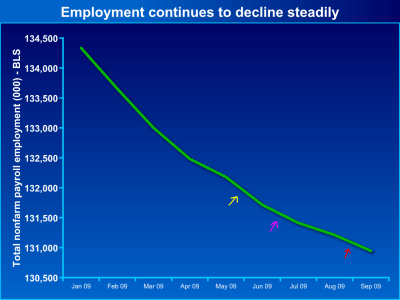
Here’s the graph of total employment since Obama took office:
Employment has declined steadily since Obama took office
Now, you may be hearing Obama say that we’ve turned the corner on unemployment. For instance, look at how the White House is spinning this graph.
Hennessey writes:
Check out the slightly different slopes of the three line segments indicated by arrows. The purple arrow shows a segment that slopes downward slightly less than the yellow arrow. A mathematician would say the shift from yellow to purple was an inflection point, shifting the curve from convex to concave.
This is what led the President in early August to say the economy was “pointed in the right direction.” The red arrow shows the worse news of last Friday’s jobs report, with a line that slopes downward slightly more sharply. The curve shifted back to a convex shape, in which the slope was more sharply downward than in the prior month.
If you’re saying to yourself, “That’s ridiculous! They’re all going down, and the differences in slopes are almost too hard to see!” then you’ve got my point.
And below I’m going to explain why Obama’s massive government spending created this worsening unemployment.
Economics in One Lesson
We are going to have to pay for all this spending on Obama’s favored special interest groups eventually, and that means that taxes will go up, or that the value of the dollar will go down, due to inflation. It has to be one or the other or both. There is no third way. When employers see that higher taxes or inflation are coming, they stop hiring people because they know that higher taxes and/or inflation kills the economy.
Perhaps it is time to review Henry Hazlitt’s Economics in One Lesson, chapter 4, entitled “Public Works Mean Taxes”.
Excerpt:
Therefore, for every public job created by the bridge project a private job has been destroyed somewhere else. We can see the men employed on the bridge. We can watch them at work. The employment argument of the government spenders becomes vivid, and probably for most people convincing. But there are other things that we do not see, because, alas, they have never been permitted to come into existence. They are the jobs destroyed by the $10 million taken from the taxpayers. All that has happened, at best, is that there has been a diversion of jobs because of the project. More bridge builders; fewer automobile workers, television technicians, clothing workers, farmers.
And consider Chapter 5 as well, entitled “Taxes Discourage Production”.
In our modern world there is never the same percentage of income tax levied on everybody. The great burden of income taxes is imposed on a minor percentage of the nation’s income; and these income taxes have to be supplemented by taxes of other kinds. These taxes inevitably affect the actions and incentives of those from whom they are taken. When a corporation loses a hundred cents of every dollar it loses, and is permitted to keep only fifty-two cents of every dollar it gains, and when it cannot adequately offset its years of losses against its years of gains, its policies are affected. It does not expand its operations, or it expands only those attended with a minimum of risk. People who recognize this situation are deterred from starting new enterprises. Thus old employers do not give more employment, or not as much more as they might have; and others decide not to become employers at all. Improved machinery and better-equipped factories come into existence much more slowly than they otherwise would. The result in the long run is that consumers are prevented from getting better and cheaper products to the extent that they otherwise would, and that real wages are held down, compared with what they might have been.
There is a similar effect when personal incomes are taxed 50, 60 or 70 percent. People begin to ask themselves why they should work six, eight or nine months of the entire year for the government, and only six, four or three months for themselves and their families. If they lose the whole dollar when they lose, but can keep only a fraction of it when they win, they decide that it is foolish to take risks with their capital. In addition, the capital available for risk-taking itself shrinks enormously. It is being taxed away before it can be accumulated. In brief, capital to provide new private jobs is first prevented from coming into existence, and the part that does come into existence is then discouraged from starting new enterprises. The government spenders create the very problem of unemployment that they profess to solve.
What Obama did, in effect, is to fire all of those millions of private sector people, so that he could reward the people who voted for him. And jobs are created far more efficiently by small businesses than they are by big government. What creates new jobs is entrepreneurs with ideas who hire people. And government spending diverts money away from these efficient entrepreneurs and towards inefficient government bureaucracies.