
Tag Archives: Gay Marriage

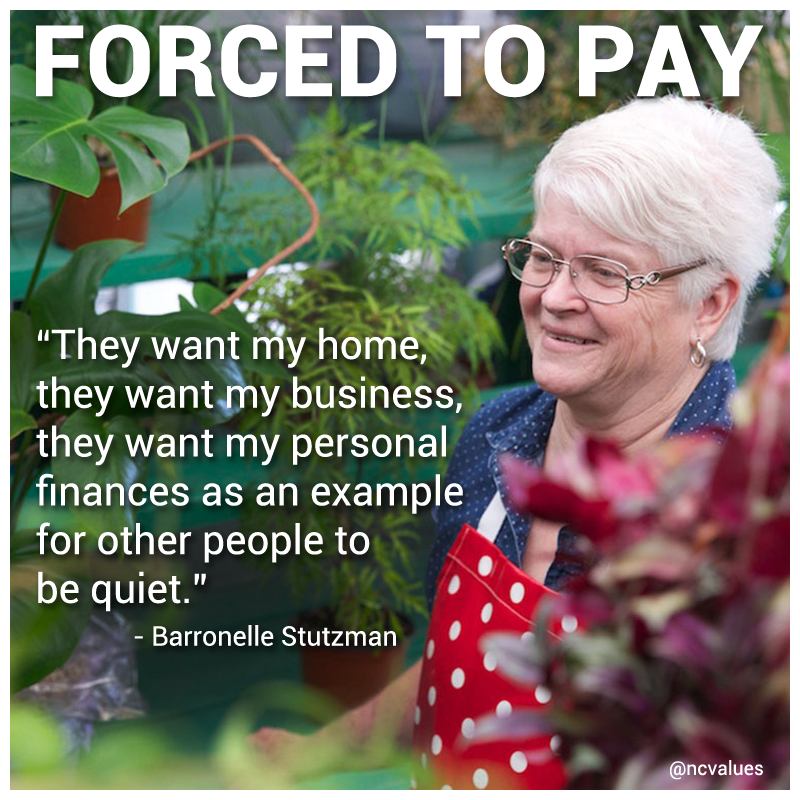
Christian florist Barronelle Stutzman explains what it is like to face persecution

Barronelle Stutzman vs Washington state

This article appeared in the Washington Post, and I though it might be good for us to find out what it is like when big government comes after you for taking the Bible seriously.

Barronelle writes:

I’ve been a florist in Richmond, Wash., for more than 30 years. In that time, I’ve developed close relationships with many of my clients.

One of my favorites was Rob Ingersoll. Ingersoll came in often and we’d talk. Like me, he had an artistic eye. I’d try to create really special arrangements for him. I knew he was gay, but it didn’t matter — I enjoyed his company and his creativity.

Then he asked me to create the floral arrangements for his wedding. I love Rob, and I’d always been happy to design for his special days. But there’s something different about a wedding.

Every person in the creative professions regularly has to make decisions about where they lend their artistic talents and which events they will participate in.  For me, it’s never about the person who walks into the shop, but about the message I’m communicating when someone asks me to “say it with flowers.”

I was raised Christian. In my religious tradition, marriage is a sacred religious ceremony between a man, a woman and Christ. It’s a covenant with the church. To participate in a wedding that violates those principles violates the core of my faith.

When Rob  asked me, I thought about it carefully. I talked over the decision with my husband, and I prayed. But ultimately I know I had to stay true to my faith. I couldn’t do it.

When I told Rob, I felt terrible that I couldn’t share this day with him, as I’d shared so many with him before. I took his hands and said, “I’m sorry I can’t do your wedding because of my relationship with Jesus Christ.” Rob said he understood, and that he hoped his mom would walk him down the aisle, but he wasn’t sure.  We talked about how he got engaged and why they decided to get married after all these years. He asked me for the names of other flower shops. I gave him the names of three floral artists that I knew would do a good job, because I knew he would want something very special. We hugged and he left.

I never imagined what would happen next. Washington State Attorney General Bob Ferguson sued me after hearing in the media what had happened. That was shocking. Even more surprising, Rob and his partner Curt, with their ACLU attorneys, filed suit shortly thereafter. A judge ruled against me, but this week, with the help of the Alliance Defending Freedom, I appealed.

We’ve always heard that same-sex marriage would never affect anyone aside from the same-sex couples who wanted to be married. But a judge recently told me that my freedom to live and work according to my beliefs about marriage expired the day same-sex marriage became the law in my state.

Our government is supposed to protect our First Amendment rights — freedom of religion and expression. But the government is telling me I can only be a faithful Christian within the four walls of my church. That’s impossible and it’s unjust. What would Rob and Curt say if the government told them they could only be who they are in their own homes?

This isn’t about bigotry. I’ve had gay and lesbian employees and friends. And it’s important to remember that Rob was a long-time customer and friend despite our different beliefs about marriage. When I had to refer him for this one event, I did everything I could to avoid hurting his feelings and I believed we would remain friends when he left the shop.  He got enough offers after this situation became public to do about 20 weddings.

In Washington, Rob and Curt have the right to get a marriage license. But that doesn’t mean that the state should be able to force people in the creative professions like myself to create expression celebrating the ceremonies.  We all have different viewpoints about how to live our lives.  One thing I’ve loved about our country is that we protect the freedom of artistic expression and the right to disagree over these kinds of issues without one side being threatened by the government over it.

But whatever the state says and however they want to try to punish me, they can’t change my faith. What happens in my business or my life is in God’s hands. Having a clear conscience means much more to me than any amount of money or my business. Rob and Curt have their beliefs about marriage and aren’t being stopped by the state from living them out. I only ask for the same freedom.

If you want to understand just how bad things are in the culture right now, read some of the comments to her post. Lots of non-Christians telling her that true Christianity consists in abandoning morality completely and celebrating whatever non-Christians tell her to celebrate.

Anyway, I definitely would not live in Washington State. But not all states are like Washington.
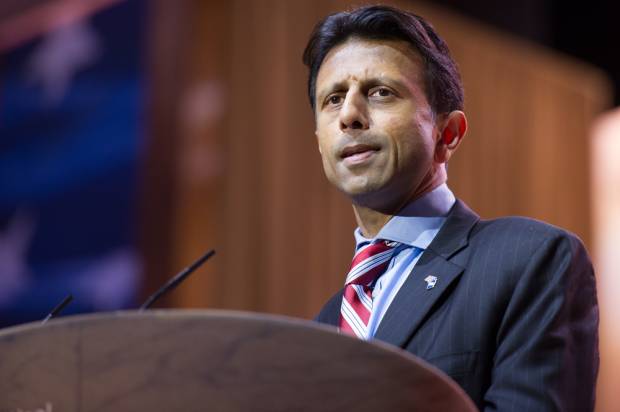
Louisiana Governor Bobby Jindal

Here’s Bobby Jindal, the Republican governor of Louisiana:

Louisiana Governor and prospective GOP presidential candidate Bobby Jindal argued that to President Obama and Hillary Clinton religious liberty only means “you get to go to church and say what you want inside church” during a speech in South Carolina on Saturday.

Jindal said, “There was a time when the left believed in the First Amendment. There was a time when the left really understood that religious liberty is the foundation of our freedom of speech, and freedom of association…without religious liberty, there are no other freedoms like freedom of speech, and freedom of association, and freedom of the press.

He continued, “And make no mistake about it this isn’t just about marriage, though, unlike President Obama and Secretary Clinton, my views on marriage are not evolving with the polls. I continue to believe in traditional marriage between a man and a woman. This debate is much, much bigger than that. It is bigger than marriage. This is about the power of the state to to close or fine Christian business owners, this is about the left trying to silence us and telling us we don’t have a right to live our lives according to our sincerely held beliefs. When Secretary Clinton, when President Obama say, ‘you’ve got the freedom of religious expression,’ to them, that just means you get to go to church and say what you want inside church. That’s not religious liberty. Religious liberty is  the ability to live our lives according to our faith 24 hours a day, seven days a week.”

Christianity is a whole life worldview. I want to be able to speak out in the public square for the Christian worldview, just like the gay activists can speak out for their worldview. That’s what the First Amendment is all about, after all. If I wanted secularism, I’d move to North Korea. Unfortunately, we seem to be headed in that direction.

A positive thing, should the SCOTUS same-sex marriage decision go against us

Marriage and family
Marriage and family

I am looking forward to something if the Supreme Court decides to redefine marriage to remove the complementary genders.

This USA Today article from Michael Farris, head of the HSLDA, hints at it.

He writes:

Justice Alito posed a predictable, but revealing question to Solicitor General Donald Verrilli, Jr., in the recent Supreme Court same-sex marriage oral argument: “In the Bob Jones case, the court held that a college was not entitled to tax exempt status if it opposed interracial marriage or interracial dating. So would the same apply to a university or a college if it opposed same-sex marriage?”

Verrilli replied that he would need to know more specifics, but allowed that “it’s certainly going to be an issue. I don’t deny that.”

The solicitor general’s answer should have been and probably was practiced. The question was unlikely to have surprised Verrilli, especially with the kind of preparation undertaken by the highest appellate lawyer for the United States in such high stakes situations. Such preparations would include multiple moot courts, simulated arguments with various lawyers playing the roles of each of the members of the Supreme Court trying to ask as many questions as possible.

As an appellate litigator and the coach of eight collegiate national moot court championship teams, I understand the goal of such preparation. You never want to hear a question from the bench that you have not thought about ahead of time.

Alito’s question was premised on the Bob Jones University case from 1983 in which the IRS revoked the school’s tax exempt status because of its policies on interracial dating and marriage. BJU defended on the basis of the free exercise of religion. The Supreme Court rejected their defense holding that the government’s goal of eradicating racial discrimination in marriage was more important than BJU’s religious rights.

So, the follow-up question from Alito’s question is obvious: If the court rules in favor of same sex marriage, how can religious colleges that refuse to acknowledge such unions avoid BJU’s fate?

No one should think that IRS implications will stop with colleges. Religious high schools, grade schools and any other religious institution will face the same outcome. And this includes churches.

All of these entities are exempt from taxation under the same section of the IRS code. And even though churches can be exempt without application, their exemption can nonetheless be revoked.

Even if it takes the IRS years to begin the enforcement proceedings against such institutions, we can expect other fallout from this decision to begin shortly after the release of the Supreme Court’s opinion.

Colleges and universities that receive federal funding will be coerced into immediate compliance. Accreditation agencies will ratchet up their bullying of Christian institutions, as has already been done against Gordon College in Massachusetts. Threats to accreditation are fatal. Colleges may not legally operate in several stateswithout it.

Christian colleges and churches need to get prepared. We must decide which is more important to us — our tax exemption or our religious convictions. Keep in mind, it is not the idea that the college itself might have to pay taxes that is the threat. Schools like Patrick Henry College, which I started, never run much of a profit. But since PHC refuses all government aid, all of our donations for scholarships and buildings come from tax deductible gifts. Cutting off that stream of revenue is effectively the end of such colleges absent a team of donors who simply don’t care if gifts are deductible.

A slogan of the American Revolution, “We have no King but Jesus” may well be overturned by a 5 to 4 decision of the Supreme Court near the end of June.

Now here’s what I want to see.

I have spent a lot of my life in church, youth groups, campus Christian groups (not talking about Ratio Christi of course) and around happy-clappy Christians who focused on feelings and being accepted. In my current church, issues like abortion and same-sex marriage have never been discussed, much less economics and foreign policy. The leaders of the church are very pious Calvinists who struggle with the idea that they should discuss anything. It probably has something to do with losing the money they get from having a tax-exempt status, but they couch it in piety when they explain to us why we are getting a gospel sermon for the millionth time in a row.

Well, now. I think that if we lose this same-sex marriage case in the Supreme Court, one of the wonderful things that will happen is that these pious churchy ministers will at last be confronted with the mistake they made by giving away the culture to the secularists. At last, all the decades of anti-intellectualism and feminization will hit them right where it hurts – in their pocketbooks. And there will be no denying that they made a terrible mistake in trying to make church solely about praise hymns, devotions and Bible study then. There is a price to pay for focusing on good feelings and comfort, and the churchy pastors are about to find out what it is.

Maybe the Sunday after the decision, the pastors in my church might actually talk to us about the good secular arguments and sociological evidence that there is in favor of traditional marriage. Hey, we might even get a sermon on the evils of divorce, with more arguments and evidence to support the Bible’s position on that issue. Maybe even a sermon on the sexual revolution and premarital sex, that pairs what the Bible teaches with secular arguments and secular evidence that can be used by the flock to make an impact with non-Christians in the culture. Money has a wonderful way of focusing the minds of the most pious of pastors.

Do Supreme Court justices understand the reasons for traditional marriage?

This article from the Public Discourse takes a look at the oral arguments from the same-sex marriage case in progress at the Supreme Court.

Here’s the list:

  • Error Number One: Massachusetts Marriage Rates Have Stayed the Same
  • Error Number Two: Because Some Men Leave Their Wives and Children, Marriage Does Not Help Keep Fathers Around
  • Error Number Three: The Purpose of States’ Recognizing and Regulating Marriage is to Bestow Dignity on Couples
  • Error Number Four: The Only Harm to Legalizing Same-Sex Marriage Is Making Marriage More Adult-Centered
  • Error Number Five: There Is a Parallel between Brown/Loving and Lawrence/Obergefell
  • Error Number Six: Age Restrictions on Marriage Are Equivalent to the Definitional Element of One Man and One Woman

One of Obama’s Supreme Court picks is showing herself a poor thinker:

Error Number Two: Because Some Men Leave Their Wives and Children, Marriage Does Not Help Keep Fathers Around

Justice Sotomayor also committed what is commonly referred to as an exception fallacy. This is where someone reaches an overall conclusion about a group on the basis of a few exceptional cases. Thus, when Mr. Bursch was making the argument that redefining marriage to include same-sex couples will disconnect marriage from the long-held norm that the institution binds children to their biological mother and father, Justice Sotomayor responded:

Marriage doesn’t do that on any level. How many married couples do fathers with the benefits or the requirements of marriage walk away from their children? So it’s not that the institution alone does it and that without it that father is going to stay in marriage. He made a choice . . . Some mothers do the same thing.

This is a classic example of the exception fallacy. Of course some men and women walk away from their marriage and their children. But that is the exception, not the rule, and it is certainly counter to the social norm of marriage that gently pushes parents to stay together and raise their children.

It is rather shocking that a justice of the United States Supreme Court would claim that “on any level” marriage does not have that effect and longstanding purpose. It is also disappointing that she would commit such a basic error of logic.

I often encounter the problem among people with no math background. You cite statistics about what outcomes are expected, and they reply with an exceptional outlier to refute the argument. I’m troubled that Supreme Court justices lack the ability to reason in this way, though.

Here’s another pretty obvious mistake:

Error Number Four: The Only Harm to Legalizing Same-Sex Marriage Is Making Marriage More Adult-Centered

Several justices struggled to see how redefining marriage in genderless terms would cause any harm or have any impact on the institution of marriage. As Mr. Bursch correctly but incompletely argued, legalizing same-sex marriage will alter the institution to be primarily concerned with fulfilling the desires of adults rather than the needs of children.

But that’s not all. As the 100 Scholars of Marriage made clear in their amicus brief, several other important and beneficial social norms will be eroded, if not erased, by same-sex marriage, including:

– Gender-diverse parenting: the norm that children both need and deserve to be raised by a man and a woman, not only because of what they learn from interacting with a parent of each sex, but because men and women parent and interact with their children differently, providing distinct but complementary benefits. By its very structure, same-sex marriage eliminates this norm and its attendant benefits to children.

– Biological bonding: the norm that marriage binds children to their biological mother and father in a family unit. Same-sex marriage and parenting, by definition, means that at best only one of a child’s biological parents will be in the home. While death, divorce, or parental delinquency create exceptions, elevating the exception to the norm undermines that norm and the benefits it produces.

– Postponing or channeling procreation: the norm that procreation should only responsibly occur within the stable bonds of marriage. Same-sex marriage is not, and biologically cannot be, about procreation. By redefining marriage in this way, the institution becomes less about being the socially recommended “place” and “time” where procreation is recommended.

– Placing social value on raising children: the norm that society values and needs children to be born and raised by their parents. Again, same-sex marriage is not primarily about procreation, and its acceptance attenuates this norm for the institution as a whole. Of course, same-sex couples can adopt or one member of the couple can reproduce with someone of the opposite sex, but these are secondary purposes and behaviors.

What impact will the weakening or elimination of these norms have on the institution of marriage, and thus the behavior of society? Put another way, as Justice Breyer asked, “what’s the empirical connection?”

Well, the last major alteration to the institution of marriage—no-fault divorce—did have unintended negative consequences, reducing marriage rates and increasing divorce rates more than expected, with children and women suffering the consequences. Additionally, the Netherlands, the country that has had same-sex marriage the longest, after controlling for other factors, has experienced a drop in opposite-sex marriage rates among young women after adopting same-sex marriage.

The truth is, no one knows for sure what the effect will be—but it clashes with history, common sense, and theory to assume it will be innocuous.

The norm of gender-diverse parenting is important, because fathers and mothers are both needed.

Look at this abstract from a very new study to see why:

The association between family structure instability and children’s life chances is well documented, with children reared in stable, two-parent families experiencing more favorable outcomes than children in other family arrangements. This study examines father household entrances and exits, distinguishing between the entrance of a biological father and a social father and testing for interactions between family structure instability and children’s age, gender, and genetic characteristics. Using data from the Fragile Families and Child Wellbeing Study and focusing on changes in family structure by age (years 0–9), the authors show that father exits are associated with increases in children’s antisocial behavior, a strong predictor of health and well-being in adulthood. The pattern for father entrances is more complicated, with entrances for the biological father being associated with lower antisocial behavior among boys and social father entrances being associated with higher antisocial behavior. Child’s age does not moderate the association; however, genetic information in the models sharpens the findings substantially.

Biological fathers need to present in the home.

It doesn’t look like we will get a good legal decision on this case. The leftist judges are just not thinking clearly.