Tag Archives: Frivorce

New study: the majority (69%) of divorces are initiated by women

This new report from Live Science gives us some numbers about who initiates divorces most frequently.

It says:

Women are more likely than men to initiate divorce in the United States, but they are no more likely than men to initiate breakups in a dating relationship, a new study finds.

“The breakups of nonmarital heterosexual relationships in the U.S. are quite gender-neutral and fairly egalitarian,” study author Michael Rosenfeld, an associate professor of sociology at Stanford University, said in a statement. “This was a surprise because the only prior research that had been done on who wanted the breakup was research on marital divorces.”

Previous research had found that women are more likely to initiate divorce, at least in the United States, Europe and Australia. In the new study, Rosenfeld compared divorces to nonmarital breakups, in an effort to understand the driving forces behind each type of breakup.

To investigate, he looked at data from the 2009 to 2015 waves of How Couples Meet and Stay Together, a nationally representative survey spearheaded by Rosenfeld and his colleagues. The new study includes 2,262 adults, ages 19 to 64, who reported having opposite-sex partners in 2009. By 2015, 371 of the participants had broken up or gotten divorced.

Women initiated 69 percent of the 92 divorces, Rosenfeld found. But there was no statistically significant difference between women and men when it came to nonmarital breakups, regardless of whether they were living together, he said.

The Ruth Institute reports on a few studies:

Female unions seem to have the highest divorce rates, followed by male unions, followed by opposite sex unions.

“For Sweden, the divorce risk for partnerships of men is 50% higher than the risk for heterosexual marriages, and that the divorce risk for female partnerships is nearly double that for men.”

“For Norway, divorce risks are 77% higher in lesbian partnerships than in those of gay men.”  (The Norwegian data did not include a comparison with opposite sex couples.)

In California, the data is collected a little differently. The study looks at couples who describe themselves as partners, whether same sex or opposite sex. The study asks the question, how likely is it that these couples live in the same household five years later. Male couples were only 30% as likely, while female couples were less that 25% as likely, as heterosexual married couples, to be residing in the same household for five years.

It really seems as if there is something about women in particular that causes them to be unable to keep to commitments in their actions, despite what they might say with their words.

So I am seeing a couple of problems in young, unmarried women that might explain this.

Feminism is bad

First, there is the feminism. Feminism was the driving force behind no-fault divorce. Today, young unmarried women are being taught to view marriage as stifling to their freedom. So if they do get married, they are often resolved that marriage should not affect their freedom in any way. That is just not the way marriage works, though – both spouses need to be equally ready to have their freedom infringed upon by things that HAVE TO GET DONE. Lots of things that have to get done will not be fun, thrilling or amusing – and that’s why it’s good to be prepared to do them before you marry.

My friend Dina says that she only knows one happily married couple from among her friends. The most frequent case she sees is wife is working in order to pay for big house, two cars, etc. and wife is denying husband sex, which makes him disengage from the marriage. A working wife tends to not be as responsive to the needs of husband and kids as a non-working wife, probably in part due to work stress. There is an epidemic of sex-withholding by women, and it causes men to disengage from marriage because they feel unloved. Although women tend to rebel against the idea that the man’s bad behavior is their fault, and that there is a “contractual” nature to marriage, that is how marriage works. You cannot stay married, women, by just doing whatever you feel like, and NOT doing whatever you DON’T feel like. Men will disengage when their needs are not supplied, and that’s no fault of theirs. It’s your fault. Denying relationship obligations causes men to underperform.

Feminism is often linked closely to “independence”. There is a lot of confusion over what the word independence means among young, unmarried women. A man uses that word to mean “lack of financial dependence on parents, the state, etc. because of good decisions in education, career and finances”. But a woman means “not having to care about the needs of a man and the leadership of a man, or the needs of children while still getting what I want from men and children”. That attitude is not compatible with life-long married love.

Emotions are bad

Second, emotions. In my experience, young, unmarried women are less likely to have reasoned out their own life plan in a practical step-by-step manner. Instead, they tend to do whatever makes them feel good moment-by-moment without any realistic plan. One Christian woman was recently telling me how attracted she was to an atheist moral relativist who had been promiscuous from the age of 15. She explained that her emotions were kindled by his GQ looks, 6-pack abs, mysterious European accent, seductive manner and witty conversations. Although she is apparently a Christian, she doesn’t take Christianity seriously in her decisions about relationships and marriage.

Peer-approval and culture play a large part in determining what women think is attractive in a man, as well as their life goals, and women are driven by these cultural standards more than men who focus on honoring their commitments regardless of their emotions. In my experience, women struggle to make their day-to-day actions match their socially-acceptable goal of getting married “some day”. Marriage is for “some day” for today’s busy women, but fun and thrills is for today. “Live in the moment”, they often tell me. If you try to talk to them about roles and responsibilities in a marriage, they will withdraw and rebel. But marriage is about each spouse doing his or her job, and feeling content about what the couple is building together. You can’t make life-long married love from emotional craziness and pursuing fun and thrills with seductive promiscuous moral relativist atheists.

How to pick a woman who won’t divorce you

Young men, I advise you to choose wives who have had to do things that they did not feel like doing. That can involve things like getting a STEM degree, getting a job in STEM, moving out of her parents’ house, getting a “boring” job that helps her pay off her debts, keeping commitments when she doesn’t feel like it, and caring for other people and even animals.

Basically, the more the woman has ground down any narcissism and hedonism she may have, by having to do nasty calculus and horrid lab work, the better. The more accustomed she is to constraints, responsibilities, expectations and obligations, the less likely it is that she’ll divorce you for unhappiness. And all of this goes for men, as well. STEM degree, STEM job, save money, serve others, give to charity.

Marriage is not the time for people to be carried away by their emotions. It’s an enterprise, and it works when both people are rational, practical, hard-working and self-controlled.
If we seriously want men to marry and become fathers, let’s repeal no-fault divorce

I saw a very good article at the Heritage Foundation web site about the importance of fathers for children. The author Virginia Allen listed out some of the benefits that fathers provide to children:

Studies have found that children raised without a father are:

  • At a higher risk of having behavioral problems.
  • Four times more likely to live in poverty.
  • More likely to be incarcerated in their lifetime.
  • Twice as likely to never graduate high school.
  • At a seven times higher risk of teen pregnancy.
  • More vulnerable to abuse and neglect.
  • More likely to abuse drugs and alcohol.
  • Twice as likely to be obese.

From education to personal health to career success, children who lack a father find themselves at a disadvantage to their peers raised in a two-parent household.

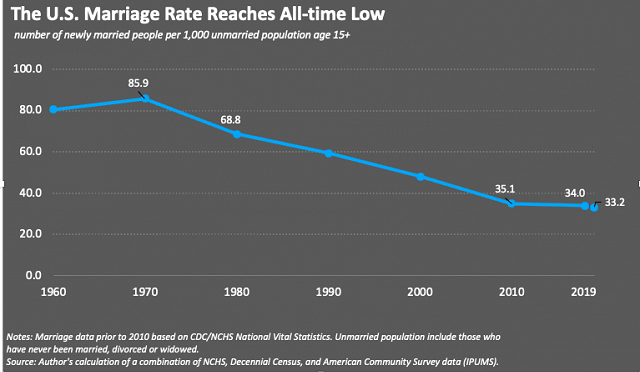
I was looking for a good analysis of why there’s been a decline of marriage and fatherhood, and I found an article by Joe Carter on far-left The Gospel Coalition, of all places. By looking at marriage rates and historical events that changed the marriage rate, he was able to identify the cause of the decline of marriage – and fatherhood.

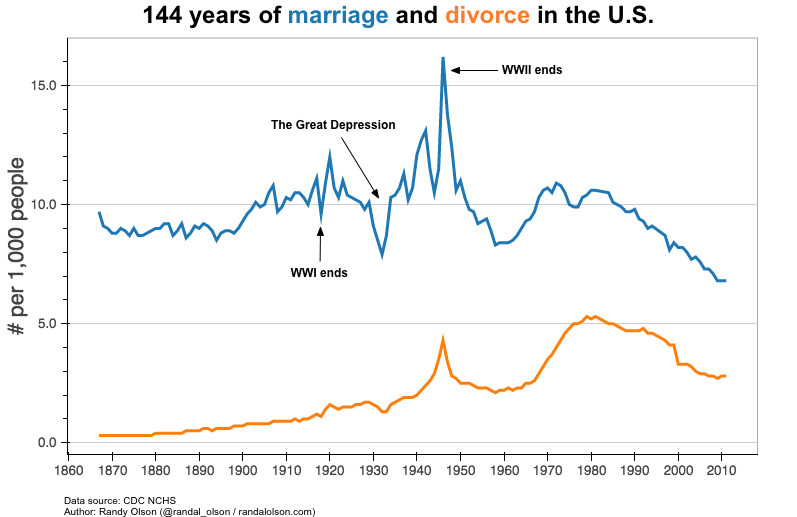
Marriage and divorce rates per capita

I’ll spare you the statistical analysis, which is excellent, and give you the conclusion – although you can guess it from the graph above:

Now that we’ve explored the data, what year should we use as the marker for the beginning of the decline of marriage in the United States? I would argue for 1985, the last year that the marriage rate topped 10 percent.

[…]What changed in 1985 that could have led to the decline in marriage? There are likely numerous factors—which we’ll examine in future articles—but one stands out in particular: By 1985, all states (except for New York) had enacted no-fault divorce legislation.

The most helpful book I know of about no-fault divorce is “Taken Into Custody”, by Dr. Stephen Baskerville. He wrote a column  for Crisis magazine that summarizes some of his ideas.

Excerpt:

Feminists were drafting no-fault divorce laws in the 1940s, which the National Association of Women Lawyers now describes as “the greatest project NAWL has ever undertaken.”

The result effectively abolished marriage as a legal contract. Today it is not possible to form a binding agreement to create a family.

The new laws did not stop at removing the requirement of citing grounds for a divorce, to allow divorce by mutual consent, as deceptively advertised at the time. Instead they created unilateral and involuntary divorce, so that one spouse may dissolve a marriage without any agreement or fault by the other.

Here’s what divorce does to the spouse who is the victim of the unilateral “no-fault” divorce:

Though marriage is a civil matter, the logic quickly extended into the criminal, including a presumption of guilt against the involuntarily divorced spouse (“defendant”). Yet formal due process protections of criminal proceedings did not apply, so forcibly divorced spouses became quasi-criminals not for recognized criminal acts but for failing or refusing to cooperate with the divorce by continuing to claim the protections and prerogatives of family life: living in the common home, possessing the common property, or—most vexing of all—parenting the common children.

Following from this are the horrendous civil liberties violations and flagrant invasions of family and individual privacy that are now routine in family courts. A personalized criminal code is legislated by the judge around the forcibly divorced spouse, controlling their association with their children, movements, and finances. Unauthorized contact with their children can be punished with arrest. Involuntarily divorced parents are arrested for running into their children in public, making unauthorized telephone calls, and sending unauthorized birthday cards.

In my conversations with men, no-fault divorce laws, and anti-male divorce courts are the main reasons given for why they do not pursue marriage and fatherhood. Men do not want to be coerced in a marriage with the threat of divorce by an unhappy wife. Men do not want to be subject to the government in so many areas of their lives if the wife does carry out the threat. They especially don’t want to be separated from their children. One my secular male friends told me that he would not marry unless the woman had evidence in her past of hating radical feminism and no-fault divorce. This was the main criteria. He actually was able to find a woman who was a men’s rights activist who hated divorce. But that was the only way he would marry.

Statistically speaking, the wife is more likely to initiate divorce than the husband. Women initiate 70% of divorces, the majority of those just because she is “unhappy”. I think this is because women get into marriage based on their feelings, and they think that it is the husband’s job to make them feel good. They see their happiness as the primary goal of the marriage, and see a marriage that does not make them happy as a marriage that needs to be ended. They’re not interested in helping a man to succeed in his mission, which, for Christian men, is to have a marriage and family that serve GOD first and foremost, not the woman’s feelings.

Are we going to repeal no-fault divorce, then?

No-fault divorce was seen as a boon to women who had married the wrong men by following their hearts. It’s an interesting question to ask whether women really would want no-fault repealed. It would mean that they would have to get serious about who they marry, instead of just getting into marriage based on feelings. They would have to evaluate men according to expectations of what a man does in a marriage, instead of on feelings. They would have to think about what men want out of a marriage, and prepare themselves to provide for his needs. They would have to say no to their feelings, when choosing a man, and in keeping a man after the wedding.

If women aren’t willing to demand the repeal of no-fault divorce laws and get serious about men and marriage, then what’s the point of complaining that men don’t want to marry and become fathers? If you’re not willing to fix the root cause of the problem, then don’t complain about the problem.

New study: the majority (69%) of divorces are initiated by women

This new report from Live Science gives us some numbers about who initiates divorces most frequently.

It says:

Women are more likely than men to initiate divorce in the United States, but they are no more likely than men to initiate breakups in a dating relationship, a new study finds.

“The breakups of nonmarital heterosexual relationships in the U.S. are quite gender-neutral and fairly egalitarian,” study author Michael Rosenfeld, an associate professor of sociology at Stanford University, said in a statement. “This was a surprise because the only prior research that had been done on who wanted the breakup was research on marital divorces.”

Previous research had found that women are more likely to initiate divorce, at least in the United States, Europe and Australia. In the new study, Rosenfeld compared divorces to nonmarital breakups, in an effort to understand the driving forces behind each type of breakup.

To investigate, he looked at data from the 2009 to 2015 waves of How Couples Meet and Stay Together, a nationally representative survey spearheaded by Rosenfeld and his colleagues. The new study includes 2,262 adults, ages 19 to 64, who reported having opposite-sex partners in 2009. By 2015, 371 of the participants had broken up or gotten divorced.

Women initiated 69 percent of the 92 divorces, Rosenfeld found. But there was no statistically significant difference between women and men when it came to nonmarital breakups, regardless of whether they were living together, he said.

The Ruth Institute reports on a few studies:

Female unions seem to have the highest divorce rates, followed by male unions, followed by opposite sex unions.

“For Sweden, the divorce risk for partnerships of men is 50% higher than the risk for heterosexual marriages, and that the divorce risk for female partnerships is nearly double that for men.”

“For Norway, divorce risks are 77% higher in lesbian partnerships than in those of gay men.”  (The Norwegian data did not include a comparison with opposite sex couples.)

In California, the data is collected a little differently. The study looks at couples who describe themselves as partners, whether same sex or opposite sex. The study asks the question, how likely is it that these couples live in the same household five years later. Male couples were only 30% as likely, while female couples were less that 25% as likely, as heterosexual married couples, to be residing in the same household for five years.

It really seems as if there is something about women in particular that causes them to be unable to keep to commitments in their actions, despite what they might say with their words.

So I am seeing a couple of problems in young, unmarried women that might explain this.

Feminism is bad

First, there is the feminism. Feminism was the driving force behind no-fault divorce. Today, young unmarried women are being taught to view marriage as stifling to their freedom. So if they do get married, they are often resolved that marriage should not affect their freedom in any way. That is just not the way marriage works, though – both spouses need to be equally ready to have their freedom infringed upon by things that HAVE TO GET DONE. Lots of things that have to get done will not be fun, thrilling or amusing – and that’s why it’s good to be prepared to do them before you marry.

My friend Dina says that she only knows one happily married couple from among her friends. The most frequent case she sees is wife is working in order to pay for big house, two cars, etc. and wife is denying husband sex, which makes him disengage from the marriage. A working wife tends to not be as responsive to the needs of husband and kids as a non-working wife, probably in part due to work stress. There is an epidemic of sex-withholding by women, and it causes men to disengage from marriage because they feel unloved. Although women tend to rebel against the idea that the man’s bad behavior is their fault, and that there is a “contractual” nature to marriage, that is how marriage works. You cannot stay married, women, by just doing whatever you feel like, and NOT doing whatever you DON’T feel like. Men will disengage when their needs are not supplied, and that’s no fault of theirs. It’s your fault. Denying relationship obligations causes men to underperform.

Feminism is often linked closely to “independence”. There is a lot of confusion over what the word independence means among young, unmarried women. A man uses that word to mean “lack of financial dependence on parents, the state, etc. because of good decisions in education, career and finances”. But a woman means “not having to care about the needs of a man and the leadership of a man, or the needs of children while still getting what I want from men and children”. That attitude is not compatible with life-long married love.

Emotions are bad

Second, emotions. In my experience, young, unmarried women are less likely to have reasoned out their own life plan in a practical step-by-step manner. Instead, they tend to do whatever makes them feel good moment-by-moment without any realistic plan. One Christian woman was recently telling me how attracted she was to an atheist moral relativist who had been promiscuous from the age of 15. She explained that her emotions were kindled by his GQ looks, 6-pack abs, mysterious European accent, seductive manner and witty conversations. Although she is apparently a Christian, she doesn’t take Christianity seriously in her decisions about relationships and marriage.

Peer-approval and culture play a large part in determining what women think is attractive in a man, as well as their life goals, and women are driven by these cultural standards more than men who focus on honoring their commitments regardless of their emotions. In my experience, women struggle to make their day-to-day actions match their socially-acceptable goal of getting married “some day”. Marriage is for “some day” for today’s busy women, but fun and thrills is for today. “Live in the moment”, they often tell me. If you try to talk to them about roles and responsibilities in a marriage, they will withdraw and rebel. But marriage is about each spouse doing his or her job, and feeling content about what the couple is building together. You can’t make life-long married love from emotional craziness and pursuing fun and thrills with seductive promiscuous moral relativist atheists.

How to pick a woman who won’t divorce you

Young men, I advise you to choose wives who have had to do things that they did not feel like doing. That can involve things like getting a STEM degree, getting a job in STEM, moving out of her parents’ house, getting a “boring” job that helps her pay off her debts, keeping commitments when she doesn’t feel like it, and caring for other people and even animals.

Basically, the more the woman has ground down any narcissism and hedonism she may have, by having to do nasty calculus and horrid lab work, the better. The more accustomed she is to constraints, responsibilities, expectations and obligations, the less likely it is that she’ll divorce you for unhappiness. And all of this goes for men, as well. STEM degree, STEM job, save money, serve others, give to charity.

Marriage is not the time for people to be carried away by their emotions. It’s an enterprise, and it works when both people are rational, practical, hard-working and self-controlled.