
Tag Archives: Free Will

Does God’s omniscience conflict with human free will?

Here’s the setup for the question, from Come Reason ministries.

Excerpt:

Hello,

Christian doctrine holds that God is all knowing (1 John 3:20), and humans have free will (Deuteronomy 30:19 is my favorite example). however, at my favorite apologetics debate board, I have seen skeptics raise an objection to these points several times. the basic logic behind their arguments is this:

  1. A being with free will, given two options A and B, can freely choose between A and B.
  2. God is omniscient (all-knowing).
  3. God knows I will choose A.
  4. God cannot be wrong, since an omniscient being cannot have false knowledge.
  5. From 3 and 4, I will choose A and cannot choose B.
  6. From 1 and 5, omniscience and free will cannot co-exist.

I have read many counter-arguments from apologetics sites, but they were either too technical (I couldn’t understand them), or not satisfying. so, I was wondering what would your input be on this issue?

Thank you,

Justin

Ever heard that one? I actually had that one posed to me by a guy I used to work with who had a Ph.D in computer science from Northwestern. So this is an objection you may actually here.

Here’s Lenny Eposito’s answer:

Hi Justin,

Thanks for writing. This is a great question as it shows how even those who appeal to logic can have biases that blind them. Let’s examine this argument and see if it follows logically.

Premises 1 and 2 in your outline above are the main premises to the argument and are not disputed. The Christian worldview argues that every human being is a free moral agent and is capable of making choices simply by exercising their will, not under compulsion or because of instinct. Also, it is a long held doctrine of Christianity that God is all-knowing. The Bible says that God knows “the end from the beginning (Isaiah 46:10).” For omniscience to be truly knowledgeable it must be correct knowledge, so premise number 4 is also granted.

However, point number 5 is where the logic falters. Those who argue in this manner make the mistake of thinking that because God possesses knowledge about a specific matter, then he has influenced it. That does not follow at all. Just because God can foresee which choice you will make, it does not mean you couldn’t still freely choose the other option.

Let me give you an example. I have a five year old son. If I were to leave a chocolate chip cookie on the table about a hour before dinner time and my son was to walk by and see it, I know that he would pick up the cookie and eat it. I did not force him to make that decision. In fact, I don’t even have to be in the room at all. I think I know my son well enough, though, to tell you that if I come back into the kitchen the cookie will be gone. His act was made completely free of my influence, but I knew what his actions would be.

In examining the argument, the assumption is made in premise 3 that because God knows I will choose A somehow denies me the choice of B. That is the premise that Christianity rejects. Omniscience and free will are not incompatible and it is a non-sequitor to claim otherwise.

Thank you Justin for this interesting question. I pray that you will continue to defend the gospel of our Lord and may He continue to bless you as you seek to grow in Him.

That’s a great answer and should work in ordinary conversations.

More technical

J.W. Wartick maps out the arguments more fully with symbolic logic here on his Always Have A Reason blog. But I’ll just excerpt the gist of it.

Excerpt:

It is necessarily true that if God knows x will happen, then x will happen. But then if one takes these terms, God knowing x will happen only means that x will happen, not that x will happen necessarily. Certainly, God’s foreknowledge of an event means that that event will happen, but it does not mean that the event could not have happened otherwise. If an event happens necessarily, that means the event could not have happened otherwise, but God’s foreknowledge of an event doesn’t somehow transfer necessity to the event, it only means that the event will happen. It could have been otherwise, in which case, God’s knowledge would have been different.

[…]Perhaps I could take an example. Let’s say that I’m going to go to classes tomorrow (and I do hope I will, I don’t like missing classes!). God knows in advance that I’m going to go to classes tomorrow. His knowledge of this event means that it will happen, but it doesn’t mean that I couldn’t choose to stay in and sleep for a while, or play my new copy of Final Fantasy XIII, or do something more useless with my time. If I chose to, say, play Final Fantasy XIII (a strong temptation!), then God simply would have known that I would play FFXIII. His knowledge does not determine the outcome, His knowledge is simply of the outcome.

If we choose A, God would foreknow A. If we choose B, God would foreknow B. His foreknowledge of our choices is contingent on our making free choices.
New study: leftists have less self-control than conservatives

Dina tweeted this article from the UK Daily Mail, and it’s worth a look.

It says:

In three studies, US scientists tested the abilities of two groups: undergraduates who considered themselves politically conservative and ‘liberals’.

They classed conservatives as those who endorse traditional values and the status quo, while liberals ‘endorse egalitarian ideals and progressive change’.

They found that the conservatives were better at ‘regulating their attention’ and persisting with tasks.

And they found the difference between the two groups was linked to how closely they believed in free will.

The authors wrote in the Proceedings of the National Academy of Sciences: ‘Three studies document a clear difference in self-control as a function of political ideology, as political conservatism (versus liberalism) was consistently related to greater self-control.’

[…]The researchers from the universities of Cincinatti, Indiana and Florida said their research followed on from previous studies that found conservatives tended to be more studious at university than their left-wing counterparts.

The authors suggest that a belief that success is down to one’s own efforts rather than being pre-determined is key to academic success.

Explaining findings that conservative students do better at university, they suggest it ‘could be that conservatives believe they have greater control over their performance and thus expend greater self control in their academic pursuits.’

This is interesting. The theistic view is that human beings are non-physical souls, and the non-physical souls tell the body what to do. Since the non-physical soul is not material, it’s behavior is not governed by fixed physical processes. This is in contrast with the naturalistic view, which is that you are your body, there is no free will, and no personal responsibility.

Isn’t it interesting that the people who do believe in free will also believe in personal responsibility, and this causes them to take more responsibility for their own choices? I cannot imagine how a person can deny free will, yet this is the natural outworking of saying “nature is all there is”.

For those who don’t like the Daily Mail, you can read about the study here in Science Daily.

Why doesn’t God make his existence more obvious to people?

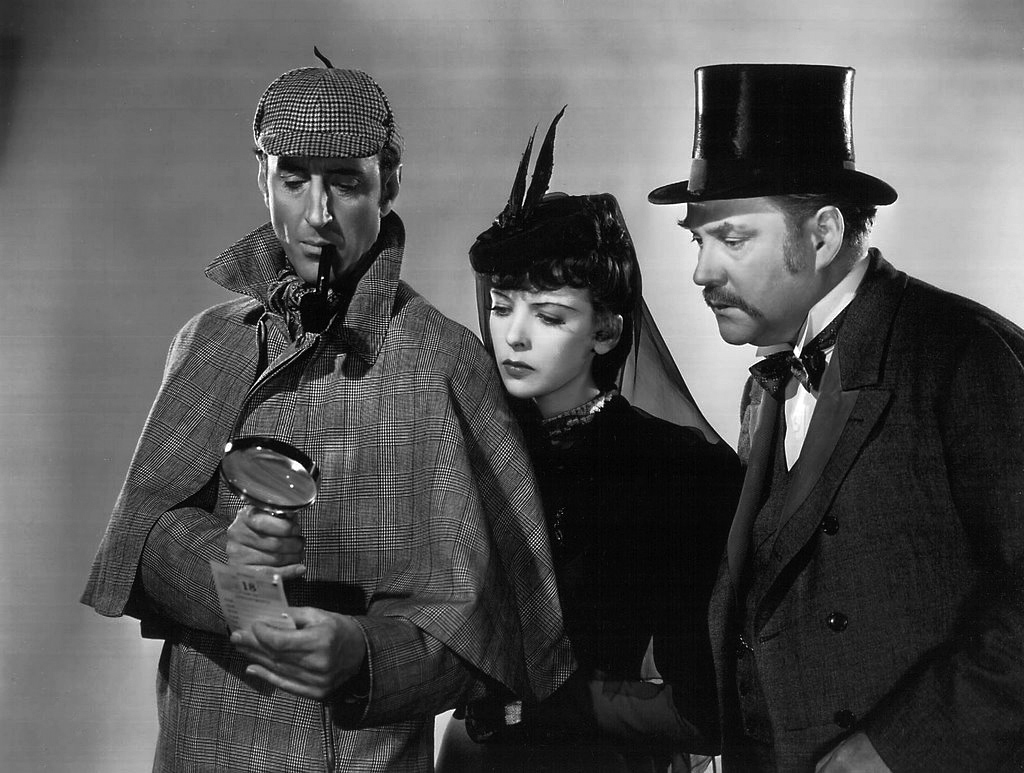
Sherlock Holmes and John Watson about to do philosophy

Have you ever heard someone say that if God existed, he would give us more evidence? This is called the “hiddenness of God” argument. It’s also known as the argument from “rational non-belief”.

Basically the argument is something like this:

  1. God is all powerful
  2. God is all loving
  3. God wants all people to know about him
  4. Some people don’t know about him
  5. Therefore, there is no God.

In this argument, the atheist is saying that he’s looked for God real hard and that if God were there, he should have found him by now. After all, God can do anything he wants that’s logically possible, and he wants us to know that he exists. To defeat the argument we need to find a possible explanation of why God would want to remain hidden when our eternal destination depends on our knowledge of his existence.

What reason could God have for remaining hidden?

Dr. Michael Murray, a brilliant professor of philosophy at Franklin & Marshall College, has found a reason for God to remain hidden.

His paper on divine hiddenness is here:
Coercion and the Hiddenness of God“, American Philosophical Quarterly, Vol 30, 1993.

He argues that if God reveals himself too much to people, he takes away our freedom to make morally-significant decisions, including responding to his self-revelation to us. Murray argues that God stays somewhat hidden, so that he gives people space to either 1) respond to God, or 2) avoid God so we can keep our autonomy from him. God places a higher value on people having the free will to respond to him, and if he shows too much of himself he takes away their free choice to respond to him, because once he is too overt about his existence, people will just feel obligated to belief in him in order to avoid being punished.

But believing in God just to avoid punishment is NOT what God wants for us. If it is too obvious to us that God exists and that he really will judge us, then people will respond to him and behave morally out of self-preservation. But God wants us to respond to him out of interest in him, just like we might try to get to know someone we admire. God has to dial down the immediacy of the threat of judgment, and the probability that the threat is actual. That leaves it up to us to respond to God’s veiled revelation of himself to us, in nature and in Scripture.

(Note: I think that we don’t seek God on our own, and that he must take the initiative to reach out to us and draw us to him. But I do think that we are free to resist his revelation, at which point God stops himself short of coercing our will. We are therefore responsible for our own fate).

The atheist’s argument is a logical/deductive argument. It aims to show that there is a contradiction between God’s will for us and his hiding from us. In order to derive a contradiction, God MUST NOT have any possible reason to remain hidden. If he has a reason for remaining hidden that is consistent with his goodness, then the argument will not go through.

When Murray offers a possible reason for God to remain hidden in order to allow people to freely respond to him, then the argument is defeated. God wants people to respond to him freely so that there is a genuine love relationship – not coercion by overt threat of damnation. To rescue the argument, the atheist has to be able to prove that God could provide more evidence of his existence without interfering with the free choice of his creatures to reject him.

Murray has defended the argument in works published by prestigious academic presses such as Cambridge University Press, (ISBN: 0521006104, 2001) and Routledge (ISBN: 0415380383, 2007). The book chapter from the Cambridge book is here. The book chapter from the Routledge book is here.

Positive arguments for Christian theism