From Keith Hennessey. He groups the questions into 4 categories, so I’ll excerpt one from each category below. The press conference is scheduled for Wednesday at 8 PM Eastern time.
Economy:
You proposed spending money from the TARP to prevent foreclosures, help small businesses, and to buy toxic assets from banks. In June CBO said they had found no evidence that any money has been spent for any of these programs. How many foreclosures have been prevented, how many small businesses have received loans from, and how many toxic assets have been purchased?
Health care:
Your Administration has said that health care reform is the key to addressing our long-term budget problem. Yet you have adopted a lower standard, that health care reform legislation simply does not make our deficit problems worse. If health care reform leaves the unsustainable budget situation unchanged, and since CBO says your budget would result in nine trillion dollars of new debt over the next decade, then how else do you propose to deal with the projected explosion of government debt over the long run?
Global Warming:
Does it make sense for the U.S. to impose higher energy costs on American workers and manufacturers if the two largest developing economies [India and China] are unwilling to slow their emissions growth? Won’t that just disadvantage American workers with little reduction in future global temperatures?
Trade:
The top Democrat and Republican on the Senate Finance Committee have called for you to submit to Congress for their approval the signed Free Trade Agreements with U.S. allies Colombia, Panama and South Korea. Why have you not submitted them to Congress? When will you do so?
These questions really expose how things have gone awry with the Obama presidency.
Canada and Mexico, our top two export markets, are embroiled in trade feuds with the U.S., both triggered by American protectionism. As a global leader and a decent hemispheric neighbor — especially during these economic doldrums — the United States immediately should rejoin Canada and Mexico on the road to free trade.
…Obama’s $410 billion omnibus spending plan defunded a pilot program in which about 100 Mexican trucks were allowed to drive goods into the U.S. beyond a 25-mile frontier zone. American trucks were given equal access to Mexican destinations. (Removing goods from one country’s trucks and reloading them onto the other’s for onward travel has boosted transit costs anew. These eventually increase price tags.)
Mexico correctly argues that the North American Free Trade Agreement, which President Clinton signed in 1995, opened U.S. roads to Mexican trucks. However, Washington kept dragging its feet. In 2002, Congress imposed 22 safety regulations on Mexican (but not Canadian) trucks, and it was only in 2007 that the Bush administration started the pilot program. In exasperation at the cancellation of this initiative, Mexico has raised tariffs on 90 American exports worth $2.4 billion, including grapes and toilet paper. This reportedly will kill 40,000 American jobs. Mexico’s backlash against U.S. protectionism interrupted its unilateral reduction of average industrial tariffs from 10.4 percent in 2008 to a projected 4.2 percent in 2013.
Even worse, June 1 brought word that Canacar — an association of 4,500 Mexican trucking companies — had filed a grievance with the U.S. State Department seeking $6 billion in damages because of the pilot program’s termination and the resulting brick wall that arose in front of big rigs at the border.
“We want reciprocity,” Canacar attorney Pedro Ojeda told the Wall Street Journal. “The U.S. has notoriously not kept its commitments.”
China has now retaliated with a “Buy China” provision in their own stimulus bill. Canada has complained and all Secretary of State Hillary Clinton has done in response is pledge “cooperation.” No, we don’t need pledges. We need to revoke “Buy American.” We need to kill it.
Here is a list of countries that are angry with Obama’s short-sighted protectionism. He wants to isolate America from the rest of the world by refusing to sign trade deals with them.
Canada ($600B) passes resolution to counter “Buy American” policy.
The European Union ($639B) calls it the “worst possible signal.”
Japan ($204B) warns the United States, and Australia ($32B) threatens retalitory measures.
After slamming the “Buy American” policy, India ($43B) raised tariffs.
Singapore ($43B) is concerned with “Buy American.”
The president of Brazil ($62B), a former labor activist, criticizes Buy American and has threaten to challenge the U.S. at the WTO.
France‘s ($72B) Nicholas Sarkozy wants a “Buy France” provision for french auto companies.
Big Labor opposes free trade, and Big Labor helped to get Obama elected.
It also ignited a trade war with Canada. In response to vague “buy American” provisions in the stimulus package, “A number of Ontario towns, with a collective population of nearly 500,000, retaliated with measures effectively barring U.S. companies from their municipal contracts — the first shot in a larger campaign that could shut U.S. companies out of billions of dollars worth of Canadian projects.”
Yet, Obama had the audacity to claim that only passing the stimulus package would save us from “irreversible decline” and economic ““disaster”.
Remember how Democrats used to complain about Bush and his “tax cuts for the rich”? Yeah, it’s strange how only people who pay taxes (59% of the public) can actually get tax cuts, isn’t it. But Obama has an even better idea: “tax hikes for the poor”.
A senior administration official said the new standards would raise the cost of an average car by $1,300, $600 of which could be attributed to the rules being announced today.
On the other hand, let’s take a look at Canada in relation to the United States, courtesy of the Cato Institute. (H/T Heritage Foundation)
The Cato Institute writes:
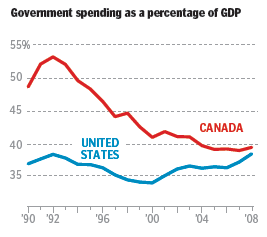
Spending: Spending by all levels of the Canadian government peaked at 53 percent of the country’s GDP in the early 1990s, then plunged to 40 percent in 2008. U.S. government spending has risen, reaching 39 percent of GDP in 2008. And with the stimulus package, that number is likely to jump even higher.
Government spending as % of GDP
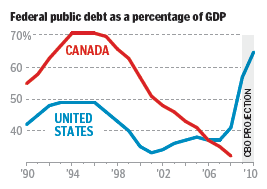
Debt: The Canadian government cut its debt from 71 percent of GDP in 1995 to 32 percent in 2008. Under President Obama’s budget plan, U.S. federal public debt will jump from 41 percent of GDP in 2008 to more than 60 percent next year.
Federal debt as % of GDP
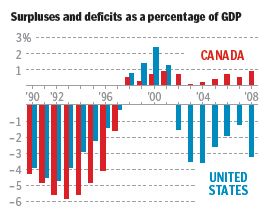
Deficits: Canada has balanced its budget every year since 1998 — not by raising taxes, but by cutting spending. The United States balanced its budget for four years in the late 1990s, but now deficits are so large that it’s difficult to imagine that ever happening again.
Surplus / Deficit as % of GDP
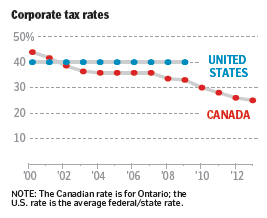
Corporate Taxes: Canada has cut the corporate tax rate from 28 percent to just 15 percent, and most provinces have trimmed corporate taxes as well. The U.S. federalstate rate stands at about 40 percent, and the Obama administration is planning to increase corporate taxes.
Corporate tax rates
It’s important to note that the Liberal party in Canada is socially progressive, but moderate on fiscal issues. Of course, now that the Conservatives have been running things, it’s gotten even better. It would be great if they could win a majority. The biggest problem in Canada right now is the fascist Human Rights Commissions, but there are candidates from the Conservative Party who intend to abolish the HRCs in BC and Ontario.

 WINTERY KNIGHT