Tag Archives: Free Enterprise

Donald Trump’s plan to introduce tariffs is just a tax on consumer goods

I have a key that will unlock a puzzling mystery

What are the consequences of adopting tariffs for all of the people who are affected? What happens next, after stage one?

Here’s a lesson in basic economics from Joe Carter, writing for the Acton Institute.

He writes:

Both Sanders and Trump propose increasing tariffs on goods imported from other countries — and increase them significantly.* This isn’t that surprising for Sanders, a socialist who, on the issue of economics, is one of the most ill-informed candidates in modern history. But Trump should (and probably does) understand the detrimental impact tariffs have on the poor. And yet he has proposed an economy-crippling, poverty-increasing tariff.

In 2012, Trump proposed a tariff on China of 25 percent. In 2016 he bumped it up to 45 percent. (He later tried to lie and say he never proposed the 45 percent increase, but there is audio of him making the proposal.) A tariff is simply a tax on imports or exports, so Trump is proposing to raise taxes on imported goods by 25 to 45 percent. (To keep this point in mind, I’ll hereafter refer to tariffs as “taxes.”)

You might be thinking, “ So what? That’s a tax the Chinese have to pay.” But that’s not the way tariffs works. China doesn’t pay the tax — you do. If a tariff on Chinese goods is increased by 25 to 45 percent then you pay 25 to 45 percent more for those goods.

Here’s a way to think about it. Imagine there are two hamburger stands in town. One is owned by the mayor’s wife, Veronica, and one is owned by a woman who lives in the next town over, Betty.

Of the two, Betty makes the tastier burger. She is also able to charge $1 a burger since she is able to buy her supplies in her own hometown for much cheaper. Veronica’s burgers aren’t quite as good and cost more to make. She has to charge $1.30 per burger.

The mayor decides to implement a new tax of 45 percent on producers (like Betty) who don’t live in the city limits. Since Betty’s profit margin is already low, she has to pass the bulk of the 45-cent tax on to her customers. Instead of $1 she now has to charge $1.35.

So who is better off in this scenario? The only winner is Veronica. Since her burgers are now cheaper, she is likely to sell more. And who is worse off? The customers who now have to pay 30 to 35 cents more for every burger. That is money they could have used to buy other products or services. Now they have to spend additional money on this new tax.

The same principle applies to taxes on goods and services imported from other countries. Customers simply have to pay more for goods and services they used to get much cheaper.

To understand how Trump’s tax increase would affect consumers, take a trip to Target or Wal-Mart and add 45 percent to almost all the prices. That’s money that comes directly out of your pocket into the hands of the federal government — all to punish you for buying goods that are cheaper to make in China.

Harvard University economist Greg Mankiw explains what most professional economists agree on. The economic benefit of free trade tied for first place, with 93% agreement:

The recent debate over the stimulus bill has lead some observers to think that economists are hopelessly divided on issues of public policy. That is true regarding business cycle theory and, specifically, the virtues or defects of Keynesian economics. But it is not true more broadly.

My favorite textbook covers business cycle theory toward the end of the book (the last four chapters) precisely because that theory is controversial. I believe it is better to introduce students to economics with topics about which there is more of a professional consensus. In chapter two of the book, I include a table of propositions to which most economists subscribe, based on various polls of the profession. Here is the list, together with the percentage of economists who agree:

  1. A ceiling on rents reduces the quantity and quality of housing available. (93%)

  2. Tariffs and import quotas usually reduce general economic welfare. (93%)

He is the author of his “favorite textbook”, which is published by Harvard University Press.

This is not controversial among professional and academic economists. Economists across the ideological spectrum understand that free trade lowers the prices of consumer goods, and allows individuals, families and businesses to get more quality for their dollars. We can do better than Donald Trump and his naive, populist economic pablum.

Related posts

Does the free market work to reduce poverty?

Economist Walter Williams

From Investors Business Daily.

Excerpt:

There has never been a purely free market economic system, just as there has never been a purely communist system. However, we can rank economies and see whether ones that are closer to the free market end of the economic spectrum are better than ones that are closer to the communist end.

Let’s try it.

First, list countries according to whether they are closer to the free market or the communist end of the economic spectrum. Then rank countries according to per capita gross domestic product. Finally, rank countries according to Freedom House’s “Freedom in the World” report.

People who live in countries closer to the free market end of the economic spectrum have far greater income than people who live in countries toward the communist end — and enjoy far greater human rights protection.

According to the 2012 “Economic Freedom of the World” report by James Gwartney, Robert Lawson and Joshua Hall, nations ranking in the top quartile with regard to economic freedom had average per capita GDP of $37,691 in 2010 compared with $5,188 for those in the bottom quartile.

In the freest nations, the average income of the poorest 10% of their populations was $11,382. In the least free nations, it was $1,209.

Remarkably, the average income of the poorest 10% in the economically freer nations is more than twice the average of those in the least free nations.

Free market benefits aren’t only measured in dollars and cents.

Life expectancy is 79.5 years in the freest nations and 61.6 years in the least free.

Political and civil liberties are considerably greater in the economically free nations than in unfree nations.

Leftists might argue that the free market doesn’t help the poor. That argument can’t even pass the smell test.

Imagine that you are an unborn spirit and God condemned you to a life of poverty but gave you a choice of the country in which to be poor. Which country would you choose?

To help with your choice, here are facts provided by Robert Rector and Rachel Sheffield in their report “Understanding Poverty in the United States: Surprising Facts About America’s Poor.”

  • Eighty percent of American poor households have air conditioning.
  • Nearly three-fourths have a car or truck, and 31% have two or more.
  • Almost two-thirds have cable or satellite TV.
  • Half have one or more computers.
  • Forty-two percent own their homes.
  • The average poor American has more living space than the typical non-poor person in Sweden, France and the U.K. Ninety-six percent of poor parents stated that their children were never hungry; in other words, they could afford food.

The bottom line is that there is little or no material poverty in the U.S.

At the time of our nation’s birth, we were poor, but we established an institutional structure of free markets and limited government and became rich.

This might be a good article send along to people who want to bash our free-market system. It’s easy for them to make assertions that we have to do this or that policy to redistribute wealth. But the real solution to helping the poor is not to take from one and give to another, it’s to put into place a system that causes wealth to be created for all. That’s what happened in the United States, and you can see how it happened in other capitalist economies like Chile, Hong Kong and Singapore. Capitalism turns poor nations into rich nations.

The pilgrims experiment with communism before the second Thanksgiving

The First Thanksgiving
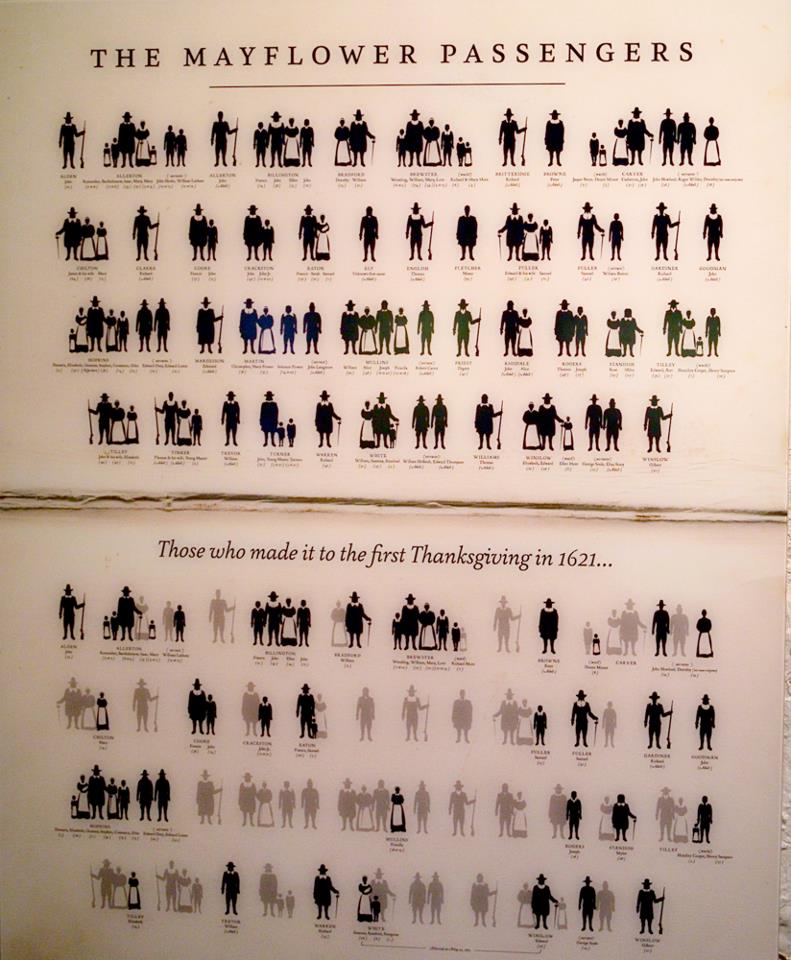
Less than half the original pilgrims made it to the the first Thanksgiving

Here’s an article from The Stream about the second Thanksgiving, by Dante Witt. I like this article because it tells us so much about the character of the United States of America. Why are we so conservative about economics?

She briefly retells the story of how the pilgrims were helped by Squanto, which I blogged about in my previous post, then she talks about the troubles they had next.

Excerpt:

Although Squanto’s farming techniques worked better than their old ones, the pilgrims still could not produce enough food. Was it bad luck? Bad soil? No. The Mayflower pilgrims were part of a joint stock company which stipulated that the pilgrims would pool their resources, and receive a share of the profit.

The strategy turned out to be deeply misguided, working about as well as various communist economic schemes hundreds of years later. The sad state of the colony after two years of communism, wrote William Bradford, “may well evidence the vanity of that conceit of Plato’s and the other ancients applauded by some of later times; that the taking away of property and the bringing of community into a commonwealth would make them happy and flourishing; as if they were wiser than God” (p. 121).

So the pilgrims amended their contract so that each family was now responsible for its own provision. The difference was stark. Bradford explained:

This had good success, for it made all hands very industrious, so that more corn was planted than could have been by any other means the Governor could use, and saved him a great deal of trouble, and gave far better content. The women now went willingly into the field, and took their little ones with them to set corn; which before would allege weakness and inability; whom to have compelled would have been thought great tyranny and oppression.

In fact, it’s estimated the colonists planted about six times the crops they would have planted otherwise.

That shows where Americans get their views of economics, but what about the praying and the gratitude?

More:

With new farming techniques and an amended government, the pilgrims did all they humanly could to ward off starvation. But they could not control the weather. A drought settled on the colony and threatened to kill the corn before the harvest. Recognizing with the Psalmist that “except the Lord build the house, they labor in vain that build it,” the colonists turned to God. According to Bradford, they “set apart a solemn day of humiliation to seek the Lord by humble & fervent prayer, in this great distress.” What was the outcome?

And he was pleased to give them a gracious & speedy answer, both to their own & the Indians admiration, that lived amongst them. For all the morning, and greatest part of the day, it was clear weather & very hot, and not a cloud or any sign of rain to be seen, yet toward evening it began to overcast, and shortly after to rain, with such sweet and gentle showers, as gave them cause of rejoicing, & blessing God. It came, without either wind, or thunder, or any violence, and by degrees in that abundance, as that the earth was thoroughly wet and soaked therewith. Which did so apparently revive & quicken the decayed corn & other fruits, as was wonderful to see, and made the Indians astonished to behold. (p. 131)

Seeing the speedy results of the Puritans’ prayers, an Indian named Hobanak said, “Now I see that the Englishman’s God is a good God, for he hath heard you, and sent you rain, and that without storms and tempests and thunder, which usually we have with our rain, which breaks down our corn, but yours stands whole and good still; surely your God is a good God.” (pp. 64-5)

Then William Bradford again proclaimed a day of Thanksgiving to God, the forerunner of the American tradition of Thanksgiving.

So, this story explains why the United States has this character that values the free enterprise system, hard work, individual achievement, prayer, and gratitude. These are the values that make us American, that made us into such a great nation.