
Tag Archives: Fossils

Thinking Christian reviews “Darwin’s Doubt”, a new book by Stephen C. Meyer

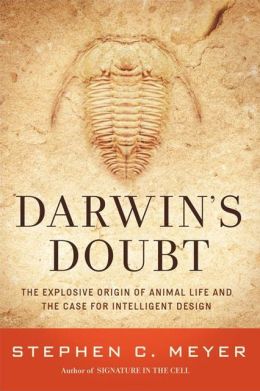
Darwin's Doubt: The Explosive Origin of Animal Life and the Case for Intelligent Design
Darwin’s Doubt: The Explosive Origin of Animal Life and the Case for Intelligent Design

NOTE: you can tune in to the Dennis Prager radio show  at 2 PM Eastern today in order to hear Dr. Meyer discuss the new book.

I found a book review of the new book on intelligent design by Dr. Stephen C. Meyer. This book is concerned with the fossil record, and it is the sequel to the highly acclaimed “Signature in the Cell“, which dealt with the origin of biological information in the first living cell.

Excerpt:

The title of the book refers to the difficulty [Charles Darwin] had in explaining the “Cambrian Explosion,” the vast proliferation of new animal body plans (new “phyla” or major animal groupings) that appears in fossils in the Cambrian strata, deposited some 530 million years ago. These animals appear suddenly in the fossil record, without any plausible predecessor such as Darwin’s theory predicted. Darwin wrote,

The difficulty of understand the absence of vast piles of fossiliferous strata, which on my theory were no doubt somewhere accumulated before the Silurian [i.e., Cambrian] epoch, is very great. I allude to the manner in which numbers of species of the same group suddenly appear in the lowest known fossiliferous rocks.

Darwin saw this accurately as a challenge to his theory. It remains one still. The animals appear too quickly in the record to be explained through his gradualistic theory.

And it remains a challenge from the perspective of mainstream science. Various theories have been proposed in explanation of the suddenness with which these new phyla came on the scene. Perhaps selective fossilization caused their predecessors to disappear from paleontologists’ view. Mainstream science casts serious doubt on that view. Statistical paleontology renders it deeply improbable. The soft-body hypothesis appears unlikely to succeed, since the evidence shows soft-bodied organisms have been frequently fossilized.

Or maybe the Cambrian animals’ precursors really are there in the record, in the form of exotic Ediacaran fossils. But these organisms are not clearly animals of any sort, and what they are is so in confusion that they could hardly be considered evidence for anything. Further,

As Nature recently noted, if the Ediacaran fauna “were animals, they bore little or no resemblance to any other creatures, either fossil or extant.” … This absence of clear affinities has led an increasing number of paleontologists to reject an ancestor/dependent relationship between the Ediacaran and Cambrian fauna.

Scientists have proposed genetic histories for these phyla, but as Meyer pointedly puts it, these scenarios all “assume a gene.” And a lot more besides. That is to say, they beg the question of evolution’s explanatory adequacy by assuming that it must be true. From there they suggest pathways according to which genes “must have” evolved. But there’s no evidence of it in the record.

Now the exciting thing is that at the time of writing (Monday night), the book is number one on Barnes and Noble:

Darwin's Doubt #1 at Barnes and Noble
Darwin’s Doubt #1 at Barnes and Noble

And number ten on Amazon:

Darwin's Doubt #10 at Amazon.com
Darwin’s Doubt #10 at Amazon.com

Now is this a book for the layman? Well, I’ve met the guy who wrote the book review above face-to-face, and his background is not in biology. I think if he can struggle through it, then I could do it too. And so could you. I think that both of Dr. Meyer’s books are must-read books for anyone interested in knowing how well the presumption of naturalism succeeds when confronted with the latest scientific evidence. These are the books you need to buy and read if you are serious about integrating science and religion. The thing to realize is that naturalists and atheists and materialists have no answer to these books. None. Do you like winning? Then spend the money and time on the books that are unstoppable in a debate.

The Gospel Coalition interviews Stephen C. Meyer on the Cambrian explosion

A great introduction to the Cambrian explosion on The Gospel Coalition, of all places!

Here’s one question and answer that emphasizes that the progress of science is making the problem posed by the Cambrian fossils worse for Darwinists.

Have the last century of fossil discoveries resolved or aggravated Darwin’s doubt?

Fossil discoveries since Darwin’s time have only made the Cambrian explosion problem worse for his theory.

Darwin believed that the fossil record was woefully incomplete, and he predicted that the problem of abrupt appearance of animals in the Cambrian would be alleviated by future discoveries.

But the opposite happened. Scientists have combed the Precambrian strata for the alleged precursors to the Cambrian animals, and they haven’t found the direct evolutionary ancestors that Darwinian theory predicts. Instead, they have made new discoveries which confirmed that the Cambrian explosion was real event—and a worldwide one—and that the animal phyla really did appear abruptly.

The first major Cambrian-era fossil discovery after Darwin’s time took place over a hundred years ago now, in 1909, when Charles Doolittle Walcott (then the head of the Smithsonian Institution) discovered the Burgess Shale Cambrian deposit in the Canadian Rockies. This deposit showed many diverse soft and hard-bodied organisms which were preserved in exquisite detail. They all appeared in the Cambrian, with no clear evolutionary ancestors.

The question remained, however, whether the Burgess Shale Cambrian animals were a lucky isolated event, or evidence of a worldwide pattern. Over the next decades, additional discoveries of Cambrian animals were made in other parts of the world, including Russia, Greenland, and Australia.

But the most spectacular find of all took place in 1984, with the discovery of Cambrian fossils in Chengjiang, China. This deposit confirmed that the Cambrian explosion was a worldwide event, with many of the same creatures found in Canada being present in beautiful detail.

So as more and more fossils have been discovered, we’ve found the same pattern over and over around the world: diverse types of animals appear abruptly in the Cambrian, without clear evolutionary precursors. This has accentuated the “dilemma” that Darwin faced.

So the progress of science is making the problem worse for Darwinists. The more discoveries we make, the tougher the problem becomes for them, and the more the effect looks like the result of intelligent action. Kudos to the Gospel Coalition for posting on science, too.

I’ve already ordered my copy of Darwin’s Doubt at the reduced price. Have you? And don’t forget that Dr. Meyer’s first book, the ground-breaking Signature in the Cell, can also be obtained. That was the best book on intelligent design out there, but people who have read Darwin’s Doubt are telling me that it will be far better!

The undisputed best book on intelligent design now has a sequel

The very best book on intelligent design is Dr. Stephen C. Meyer’s “Signature in the Cell“, which discusses the knotty problem of the origin of life. And now, a new book by Dr. Meyer has been announced to tackle another huge problem: the fossil record.

Here is the description of the new book, entitled “Darwin’s Doubt”:

Darwin’s Origin of Species launched a revolution whose scientific, cultural and spiritual effects are still with us. Now a new revolution is on the horizon. On June 18, the HarperOne imprint of HarperCollins will publish Darwin’s Doubt: The Explosive Origin of Animal Life and the Case for Intelligent Design, by Stephen C. Meyer.

[…]Meyer begins with what Darwin himself regarded as a troubling enigma, a subject of doubt and even some scientific distress. It is a mystery from which subsequent generations of Darwinists have sought to distract the public’s attention. Some 530 million years ago, in the event called the Cambrian explosion, there sprang suddenly into existence the majority of animal body plans (phyla) that have existed on Earth. The shallow seas of the Cambrian period abruptly teemed with diverse, exotic animals.

Evolutionary biologists and paleontologists have struggled to explain this epic event. Dr. Meyer takes his readers on a journey through scientific history, starting with the discovery of the Burgess Shale by Charles Walcott in 1909. He shows how failed attempts to give a satisfying Darwinian explanation of the Cambrian explosion have opened the door to increasingly profound questions, posed by evolutionary biologists themselves, leading to a far greater mystery: the origin of the biological information necessary to build the animals of the Cambrian and all the living creatures that have existed on Earth.

I have already pre-ordered my copy!