Bill Whittle explains. (7 minutes)
This is not to mention his record on abortion – the most pro-abortion President ever. Or the election of hardline Muslim extremists in Egypt.
The man is a catastrophic failure.

Bill Whittle explains. (7 minutes)
This is not to mention his record on abortion – the most pro-abortion President ever. Or the election of hardline Muslim extremists in Egypt.
The man is a catastrophic failure.
From the Heritage Foundation.
Excerpt:
The Obama Administration’s risky decision to seek the quickest possible exit from Iraq has contributed to a mushrooming political crisis there that is rapidly unraveling the hard-won gains of U.S. troops and threatens to plunge the country into a civil war that will greatly benefit Iran.
Shortly after the December 15 end-of-mission ceremony for U.S. troops, Iraqi Prime Minister Nouri al-Malikipurged many senior Sunni Arab political leaders from his fractious governing coalition. Maliki’s government, dominated by Shiite political parties of various stripes, also announced that it will prosecute Vice President Tareq al-Hashemi, a leader of the predominantly Sunni Arab Iraqiyah party, on terrorism charges. Hashemi, who denounced the allegations as propaganda cover for a political coup, has fled to the semi-autonomous Kurdish region in northern Iraq.
Iraq’s fragile unity is now dissolving in growing political tensions between the leaders of the Shiite majority and Sunni minority and between the Shiite-dominated central government and the non-Arab Kurdish minority. But the Obama Administration, blindsided by simmering tensions that it had downplayed in its rush for the exit, appears to be on auto-pilot.
The Administration gave a higher priority to domestic political considerations than to Iraq’s long-term security needs when it neglected to negotiate an extension of the U.S. troop presence past the end-of-year deadline set by the 2008 Status of Forces Agreement. Although the Bush Administration had envisioned a follow-on agreement to extend the military presence, and the Obama Administration had initially planned for a smaller residual force of military trainers and advisers, in the end politics trumped security in the White House’s deliberations.
Pulling troops out of the Middle East will make it harder for us to gather intelligence and support our allies against Islamic aggression. This decision to pull troops out ahead of the 2012 election is very similar to the decision to delay the Keystone XL pipeline until after the election.
Excerpt:
In November, the White House announced it would delay deciding on the project until after next year’s election. Administration officials claim they need more time to evaluate the potential environmental impacts of the $7 billion, 2,100-mile project to transport crude oil from Alberta, Canada, to major American refineries in the Gulf Coast.
Not content to wait until 2013, Republicans inserted a Keystone approval provision into the payroll tax extension. The result of that move is still in flux, as House Republicans have rejected the Senate’s measure.
Regardless of the outcome, President Obama’s desire to delay the pipeline is just the latest example of his pernicious proclivity for putting politics over sound policy when it comes to energy regulations.
The president simply doesn’t want to bear the political costs of deciding either way on Keystone until after his re-election bid. He’s wants to remain non-committal.
[…]Shambling on Keystone might be smart politics — but there’s no good policy reason to delay approval. And there is a huge cost of delay, which can be captured in just four letters: J-O-B-S.
Keystone XL requires miles of pipe to be welded and installed, and at least 30 new pumping facilities to be constructed. American workers would staff many of those operations.
Indeed, if Keystone XL were allowed to proceed as planned, oil sands development and related operations would directly create thousands of new jobs. Tens of thousands additional positions would be created indirectly at businesses along the pipeline’s pathway.
That same political strategizing driving the Keystone delay also undergirds the White House’s stance on hydraulic fracturing.
Colloquially know as “fracking,” this technique has proven invaluable in extracting natural gas buried under the earth’s surface. It involves pumping a high-pressure mixture of water and sand into the rock surrounding deposits to free up gas for collection.
In the Marcellus shale — a massive reserve running from Ohio and Pennsylvania into New York — fracking is the only way for developers to get access to gas located deep underground. Unfortunately, policymakers high and low have succumbed to environmentalist alarmism on fracking.
New York — with the tacit support of the White House — has instituted a fracking moratorium and effectively prohibited exploration of the parts of the Marcellus that run under the state.
Again, the cost of currying favor with environmentalists? Jobs. According to the Department of Environmental Conservation, Marcellus development in New York could generate up to 80,000 new local positions.
The more we decline to develop our own energy resources here at home, the worse it is for our economy. But it’s also bad for our national security to continue to buy oil from people who don’t like us very much. If we could develop our own energy resources at home – and buy from Canada – then we could use the money we save to keep our commitments in the Middle East. It’s not good for our economy or our national security to make short-sighted decisions that are going to hurt us in the long-run.
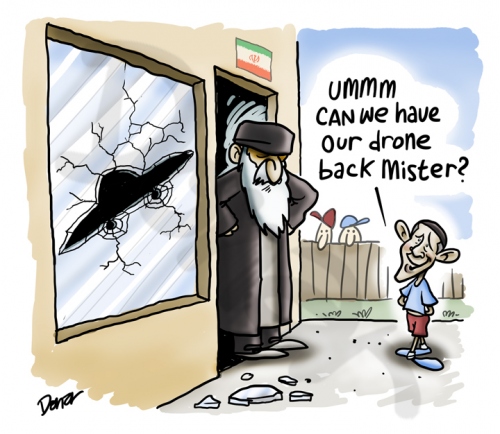
CNN reports:
President Barack Obama said Monday that the United States has asked Iran to return a U.S. drone aircraft that Iran claims it recently brought down in Iranian territory.
“We’ve asked for it back. We’ll see how the Iranians respond,” Obama said in a news conference, alongside Iraqi Prime Minister Nouri al-Maliki.
A top Iranian military official previously vowed not to return the unmanned American stealth plane that it says it has.
[…]Former U.S. Vice President Dick Cheney on Monday criticized Obama’s decisions on the drone, but for an entirely different reason. He said that, after the aircraft went down, the president should have ordered an airstrike over Iran.
“The right response to that would have been to go in immediately after it had gone down and destroy it,” the Republican, who served with President George W. Bush, told CNN’s Erin Burnett. “You can do that from the air … and, in effect, make it impossible for them to benefit from having captured that drone.”
Instead, “he asked nicely for them to return it, and they aren’t going to,” Cheney said.
[…]One U.S. official said the United States can’t be certain it’s the real stealth drone, because U.S. personnel don’t have access to it. But he added there’s no reason to think it’s a fake. However, a second senior U.S. military official said that a big question is to how the drone could have remained virtually intact given the high altitude it is believed to have crashed from.
All American Blogger found this story on Fox News:
In an interview broadcast live Monday night on Venezuelan state television, Iranian President Mahmoud Ahmadinejad said nothing to suggest his country would grant the U.S. request.
“The Americans have perhaps decided to give us this spy plane,” Ahmadinejad said. “We now have control of this plane.”
Speaking through an interpreter, Ahmadinejad said: “There are people here who have been able to control this spy plane, who can surely analyze this plane’s system also. … In any case, now we have this spy plane.”
He added, “Very soon, they’re going to learn more about the abilities and possibilities of our country.”
On Tuesday, a semi-official Iranian news agency said authorities have shrugged off the U.S. request. Defense Minister Gen. Ahmad Vahidi said the United States should apologize for invading Iranian air space instead of asking for the return of the unmanned aircraft.
Remember when Iran was having their elections and they started shooting people down in the street? Unlike Germany, France and Canada, Obama had nothing to say about that. Ronald Reagan would have had something to say. Margaret Thatcher would have something to say. But Obama had nothing to say. Maybe the Iranians looked at what Obama did and decided that Obama is a paper tiger.
Lately, we’ve seen an Iranian-backed attack on U.S. soil, an Iranian-backed attack on a U.K. embassy, and increased Iranian operations in Latin America. What could be emboldening Iran to be so aggressive? If we are nice to them and bow down to them and give them money, won’t that make them like us more?
 WINTERY KNIGHT