
Tag Archives: Foreign Aid

China continues to sell advanced anti-ship cruise missiles to Iran

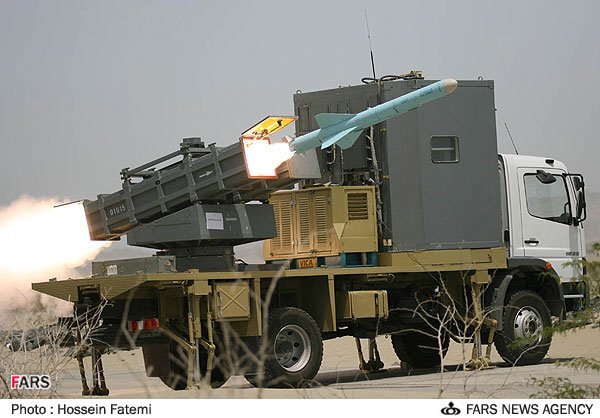
Firing a Chinese-manufactured C-802 anti-ship cruise missile

The Washington Times reports.

Excerpt:

China is continuing to provide advanced missiles and other conventional arms to Iran and may be doing so in violation of U.N. sanctions against the Tehran regime, according to a draft report by the congressional U.S.-China Commission. “China continues to provide Iran with what could be considered advanced conventional weapons,” the report of the U.S.-China Economic and Security Review Commission says. According to the report, which will be made public Nov. 16, China sold $312 million worth of arms to Iran, second only to Russia, after Congress passed the Iran Freedom Support Act in 2006 that allows the U.S. government to sanction foreign companies that provide advanced arms to Iran. The report also noted that, after Russia began cutting back arms transfers to Iran in 2008, China became the largest arms supplier to the Iranian military. Most of the weapons transfers involved sales of Chinese anti-ship cruise missiles, including C-802 missiles that China promised the United States in 1997 would not be exported to Iran. China also built an entire missile plant in Iran last year to produce the Nasr-1 anti-ship cruise missile.

The Nasr-1 has a range of 19 miles. The C-802 has a range of 75 miles. That means that the C-802 has about the same range as a Harpoon SSM. Not good. I am not worried about the Nasr-1, but the C-802 is a problem. These weapons could be used by terrorists to attack allied naval vessels. In fact, the New York Times reported that Hezbollah, a terrorist group linked to Iran, used the C-802 missile to sink an Israeli Saar 5 corvette back in 2006.

Excerpt:

The power and sophistication of the missile and rocket arsenal that Hezbollah has used in recent days has caught the United States and Israel off guard, and officials in both countries are just now learning the extent to which the militant group has succeeded in getting weapons from Iran and Syria.

While the Bush administration has stated that cracking down on weapons proliferation is one of its top priorities, the arming of Hezbollah shows the blind spots of American and other Western intelligence services in assessing the threat, officials from across those governments said.

American and Israeli officials said the successful attack last Friday on an Israeli naval vessel was the strongest evidence to date of direct support by Iran to Hezbollah. The attack was carried out with a sophisticated antiship cruise missile, the C-802, an Iranian-made variant of the Chinese Silkworm, an American intelligence official said.

At the same time, American and Israeli officials cautioned that they had found no evidence that Iranian operatives working in Lebanon launched the antiship missile themselves.

But neither Jerusalem nor Washington had any idea that Hezbollah had such a missile in its arsenal, the officials said, adding that the Israeli ship had not even activated its missile defense system because intelligence assessments had not identified a threat from such a radar-guided cruise missile.

[…]Officials said it was likely that Iran trained Hezbollah fighters on how to successfully fire and guide the missiles, and that members of Iran’s Al Quds force — the faction of the Revolutionary Guards that trains foreign forces — would not necessarily have to be on the scene to launch the C-802.

At the same time, some experts said Iran was not likely to deploy such a sophisticated weapon without also sending Revolutionary Guard crews with the expertise to fire the missile.

Note that this is the same Quds force that likely trained Iraqi terrorists in the use of IEDs and is suspected of being involved with the recent attack on the Saudi ambassador on American soil. I have no idea why we were dicking around in Libya and Egypt when we have major problems with Iran, and, by extension, Syria and Lebanon.

Meanwhile, the Obama administration sends $47 million a year to China for foreign aid.

Should we cut foreign aid to governments who oppose us at the UN?

From CNS News, a story about foreign policy.

Excerpt:

A Republican amendment to appropriations legislation would bar funding for any government that opposes the U.S. position at the United Nations more often than not. Although unlikely to make it into law, the amendment draws fresh attention to the fact that a majority of countries, including most leading recipients of U.S. foreign aid, would fall into that category.

Among multiple amendments inserted into the State Department and foreign operations authorization bill during a House Foreign Affairs Committee markup last week was one by Rep. Jeff Duncan (R-S.C.) prohibiting any foreign assistance to governments that vote against the U.S. position at the U.N. more than 50 percent of the time.

Grades would be obtained from annual State Department reports on voting practices at the U.N., which have been required under U.S. law for decades, and would relate to votes in the General Assembly during its most recent session, or in the case of members of the Security Council, to their votes in both the council and assembly.

In order to waive the prohibition, the president would, on a case-by-case basis, have to issue Congress with a determination that invoking the waiver was “important to the national interests of the United States.”

Duncan’s amendment passed by a party-line vote of 22-18, and was among those incorporated into the final version of the bill that passed out of the full committee by a 23-20 vote late last Thursday night.

“We’re $14.3 trillion in debt,” the tea party-backed Republican freshman said in a statement Monday. “Why should we pay countries to hate us when they’ve shown they’re willing to do it for free?”

“The United States has no business giving money away to countries and groups who seek to do us harm.”

This bill makes sense, so the Democrats are opposed to it.

Is the Euro aggravating the European debt crisis?

ECM sent me this story from the liberal German newspaper “Der Spiegel”.

Here’s the thesis of the article:

In the past 14 months, politicians in the euro-zone nations have adopted one bailout package after the next, convening for hectic summit meetings, wrangling over lazy compromises and building up risks of gigantic dimensions.

For just as long, they have been avoiding an important conclusion, namely that things cannot continue this way. The old euro no longer exists in its intended form, and the European Monetary Union isn’t working. We need a Plan B.

Instead, those in responsible positions are getting bogged down in crisis management, as they seek to placate the public and sugarcoat the problems. They say that there is only a government debt crisis in a few euro countries but no euro crisis, citing as evidence the fact that the value of the European common currency has remained relatively stable against other currencies like the dollar.

But if it wasn’t for the euro, Greece’s debt crisis would be an isolated problem — one that was tough for the country, but easy for Europe to bear. It is only because Greece is part of the euro zone that Athens’ debts are a problem for all of its partners — and pose a threat to the common currency.

If the rest of Europe abandons Greece, the crisis could spin out of control, spreading from one weak euro-zone country to the next. Investors would have no guarantees that Europe would not withdraw its support from Portugal or Ireland, if push came to shove, and they would sell their government bonds. The prices of these bonds would fall and risk premiums would go up. Then these countries would only be able to drum up fresh capital by paying high interest rates, which would only augment their existing budget problems. It’s possible that they would no longer be able to raise any money at all, in which case they would become insolvent.

Well, the article talks about how economically productive counties like Germany are on the hook for the bailouts to underperforming countries like Greece and Portugal. That will happen unless Greece reverts to the drachma and stops dragging down the Euro. But the strong European countries are not the only source of bailout funds – there’s also the International Monetary Fund. And guess who funds them?

Consider this article by John Bolton in the New York Post.

Excerpt:

Most Americans had barely heard of the International Monetary Fund before the arrest of its managing director, Dominique Strauss-Kahn, for sexually assaulting a hotel housekeeper. Yet the race to replace him offers a chance to rethink everything about what the real American interest is in the IMF — including whether its continued existence is beneficial.

The top contenders for Strauss-Kahn’s job are French Finance Minister Christine Lagarde and Bank of Mexico Governor Agustin Carstens. Europeans have headed the IMF since its founding, as Americans have led the World Bank — prerogatives that Third World countries increasingly resent as vestiges of colonialism. Carstens’ candidacy is the most visible manifestation of this rising discontent.

[…]Europe is eager to keep the top IMF job not simply because of geographical chauvinism but because continued IMF assistance is critical to European Union efforts to bail out the fractured economic and fiscal system in Greece and several other EU countries. Lurking behind the bailout crisis is the EU’s growing panic over the viability of its currency, the euro. Having a sympathetic ear at the IMF’s pinnacle seems absolutely critical to protect Europe’s parochial interests.

What of America’s interests? We should have long ago resisted throwing our scarce resources, through the IMF or otherwise, into the sinkhole of defending the euro. The currency was always conceived to be as much a political statement as an economic policy: Its European proponents believed the euro would enhance Europe’s strength as an alternative and perhaps rival to America.

If the United States and a few other developed countries like Japan decide to break with Europe over this vote, the IMF’s voting system, based on world-wide economic strength, makes defeating Lagarde a real possibility.

Today’s IMF does little or nothing for US national interests, especially when we face enormous domestic economic challenges. Why should Washington not support Carstens, break the EU hold on the IMF and stop IMF support for the euro?

We can barely afford us, and yet we have to bailout these profligate European nations? Give me a break.