
Tag Archives: Fertility

Who suffers the most from the trend of extended adolescence?

Marriage and family
Marriage and family

My friend Tracy sent me this interesting post. As I read it, I thought I was going to disagree with him about who is to blame for the mess he describes, but as we’ll see in a bit, I don’t.

Here’s his intro, which pretty much everyone agrees on:

The Five Traditional Milestones of Adulthood

Something magically happens between adolescence and young adulthood.  There are five traditional milestones of that mark entrance into adulthood that sociologists, psychologists, and the general population have used as a proxy to determine when someone has reached that tipping point of maturity.  It is at this time adolescence is shed and emotional maturity comes to full fruition.

These are:

  • Leaving Home
  • Becoming Financially Independent
  • Completing School
  • Marrying
  • Starting a Family

I hate not being married and not having any children, but I can’t marry a feminist and that’s all the church seems to be producing these days. The other ones I had finished by age 23 (debt-free).

He has some examples to illustrate who is and isn’t mature:

Examples of Adults:

  • A 25-year old teacher with a college degree, who works full time, is married, has a child, owns her own home, and pays for her own living expenses
  • A 65-year old janitor with a high school diploma, who works full time, is married or widowed, has children, owns his own home, and pays for his own living expenses

Examples of Extended Adolescence: 

  • A 30-year old who has part of their rent and bills covered by parents, endlessly enrolls in colleges or universities seeking additional degrees or credentials, single, without children.
  • A 45-year old high-school dropout living on social welfare programs who spends his days getting drunk in bars

OK, then he talks about who suffers the most from this, and it’s women:

What is particularly interesting is the interaction between biology and the paradigm shift that has occurred with so much of the younger generation suffering from extended adolescence. Women have a specific, limited window of time in which they can genetically reproduce and to which they are attractive to potential mates.  This so-called “biological clock”, written into the code at the very deepest core of our DNA, puts a limit on childbearing for females.

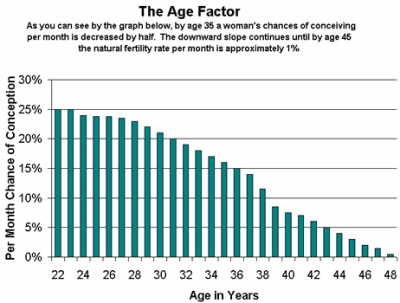
  • Fertility: Female fertility peaks at 20 to 30 years old.  After 30 years old, fertility drops by 20%.  After 35, it drops 50%.  After 40, it drops 95%.  As for in vitro fertilization, the American Society for Reproductive Medicine states that women in their early 40’s have, on average, only a 3% to 5% chance of having a baby through this method.
  • Down Syndrome: At 25, a woman has about 1 chance in 1,250 of having a baby with Down Syndrome; at age 30, a 1-in-1,000 chance; at age 35, a 1-in-400 chance; at age 40, a 1-in-100 chance; and at 45, a 1-in-30- chance.
  • Miscarriage: Only 9 percent of recognized pregnancies for women aged 20 to 24 end in miscarriage; 15 percent of women aged 25-30 miscarry; 40 percent of women over 40 do and more than 50 percent miscarry at 42 years of age.

These limitations do not apply to men (an 80 year old man can still reproduce).  Men have virtually no opportunity cost to waiting to find a mate.  If they want to spend their twenties working their way up their field, putting money in the bank, playing video games, and hanging out with friends, they can always wake up one morning and decide they are ready to settle down, get married, and have kids.  As such, the biological cost of extended adolescence is significantly and substantially higher for women than it is for men.  Females suffer from a Mother Nature-induced “use it or lose it” policy.

I don’t think that a Down syndrome child is insurmountable, but it’s more challenging.

So, should men be expected to ride to the rescue at the last minute, to make things “work out” for women who refused to marry when they were in their 20s, when they were fertile and attractive?

Nope:

This fear was encapsulated by Kay Hymowitz in a book called Manning Up: How the Rise of Women Has Turned Men Into Boys.

[…]As one reviewer somewhat critically noted of the book, “Hymowitz wants the child-men [those suffering from extended adolescence] to man up so that women don’t have to become spinsters or “choice mothers” at the expense of their careers. Might women alter their own behavior? “[T]he economic and cultural changes are too embedded, and, for women especially, too beneficial to reverse.” So the answer is no. Although it is women who are becoming disenchanted with the way things are, and although it is women who have created this situation, it is [in her opinion] men who ought to change.  And they are to change precisely when women are ready.”

The reviewer is correct because men are acting rationally within the confines the new paradigm.  In today’s world, men are presented no social, financial, emotional, or reproductive advantage by adjusting their own life to the ticking of a potential mate’s biological clock.  It is for the woman, to borrow a phrase, “too damn bad”.  It may not be fair, but in a finite world, there is an opportunity cost to every decision we make.  That has always been one of the central themes of this blog.  Incentive systems drive nearly everything in civilization from the type of people we attract into certain industries to the kind of behavior we reward.  The incentive system for men has changed and society now reflects this reality.

I actually blame the pastors and parents for this. Pastors and parents don’t challenge women’s feelings with the truth about what she ought to be doing in order to grow up and be well-positioned in the future. They want to let women decide what to do at every point in their lives, based on their feelings in the moment. The refusal to make judgments leads to women having delusions like “I can have children when I’m 35” and “I can change a bad man into a good man after I marry him” and “a degree in English is as worthwhile as a degree in computer science”.

Feminism has a lot to do with it. Women used to be taught by pastors and parents that they should choose chaste men with good jobs, work histories and savings. But feminism says that men don’t have any special provider role, and now the main things that women look for in a man is that he is attractive, fun, and lets her do whatever she feels like doing – no matter how crazy and irrational it is.

One woman recently told me that a friend of ours who is dating a penniless 28-year-old student who has never worked a day in his life need not worry, because “if they marry, he’ll drop out of school and start to work and provide for her”. She is 33, and she thinks that marrying a full-time student is a good idea, because he enthusiastically supports her crazy plans to pursue fun, thrills and travel into her mid-30s. She tells him that God is telling her (through her feelings) to pursue fun and thrills through travel – a position she held when she still an atheist in college, mind you. And he, in response, is both unwilling to, and incapable of, questioning her plan from a practical point of view. She likes that he lets her fly the plane, even it it means she’ll crash it and kill them both.

Pastors and parents don’t dare hurt the self-esteem of sensitive little girls by telling them to study hard things, get full-time jobs, move out of the house and focus on marrying a man who can provide during their 20s. And what happens when the “fun-thrills-travel until you’re 35” plan explodes and no one wants to marry her except losers? Well, then, all pastors and parents blame men for not wanting to marry her. But men don’t marry 35-year-old women when the value proposition of marriage has been greatly diminished by age and infertility. (Or worse: by promiscuity, cohabitation, divorce, and children from other men)

Women who think that they can play the fool through their 20s and early 30s, calling their feelings the voice of God, and being affirmed by parents and pastors in their crazy views, are in for a surprise. Men have needs and feelings too. Men respond to incentives. Marriage-minded women need to actively repudiate feminism, or they must live with the consequences of their failure to engage.

Top fertility specialist advises women: don’t wait till 30 to try to have children

Marriage and family
Marriage and family

Dina sent me this UK Daily Mail article a while back, but I held onto it until I could find something to pair it with.

It says:

One of Britain’s top NHS fertility specialists last night issued a stark warning to women: Start trying for a baby before you’re 30 – or risk never having children.

In a strongly worded letter to Education Secretary Nicky Morgan, consultant gynaecologist Professor Geeta Nargund has also demanded that teenagers are taught about the dangers of delaying parenthood, because of the spiralling cost to the taxpayer of IVF for women in their late 30s and 40s.

Professor Nargund cites the agony of a growing number of women left childless as a key reason why fertility lessons must be included in the national curriculum. Her controversial intervention – in which she warns Britain faces a ‘fertility timebomb’ – will fuel the debate over the best time to start a family, amid the rise in women delaying motherhood to pursue careers.

[…]Arguing passionately for fertility lessons, she tells Mrs Morgan: ‘Information is power and the best way to empower people to take control of their fertility is through education.’ Prof Nargund said last night: ‘Ideally, if a woman is ready for a child, she should start trying by the time she is 30. She should consider having a child early because as a woman gets older, her fertility declines sharply.’

If a woman started trying early enough, doctors would still have time to diagnose problems and take action before it was too late, she said.

Her comments were endorsed by Professor Allan Pacey, outgoing chair of the British Fertility Society.

‘You need to be trying by 30 because if there is a problem and you need surgery, hormones or IVF, then you’ve got five years to sort it out,’ he said. ‘If a woman starts trying at 35, doctors have got to sort it out when she is already on a slippery fertility slope’.

Let’s see how accurate women’s beliefs about fertility and age are.

Consider this article from Aeon magazine.

It says:

Many studies show that women are not only woefully ignorant when it comes to fertility, conception and the efficacy of assisted reproductive technologies (ART) – but they overestimate their knowledge about the subject. For instance, a 2011 study in Fertility and Sterility surveyed 3,345 childless women in Canada between the ages of 20 and 50; despite the fact that the women initially assessed their own fertility knowledge as high, the researchers found only half of them answered six of the 16 questions correctly. 72.9 per cent of women thought that: ‘For women over 30, overall health and fitness level is a better indicator of fertility than age.’ (False.) And 90.9 per cent felt that: ‘Prior to menopause, assisted reproductive technologies (such as IVF) can help most women to have a baby using their own eggs.’ (Also false.) Many falsely believed that by not smoking and not being obese they could improve their fertility, rather than the fact that those factors simply negatively affect fertility.

[…]According to a 2011 study in Human Reproduction, which surveyed 410 undergraduate students, most overestimated a women’s chances of spontaneous pregnancy in all age groups, but particularly after receiving IVF beyond age 40. Only 11 per cent of the students knew that genetic motherhood is unlikely to be achieved from the mid-40s onward, unless using oocytes or egg cells frozen in advance. ‘This can be explained by technological “hype” and favourable media coverage of very late pregnancies,’ the authors concluded.

So, I guess now I’ll issue my advice to women in their 20s on how to avoid infertility:

Money gives men confidence to pull the trigger on marriage, so you should focus your efforts on men with a solid balance sheet and a gap-less resume. Beware of men who paint a rosy picture of their finances in the future that makes you feel good, but who have not demonstrated their ability to earn or save. It’s much better to focus your time on a man who can marry you right now. The best way to tell if a man is capable of marriage is not by listening to confident words, it’s by looking to see how he has prepared to perform his roles, one of which is provider.

Be debt free. Study STEM in school, update your resume, and get a job that pays well. Jobs are not meant to be fun or fulfilling. You need to be preparing financially for marriage, and that means a normal 9-5 job in an office with 3% annual raises and 401K matching. The more you save to help your man with the down payment on your house, the better. Pursuing fun and spending money on frivolous things like travel is not the way to prepare for marriage (unless you travel as part of your job, of course). Don’t live in the moment, do sacrifice for the future. Believe me: a woman’s debt is a serious damper on a man’s willingness to marry her.

If you went to college, chances are that you absorbed a lot of feminism. Feminism emphasizes being free of constraints, feeling happy, having fun, career over family, and independence from the needs of men and children. You need to renew your mind in order to undo the cultural denigration of marriage and children. Get yourself a marriage mentor, ask for book recommendations that will educate you about the challenges and rewards of marriage. A good marriage mentor will explain to you why marriage is a better plan than the feminist plan, and will emphasize self-denial, self-sacrifice, self-control and serving others. It’s only by getting specific about marriage and parenting that your heart will change to want to work on marriage rather than work on the things that the feminist culture prefers. I recommend Dr. Laura’s book on husbands, and lectures by Dr. Jennifer Roback Morse.

I guess my closing advice would be to be careful about the things you hear about marriage in the culture. A lot of people have agendas that sound good, but ultimately, they don’t satisfy. I really recommend that you read Philippians and mediate on Philippians 2 and 4, which talk about the importance of caring about other people (2) and sharing with other people (4).

Fertility and pregnancy: how long can a woman wait before having a baby?

Woman's fertility by age
Woman’s fertility by age

This is from Aeon magazine. The author writes for several ultra-leftist publications, including the New York Times, the Los Angeles Times, Salon and Slate.

She writes:

Many studies show that women are not only woefully ignorant when it comes to fertility, conception and the efficacy of assisted reproductive technologies (ART) – but they overestimate their knowledge about the subject. For instance, a 2011 study in Fertility and Sterility surveyed 3,345 childless women in Canada between the ages of 20 and 50; despite the fact that the women initially assessed their own fertility knowledge as high, the researchers found only half of them answered six of the 16 questions correctly. 72.9 per cent of women thought that: ‘For women over 30, overall health and fitness level is a better indicator of fertility than age.’ (False.) And 90.9 per cent felt that: ‘Prior to menopause, assisted reproductive technologies (such as IVF) can help most women to have a baby using their own eggs.’ (Also false.) Many falsely believed that by not smoking and not being obese they could improve their fertility, rather than the fact that those factors simply negatively affect fertility.

Fertility fog infects cultures and nations worldwide, even those that place more of a premium on reproduction than we do in the West. A global study published for World Fertility Awareness Month in 2006 surveyed 17,500 people (most of childbearing age) from 10 countries in Europe, Africa, the Middle East and South America, revealing very poor knowledge about fertility and the biology of reproduction. Take Israel, a country that puts such a premium on children that they offer free IVF to citizens up to age 45 for their first two children. According to a 2011 study in Human Reproduction, which surveyed 410 undergraduate students, most overestimated a women’s chances of spontaneous pregnancy in all age groups, but particularly after receiving IVF beyond age 40. Only 11 per cent of the students knew that genetic motherhood is unlikely to be achieved from the mid-40s onward, unless using oocytes or egg cells frozen in advance. ‘This can be explained by technological “hype” and favourable media coverage of very late pregnancies,’ the authors concluded.

[…]For a woman over 42, there’s only a 3.9 per cent chance that a live birth will result from an IVF cycle using her own, fresh eggs, according to the American Society of Reproductive Medicine (ASRM). A woman over 44 has just a 1.8 per cent chance of a live birth under the same scenario, according to the US National Center for Chronic Disease Prevention and Health Promotion. Women using fresh donor eggs have about a 56.6 per cent chance of success per round for all ages.

Indeed, according to research from the Fertility Authority in New York, 51 per cent of women aged between 35 and 40 wait a year or more before consulting a specialist, in hopes of conceiving naturally first. ‘It’s ironic, considering that the wait of two years will coincide with diminished fertility,’ the group says.

[…]‘No one talks about fertility,’ said [reproductive endocrinologist Janelle Luk, medical director of Neway Fertility in New York City], who does not believe women are really open to hearing about it. ‘I don’t think women know that there’s a limit: the message is equal, equal, equal. Women say: “We want to go to college, we want to work on our careers, we want to be equal to men.” But our biological clock is not.’

[…]Another way women might even out the fertility playing field is by focussing on the so-called male biological clock. But is there one? Although there have been recent news stories about how advanced age in men (over 40 or 50) increases time to conception and the incidence of autism and schizophrenia, the absolute risk is negligible. ‘When you look at the numbers, you have to separate what the absolute risk and the increased risk is,’ said Natan Bar-Chama, director of male reproductive medicine and surgery at Mount Sinai Medical Center in New York. ‘The absolute risk is still really very small.’

I think if I ever have a daughter, I will be sure to urge her to be skeptical of her emotions and intuitions, to learn how to assess probabilities, to disregard exceptional cases when making plans, to resist the feminism in the culture, to get wisdom from older married women with children instead of young unmarried childless women, to accept that she is not so special that laws and rules don’t apply to her, and to accept that the universe is not malleable according to her needs and desires. I hope my wife will see the value of reining our daughter in before the catastrophes like infertility happen.

Where does the organized opposition to educating young women about fertility facts come from?

‘We feel that women should be able to talk to their ob/gyn about fertility,’ said Sandra Carson, ACOG’s vice president for education. ‘We certainly want to remind women gently that, as they get older, fertility is compromised, but we don’t want to do it in such a way that they feel that it might interfere with their career plans or make them nervous about losing their fertility.’ In other words, there are no guidelines for talking to a woman about her fertility unless she herself brings it up.

All this talk of ‘gentle’ reminders and ‘appropriate’ counselling has a history – a political one. Back in 2001, the ASRM devoted a six-figure sum to a fertility awareness campaign, whose goal was to show the effects of age, obesity, smoking and sexually transmitted diseases on fertility. Surprisingly, the US National Organization for Women (NOW) came out against it. ‘Certainly women are well aware of the so-called biological clock. And I don’t think that we need any more pressure to have kids,’ said Kim Gandy, then president of NOW. In a 2002 op-ed in USA Today, she wrote that NOW ‘commended’ doctors for ‘attempting’ to educate women about their health, but thought they were going about it the wrong way by making women feel ‘anxious about their bodies and guilty about their choices’.

We don’t want women to feel bad, so it’s best to let them follow their hearts. That view is not helpful to women! If we want to help women, we must tell them the truth, and take the consequences.

All this talk about fertility could be accompanied by a discussion of the hard fact that a woman’s attractiveness will decline as she ages. This is a troubling lesson that countless women have had to learn the hard way. When you are young, you stand a much better chance of finding a successful male with good values and who is willing to commit to marriage and parenting. Many women will testify that, as you get older, this convenience deteriorates quickly. The good men will be claimed by the responsible women who don’t waste their youthful years seeking thrills.  Men who are contemplating marriage value a woman’s appearance, fertility, vulnerability and submissiveness to his leadership. Women need to be careful not to embark on a course that will reduce their ability in any of these areas that are important to men, e.g. – careerism, premarital promiscuity, etc.

Related posts