
Tag Archives: Feminism

Men on strike: the social changes that caused men to opt out of marriage

Painting: "Courtship", by Edmund Blair Leighton (1888)
Painting: “Courtship”, by Edmund Blair Leighton (1888)

I read and enjoyed Dr. Helen Smith’s book “Men on Strike” a few years back. The book explains a few of the developments that have led to men underperforming in school and in the workplace, and opting out of marriage and fatherhood.

Dr. Helen comes to this problem as a secular libertarian, not as a Christian conservative.

A review of Dr. Helen’s book appeared in Salvo magazine. The review is written by Terrell Clemmons, who has the best Christian worldview of any woman I know – I frequently rely on her advice.

Terrell writes:

While the feminist movement may originally have been about equal respect for both sexes, what it has morphed into, she argues, is female privilege. From rape laws that empower women but not the men they may falsely accuse, to divorce laws tilted in favor of the wife, to the feminization of the U.S. education system, men have become the sex under the gun, while women enjoy the status of a protected class.

But unlike their mothers or grandmothers, men today are not taking to the streets burning their undergarments and shrieking demands (thank God). They’re doing just the opposite, which is far worse. They’re going on strike. The strike zones are manifold:

Higher Education.In addition to the enrollment imbalance, which is approaching a 60/40 ratio of women to men, college has become, in the words of one professor, “a hostile working environment [in which] males increasingly feel emasculated.” Smith quotes a student named John, who had this to say about his college experience: “I had already been cautious around women, having grown up with Tawana Brawley in my backyard and daily stories of sexual harassment; I played it safe and passive every time. But it doesn’t matter. The only way not to lose is to not play. So I’m out.”

Work,including community involvement. With higher female graduation rates and salaries, men today are falling behind their fathers economically and professionally. Consequently, their efforts to prove themselves worthy mates through hard work and higher earnings don’t win female attention the way they used to. Discouraged, too many retreat to a man cave, and inertia sets in from there.

Marriage.Marriage rates are down, and honest men opting out will tell you why. Smith cites a Rutgers University study of single heterosexual men which turned up the top reasons they hadn’t married. They can get sex and the companionship of cohabitation without marriage more easily than in times past, and they don’t want to open themselves up to the risk of divorce and financial loss. It really isn’t that complicated a decision. In fact, it’s often not an actual decision at all. It just happens.

The simplest explanation for the difficulties that boys face in an education system that is dominated by women (teachers and administrators) is discrimination. And in the workplace, the government requires employers to report on male and female head counts, and promote women who are not qualified. I have seen receptionists with tattoos and no college degrees promoted to six-figure manager jobs in companies where I worked.

There is one more which to me was the most surprising one in the book – paternity fraud, and the laws that support paternity fraud:

Take the following cases of nonconsensual insemination: Nathaniel from California, age 15, had sex with 34-year-old Ricci, which, due to his age, was legally considered nonconsensual. Emile from Louisiana was visiting his parents in the hospital when a nurse offered him oral sex, if he wore a condom, which she conveniently offered to dispose of for him afterward. S. F. from Alabama passed out drunk at the home of a female friend and awoke undressed the following morning. In all three cases, including the one involving the minor, a woman got sperm and, nine months later, a child, and the man got ordered by a court of law to pay support for eighteen years.

Less devious, but similarly amiss, are those cases in which a man, having been betrayed by his wife or girlfriend, was nevertheless held financially responsible for a child genetically proven to be another man’s offspring. While not as sensational as sperm-jacking, it is another form of paternity extortion.

In each of those cases, the man was found liable to pay child support – including the case of the 15-year-old boy, who was forced to pay child support to his statutory rapist when he turned 18. This is how the court system works, and more and more men are understanding the risks.

I often encounter “pro-marriage” people while gathering stories for the blog. These pro-marriage people come in two varieties.

On the one end of the spectrum are people like Terrell Clemmons and Jennifer Roback Morse, who understand marriage, but who also understand the social changes that have made marriage unattractive for men. Both Clemmons and Morse have a background in STEM fields, so they are able to understand incentives and tradeoffs. They understand that society has to rollback the changes to education, divorce laws, etc. if they expect men to be interested in marriage again. They understand that men are not just accessories of women, but instead have their own desires, feelings and reasons for marrying.

On the other end of the spectrum are feminist men, who are not able to understand the changing incentives that face men in a world that has evolved under the influence of radical feminism. It is just simpler (less thinking) for these men to accept the radical feminism as a given, and then urge men to “man up”. I think a much better idea would be for the “man up” crowd to realize how marriage has changed, and how the schools and the workplace have changed, then make all of these things more attractive to men. It doesn’t do any good to try to “dare” men into jumping off a cliff. Men aren’t stupid, and they do what is in their own best interests. If the man-up crowd wants younger men to marry, then they need to change the incentives offered to men. And that means changing women first.

Radical feminists explain how feminism prepared them for dating and marriage

These women are very angry, is that why men avoid them?

So, quick review. Radical feminism is the view that there are no differences whatsoever between men and women. And the reason why men do better at work is not due to a stronger desire to provide, it’s just caused by sexism in the workplace. Feminists don’t focus on marriage or choose men for marriage ability – that’s “sexist”. So, why don’t men want to date or marry feminists?

I like to read a web site called “Bolde” to find out what feminists are thinking. They have good articles, and even if I disagree with the authors, I do feel sorry for them.

Here’s an article called “I’m All For Feminism, But It’s Kinda Making It Harder To Date” that says:

It doesn’t take much for me to overanalyze a guy’s intentions nowadays. I used to see a guy opening a door for me as nice and polite, but lately, gestures like this have been making me angry. I know the guys offering these acts of chivalry have no intention to make me feel small or lesser than, but now that my eyes have been opened to feminist theory, it’s all I’m able to think about.

[…]When I’m out with a guy and he says one thing that’s even REMOTELY offensive towards women, I find it really hard to recover. I instantly write guys off if they aren’t “woke” to the current social mindset towards gender politics and can’t let it go. Let’s just say I’ve gone on A LOT of first dates that never go anywhere.

[…]All it takes is one quick scroll down my newsfeed and I have enough feminist rants to last me several winters. I think I’ve almost trained my brain to assume ALL men are here to try to put me down and dominate me when that’s far from the truth. I’ve made it kind of an automatic reflex at this point, though.

She actually says in her article that she’s been “brainwashed”. And that’s basically the case. Before feminism, women used to evaluate men for traditional male roles: protector, provider, moral and spiritual leader. They looked for evidence of moral convictions, mentoring, charity, kindness, etc. After feminism, women are more likely to get the tingles for a guy who is tall, pierced and tattooed. To look for husband qualities in a man is “sexist”. Early marriage is “boring”. Having lots of children is “wasting your education”.

It’s pretty clear from reading her article that she would not be a good partner. Men are looking for a woman who will listen to their life plan, and give up the pursuit of fun, thrills and travel in order to help them achieve it. Although it should be obvious, we aren’t going to commit to a woman who is seeking to grab the reins from us, and tear us down. Men tend to be more focused than women on reason and practicality. That’s good, but it’s a very cold existence. We want a woman to be caring and helpful, not a snarky competitor.

Here’s another one from Bolde entitled: “I Say I Want A Good Man But The Idea Of Dating A Mature Guy Scares Me“:

I’ve dated very few men in my life and a whole lot of boys.

[…]I think that I have a need to feel like I’m in charge of romantic situations. It dates back to my childhood issues, I guess. I want to keep the upper hand.

[…] I’m very honest, yes, but I’m emotionally closed-off. There is a definite distinction between the two. There are certain places that I simply don’t (or can’t) go with most people. When I’m confronted with a man who is open with his feelings, it freaks me out.

[…][M]ost of the men I’ve met who are emotionally developed also have the rest of their act together, and it makes me feel like maybe I don’t.

[…]I get paranoid because I hate being at a disadvantage.

[…]I’m not that different from the rest of my generation in some ways. I’m used to the ease of being single, and while ideally I’d like a deep and loving adult relationship, I also know that it takes time and energy that I’m not sure I’m willing to give up.

[…]I’m always falling for men who are unavailable in some way or another. I hate that I’m like this and I know that I operate this way because it feels safer than engaging in risky vulnerability with someone who truly wants to be with me.

[…]I’ve not had many mature relationships in my life. I’ve been in love and I’ve had serious boyfriends, but there was often an element of childishness to our interactions. We never really discussed our futures together or acted… adult. Now I feel like I don’t even know how to begin.

I’ve had experiences with women like this who smashed themselves up on the rocks of bad boys over and over. I think she really explains why it is that so many women are attracted to younger bad boys who don’t want to commit. The truth is that women are scared of commitment. They don’t want to give up their free and easy single lives in order to have to put effort into making a relationship work. They want husbands and homes, but without expectations, responsibilities, or obligations. And the better a man is at manly traits like protecting, providing, and leading on moral and spiritual issues, the less they like him. It’s even worse if he has a good STEM education, a good resume, and a good balance sheet. They deliberately bypass commitment-ready men because they don’t want to be led – even by a good leader.

By the way, in my experience, what she describes above is the natural outworking of being promiscuous with hot bad boys. Women who do that lose trust for men, and they lose their confidence dealing with good men who want to marry them. And naturally all that sex with attractive men makes the woman less content with the one she has to “settle” for – since she didn’t respect men who were good at commitment in the first place. Promiscuity trains people to pre-emptively nuke relationships rather than invest effort into making them work.

If we seriously want men to marry and become fathers, let’s repeal no-fault divorce

I saw a very good article at the Heritage Foundation web site about the importance of fathers for children. The author Virginia Allen listed out some of the benefits that fathers provide to children:

Studies have found that children raised without a father are:

  • At a higher risk of having behavioral problems.
  • Four times more likely to live in poverty.
  • More likely to be incarcerated in their lifetime.
  • Twice as likely to never graduate high school.
  • At a seven times higher risk of teen pregnancy.
  • More vulnerable to abuse and neglect.
  • More likely to abuse drugs and alcohol.
  • Twice as likely to be obese.

From education to personal health to career success, children who lack a father find themselves at a disadvantage to their peers raised in a two-parent household.

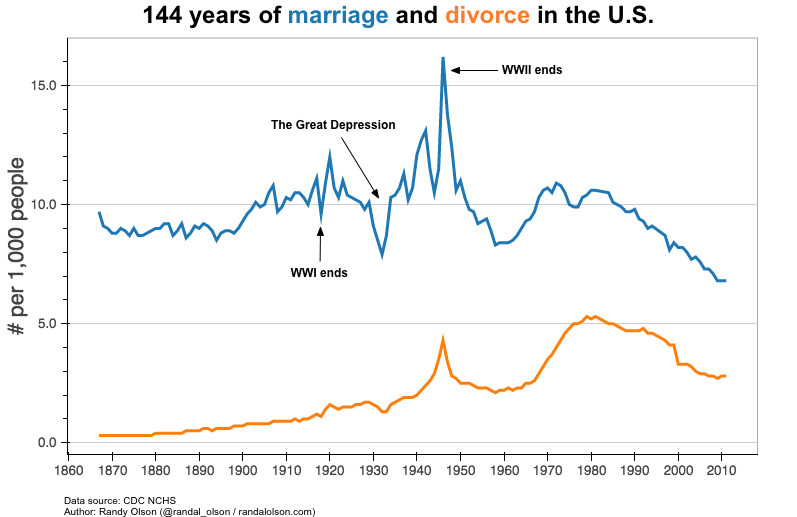
I was looking for a good analysis of why there’s been a decline of marriage and fatherhood, and I found an article by Joe Carter on far-left The Gospel Coalition, of all places. By looking at marriage rates and historical events that changed the marriage rate, he was able to identify the cause of the decline of marriage – and fatherhood.

Marriage and divorce rates per capita

I’ll spare you the statistical analysis, which is excellent, and give you the conclusion – although you can guess it from the graph above:

Now that we’ve explored the data, what year should we use as the marker for the beginning of the decline of marriage in the United States? I would argue for 1985, the last year that the marriage rate topped 10 percent.

[…]What changed in 1985 that could have led to the decline in marriage? There are likely numerous factors—which we’ll examine in future articles—but one stands out in particular: By 1985, all states (except for New York) had enacted no-fault divorce legislation.

The most helpful book I know of about no-fault divorce is “Taken Into Custody”, by Dr. Stephen Baskerville. He wrote a column  for Crisis magazine that summarizes some of his ideas.

Excerpt:

Feminists were drafting no-fault divorce laws in the 1940s, which the National Association of Women Lawyers now describes as “the greatest project NAWL has ever undertaken.”

The result effectively abolished marriage as a legal contract. Today it is not possible to form a binding agreement to create a family.

The new laws did not stop at removing the requirement of citing grounds for a divorce, to allow divorce by mutual consent, as deceptively advertised at the time. Instead they created unilateral and involuntary divorce, so that one spouse may dissolve a marriage without any agreement or fault by the other.

Here’s what divorce does to the spouse who is the victim of the unilateral “no-fault” divorce:

Though marriage is a civil matter, the logic quickly extended into the criminal, including a presumption of guilt against the involuntarily divorced spouse (“defendant”). Yet formal due process protections of criminal proceedings did not apply, so forcibly divorced spouses became quasi-criminals not for recognized criminal acts but for failing or refusing to cooperate with the divorce by continuing to claim the protections and prerogatives of family life: living in the common home, possessing the common property, or—most vexing of all—parenting the common children.

Following from this are the horrendous civil liberties violations and flagrant invasions of family and individual privacy that are now routine in family courts. A personalized criminal code is legislated by the judge around the forcibly divorced spouse, controlling their association with their children, movements, and finances. Unauthorized contact with their children can be punished with arrest. Involuntarily divorced parents are arrested for running into their children in public, making unauthorized telephone calls, and sending unauthorized birthday cards.

In my conversations with men, no-fault divorce laws, and anti-male divorce courts are the main reasons given for why they do not pursue marriage and fatherhood. Men do not want to be coerced in a marriage with the threat of divorce by an unhappy wife. Men do not want to be subject to the government in so many areas of their lives if the wife does carry out the threat. They especially don’t want to be separated from their children. One my secular male friends told me that he would not marry unless the woman had evidence in her past of hating radical feminism and no-fault divorce. This was the main criteria. He actually was able to find a woman who was a men’s rights activist who hated divorce. But that was the only way he would marry.

Statistically speaking, the wife is more likely to initiate divorce than the husband. Women initiate 70% of divorces, the majority of those just because she is “unhappy”. I think this is because women get into marriage based on their feelings, and they think that it is the husband’s job to make them feel good. They see their happiness as the primary goal of the marriage, and see a marriage that does not make them happy as a marriage that needs to be ended.

Are we going to repeal no-fault divorce, then?

No-fault divorce was seen as a boon to women who had married the wrong men by following their hearts. It’s an interesting question to ask whether women really would want no-fault repealed. It would mean that they would have to get serious about who they marry, instead of just getting into marriage based on feelings. They would have to evaluate men according to expectations of what a man does in a marriage, instead of on feelings. They would have to think about what men want out of a marriage, and prepare themselves to provide for his needs. They would have to say no to their feelings, when choosing a man, and in keeping a man after the wedding.

If women aren’t willing to demand the repeal of no-fault divorce laws and get serious about men and marriage, then what’s the point of complaining that men don’t want to marry and become fathers? If you’re not willing to fix the root cause of the problem, then don’t complain about the problem.