
Tag Archives: Fascism

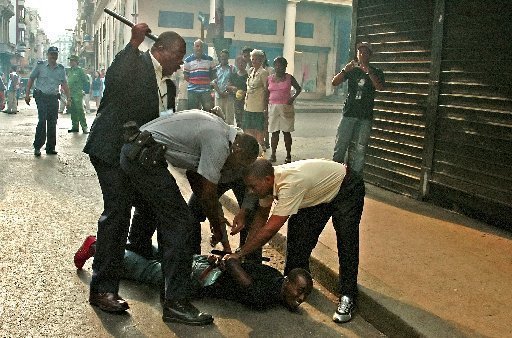
Communist Cuba’s violent suppression of dissenters under Fidel Castro

Communism in action: Cuban government arrests dissenter after a beating

My mother was watching CNN on Saturday, and she called to tell me that Sanjay Gupta was talking about the great healthcare in Cuba. Now, I know that CNN hires a lot of Marxists like Gupta and Zakaria, but many people may not realize how far left they are, and how that bias affects what they say on air. Let’s see what Cuba is really like using some evidence for a change.

The Daily Signal has the numbers on Cuba’s treatment of dissidents from a respected source:

As for the dissidents, the Obama administration has abandoned them. Many have told me they feel betrayed by our president, and by extension, by the United States. Guillermo Fariñas, especially, has a reason to feel betrayed, as Obama promised him personally at a meeting in 2013 that he would take no step toward re-establishing relations with Cuba without prior consultations with the opposition. This did not happen.

And dissidents have suffered the consequences. Political arrests have intensified since December of 2014. Throughout 2015, there were more than 8,616 documented political arrests in Cuba.

And in 2016? There already had been over 8,505 political arrests during the first eight months, and they are expected to top 10,000. This represents the highest rate of political arrests in decades and nearly quadruples the tally of political arrests throughout all of 2010 (2,074), early in Obama’s presidency.

These figures come from the Cuban Committee for Human Rights and National Reconciliation, which is recognized by Amnesty International, Freedom House, and other major human rights groups.

Shutting down communication with the outside world to cover up the arrests, the torture, the human rights abuses, the poverty, and the horribly ineffective health care:

And because Cuba’s communist leaders cannot allow Cubans to be in free contact with the outside world, internet connectivity has dropped. The International Telecommunication Union (ITU) has something called the Measuring the Information Society Report, which is the world’s most reliable source of data and analysis on global access to information and communication.

Last year, the International Telecommunication Union dropped Cuba’s ranking to 129 from 119. This means that Cuba actually has lower internet connectivity than some of the world’s most infamous suppressors of the internet, including Zimbabwe (which is 127), Syria (which is 117), Iran (91), China (82), and Venezuela (72).

What about Cuba’s health care system and economy? Didn’t Castro’s communist reforms make that better?

Investors Business Daily explains:

Before the revolution, Cuba had the 13th-lowest infant mortality rate in the world. It was lower than France, Belgium and West Germany. Today, it ranks about 40th. That still looks respectable, until you consider how it was accomplished: Cuba has one of the highest abortion rates in the world. At the first sign of any trouble when a woman is carrying a baby, it is aborted — regardless of the parents’ wishes.

That’s why their infant mortality rate isn’t even worse.

But surely health care for all is a major accomplishment, right?

No. As has been noted in many other places, Cuba has three separate health care systems. One for paying customers from places like the U.S., who go to Cuba for discount treatments of cosmetic surgery and the like.

There’s another for Cuba’s ruling Communist elite, also a good system. This is the health care system visiting journalists are taken to see, and that they later glowingly report on.

But there’s still another system for the rest — the average Cubans. It is abysmal, and even that might understate how bad it is.

“Cubans are not even allowed to visit those (elite) facilities,” according to the Web site The Real Cuba. “Cubans who require medical attention must go to other hospitals, that lack the most minimum requirements needed to take care of their patients.”

It goes on: “In addition, most of these facilities are filthy and patients have to bring their own towels, bed sheets, pillows, or they would have to lay down on dirty bare mattresses stained with blood and other body fluids.”

As for doctors, well, they make an average of about $25 to $35 a month. Many have to work second jobs to make ends meet, using substandard equipment. Drug shortages are rife. As a result, one of Cuba’s ongoing problems is that doctors leave as soon as they can for other countries, where they can make a decent living.

The country has over 30,000 doctors working overseas officially. Why? Out of kindness? No. The Castro regime earns an estimated $2.5 billion a year in hard currency from doctors working elsewhere, which means Cuba’s poor must go without decent care or access to doctors.

As for “universal literacy,” please. Primary and secondary schools are little more than Marxist indoctrination centers, where students are taught only what the state wants them to know. That’s how they keep people quiet.

Then there’s  Cuba’s higher education, in which “universities are training centers for bureaucrats, totally disconnected from the needs of today’s world. To enter the best careers and the best universities, people must be related to the bureaucratic elites, and also demonstrate a deep ideological conviction,” notes Colombian journalist Vanesa Vallejo, of the PanAm Post, a Latin American news site.

Nor is it “free.” In fact, those who graduate from college must work for a number of years for the government at a substandard wage of $9 a month. They are in effect slave labor. As with most “free” things the socialists offer, the price is very high and nonnegotiable.

In sum, Castro took a healthy country and made it sick. Those who glorify him deserve the scorn they get for propagating such a longstanding lie.

Regarding health care in Cuba, here are a couple of videos that were smuggled out of the actual health care system used by  ordinary Cubas:

And:

So, that’s the truth about Cuba – very different from what the regime itself and its wealthy supporters in Hollywood and the far left mainstream media want you to believe.

I’d really like to read what Mary Anastasia O’Grady has to say about the death of Castro in the Wall Street Journal, and I hope she writes about this story soon. UPDATE: Here it is, finally.

Before the rise of secularism, Americans believed in conscience

Dissent, disagreement, conscience and religious liberty
The importance of respecting the conscience of others

In the last 50 years, America exchanged religious liberty for hedonism. We used to believe that conscience was a good thing, and we respected individual differences rooted in religious convictions. But today, secular leftist politicians, lawyers and judges attack Christians using the courts. Pro-lifers, pro-marriage business owners, and people expressing Christian convictions in public have all felt what it is like to have conscience attacked by the secular leftist state.

Let’s take a look at what things were like in a different time when moral convictions had not been destroyed by secular leftism.

Consider this article in The Federalist about a new movie called “Hacksaw Ridge”.

Excerpt:

Over last weekend, I saw the new Mel Gibson flick “Hacksaw Ridge.” Gruesome and at times overshadowed by lead actor Andrew Garfield’s awkwardness, “Hacksaw Ridge” was an ode to the age-old American custom of protecting dissent by protecting the conscience.

In an age when attacks upon conscience and religious liberty grow more and more fiery, the true tale of World War II hero Desmond Doss’ conscientious objection to killing is a reminder of the difficult stakes involved in ensuring that individual liberty is the presumption that government takes toward individuals, even during war.

“Hacksaw Ridge” is the story of Doss, a Seventh Day Adventist whose religion prohibited taking the life of a fellow human being. Doss, obviously a patriot, felt obligated to serve in World War II as a medic. Where war is the business of taking life, Doss saw his role as helping save lives. That he does, as his heroism is on full display in his military record and receiving the Medal of Honor from President Truman.

The article has 6 sections.

The first one makes the point about how things have changed:

1. The Conscience Is Sacred

Doss arrived at his pacifism through religious conviction. It was an ethical precept he arrived at by religious devotion and piety, which means his pacifism was not something arbitrarily considered. Throughout the movie, the tattered Bible he carried with him everywhere he went symbolized the solemnity of his beliefs. Standing before a court martial, he was willing to go to jail for his convictions.

This is important today because so much hostility is based in rejecting religious motivation around contentious issues such as sexuality. Liberals are inclined to believe that any and all opposition to the ever-expanding lexicon of the sexual revolution is based in animus. That’s hogwash. Today’s dissenters from the sexual revolution have no use for animus. Rather, they believe the purposes of sexuality and human embodiment are different than what secular progressivism teaches.

Doss’ sincerity is a reminder that the convictions people arrive at by religious motivation are not designed to be capricious, but are ordered toward certain ends that people will naturally disagree about.

Part 3 was also good, because it explains efforts by Republicans to pass laws like the Religious Freedom Restoration Act – laws that are opposed by atheists in the Democrat party:

3. It’s Good to Accommodate People’s Consciences

When almost court-martialed for insubordination, Doss insists that his desire all along was to be a medic. This request was eventually approved. In the movie, we see the U.S. government preserve a man’s conscience by assigning him a duty that did not violate it. The U.S. government was right to accommodate Doss where accommodations can be made. In this move, it recommitted itself to an important principle at the heart of our constitutional system: The presumption of liberty.

This means it is government’s burden to prove infringing upon a person’s liberty is absolutely necessary. In Doss’ case, it was deemed unessential for him to carry a weapon, so he served in a different capacity. This is at the heart of legislation like the Religious Freedom Restoration Act, which puts the burden on the government to prove its case and make every last accommodation where possible.

The problem with people on the secular left today is that they have no empathy. For them, other people have no right to disagree because it makes them feel bad – but they don’t see how jail time and fines amounting to hundreds of thousands of dollars makes the victim of their legal attacks feel bad:

5. Protecting Conscience Means Developing Empathy for Others’ Convictions

As the movie’s plot develops, Doss’ fellow soldiers come to understand that his motives aren’t sinister. They realize that, when freed to live faithfully, Doss is there to help save their lives. Throughout this, and when they learn of his sincerity, his enemies-turned-friends gained a greater understanding of Doss’ convictions. They came to understand the force of his resolve, which dampens their mockery.

In one visceral scene in particular, Doss and the most intense warrior in his battalion are in a foxhole together. There, in seeing Doss’ devotion to sacrifice and conscience, his enemy-turned-friend makes lighthearted gestures recognizing that Doss’ motives are pure. In the crucible of conflict, progress occurs.

As in the case of Doss, protecting conscience doesn’t mean you will agree with the conscience you’re protecting. In fact, disagreement underscores the very need for protection. If conscience and religious liberty are simply ideas our society supports when popular, such protections are easily undone.

One of my favorite passages in the Bible talks about conscience.

1 Corinthians 4:2:

1 This is how one should regard us, as servants of Christ and stewards of the mysteries of God.

2 Moreover, it is required of stewards that they be found faithful.

3 But with me it is a very small thing that I should be judged by you or by any human court. In fact, I do not even judge myself.

4 For I am not aware of anything against myself, but I am not thereby acquitted. It is the Lord who judges me.

You can clearly see in today’s gay rights movement the problem with the government choosing to favor sinful behavior over religious liberty. People who are involved in sinful lifestyles don’t have the ability to do the right thing when it comes to respecting others. Engaging in a sinful lifestyle corrupts the ability to be respectful of the human rights of others. The desire to feel good and be approved of is seen as more important than respecting the right of others to disagree.

Who knows how far the secular left would go to punish dissenters from gay marriage? Although the media doesn’t cover it, there have been countless episodes of violence and vandalism, workplace persecution and job terminations, not to mention an armed attack by a domestic terrorist at the Family Research Council building. Because people in a sinful lifestyle don’t respect conscience rights of those who disagree. Conversely, when a person stands alone for a moral virtue (e.g. – chastity), there is no desire to compel others.

Belfast bakery sued by gay activist loses appeal and must pay £88,000

Gay activist vandalizes pro-marriage sign

I heard about this story from my friend Jonny in Northern Ireland, who sent me updates about new developments. I didn’t realize that the penalty for disagreeing with same-sex marriage was going to be over a hundred thousand dollars! Especially when, as the article mentions, same-sex marriage is not even legal in Northern Ireland.

NBC News reports.

Excerpt:

A Northern Irish bakery that refused to bake a cake iced with a pro-gay slogan lost its bid to overturn its prosecution for discrimination on Monday as a local court rejected an appeal based on its owners’ Christian beliefs.

Ashers Baking Co in Belfast had been found guilty of discrimination in May last year for refusing to make a cake bearing the words “Support Gay Marriage” and a picture of characters Bert and Ernie from the television show Sesame Street.

The firm initially accepted the order from Gareth Lee, a gay rights activist, but later contacted him to cancel it and refund his money. Judge Declan Morgan on Monday ruled the bakery had directly discriminated against Lee.

Northern Ireland is the only part of the United Kingdom where same-sex marriage is not allowed, and the largest political party, the socially conservative Democratic Unionist Party (DUP), has blocked attempts to legalize it.

By contrast the Republic of Ireland in May last year approved gay marriage after a referendum backed the measure, signaling a major change in what was once a strongly Catholic and socially conservative society.

[…]Daniel McArthur, general manager at Ashers, told journalists he was disappointed with the judgment, saying it undermined “democratic freedom, religious freedom and freedom of speech”.

Northern Ireland’s Equality Commission, which backed Lee’s case, said it is seeking costs of 88,000 pounds ($108,000) from the bakery, which said it is taking legal advice on what to do next.

The Belfast Telegraph notes that the bakery was not discriminating against a gay person – they did not know what the sexual orientation of the customer was. They simply objected to endorsing a message on a cake that they did not agree with.

Excerpt:

The McArthur family insisted they did not know the sexual orientation of Mr Lee, an LGBT activist, when declining his order.

The family insist their problem was with the cake, not the customer. But Mr Lee claimed it made him feel a lesser person.

However, on Monday morning the Court of Appeal upheld the original decision that Ashers Bakery had “directly discriminated”.

In delivering the appeal judgement, Northern Ireland’s Lord Chief Justice Sir Declan Morgan rejected the argument that the bakery would be endorsing the slogan by baking the cake.

He said: “The fact that a baker provides a cake for a particular team or portrays witches on a Halloween cake does not indicate any support for either.”

Lord Chief Justice said bakers couldn’t provide a service only to customers who agreed with their religious beliefs.

[…]After the ruling, speaking publicly for the first time, LGBT activist Gareth Lee said he was “grateful” for the outcome of the appeal.

Mr. Lee had feelings, and the Ashers got a hundred thousand dollar bill (payable to Northern Ireland’s Equality Commission) for hurting those feelings.

Keep in mind always that the Asher family is not just paying Northern Ireland’s Equality Commission. The family is also paying the salary of this judge with the income from their business. They are paying this secular judge from the secular leftist government to punish them for being faithful to their Biblical convictions. That’s why Christians should never vote to enlarge a secular government using money from private individuals and private businesses beyond what the Constitution limits the government to do.

I often hear Christians complain to me about why I am so focused on getting young people to study STEM degrees in school, to get jobs in STEM fields, and to save money and donate effectively.

Premier Christian Radio explains why money matters:

Throughout the legal battle Ashers has been supported by The Christian Institute, which has organised public rallies and garnered financial backing for the case.

Simon Calvert from the organisation pledged the family would not have to worry.

On Premier’s News Hour he said: “We [will] back the family all the way and so the family don’t have to worry about the cost.

“The Christian Institute legal defence fund has got that covered but, you know, that’s going to be a lot of money.”

The organisation had spent £200,000 itself in legal costs, he said.

“It is a lot of money, but Christians are concerned about the state of religious liberty in the UK and they have been willing to donate to our legal defence fund to help us to fight this case and cases like it,” he added.

The money to prosecute Christians came from Christians through taxes, and whatever is left over after taxes is used for the defense of Christians from the secular government. That’s why money matters. And that’s why Christians should not be voting to expand government, which raises tax rates, and shuts off the flow of dollars to organizations that defend Christians in court. It also shows why aliases are practical – the more you can fight the secularists without getting hit and incurring costs yourself, the more money there is for the people who are pinned down by the state and need assistance. You don’t want to be someone who has no money to donate, but asks for others to support you. Have the alias, then earn the money. Then you can donate to others, and not depend on them because you won’t be in legal trouble yourself. This is so simple, but many Christians don’t understand how to think about these financial issues.