A fine article by Aaron, who writes at Apologetics Junkie.
Excerpt:
A self-defeating (or self-refuting) statement is one that fails to meet its own standard. In other words, it is a statement that cannot live up to its own criteria. Imagine if I were to say,
I cannot speak a word in English.
You intuitively see a problem here. I told you in English that I cannot speak a word in English. This statement is self-refuting. It does not meet its own standard or criteria. It self-destructs.
The important thing to remember with self-defeating statements is that they are necessarily false. In other words, there is no possible way for them to be true. This is because they violate a very fundamental law of logic, the law of non-contradiction. This law states that A and non-A cannot both be true at the same time and in the same sense. For example, it is not possible for God to exist and not exist at the same time and in the same sense. This would violate the law of non-contradiction. So if I were to say, “God told me He doesn’t exist” you would see intuitively the obvious self-refuting nature of this statement.
Aaron goes on to explain how to deal with self-refuting statements in the article.
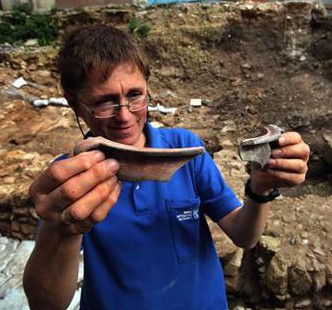
Israeli archaeologist Yardena Alexandre inspects Roman 1st-century pottery found from the city of Nazareth.
I was discussing a recent debate that a friend attended between an atheist musician named Dan Barker and a Christian with a doctorate in New Testament Studies named Justin Bass.
According to my friend’s report, the atheist questioned the existence of Nazareth, and then went on from there to assert that everything we know about Jesus is legendary.
This is what the atheist’s argument sounds like:
If the New Testament contains reliable history about Jesus, then Nazareth must exist.
Nazareth does not exist.
Therefore, the New Testaments does not contain reliable history about Jesus. (M.T. 1,2)
I was able to find a web site where an atheist was making the claim that Nazareth did not exist at the time of Jesus. So this is not completely outside the realm of mainstream atheism. I doubled checked with two more people who attended the debate that Barker indeed made an argument like the one above.
Two things to say about this 3-step argument. First off, when speaking to atheists, Christians only care about making a case for the resurrection. This is for two reasons. One, our goal is to disprove atheism, and the historical argument for the resurrection is the most evidenced miracle claim in the New Testament. Nazareth is not part of that core of minimal facts about the resurrection of Jesus. Second, it’s possible to be a Christian by accepting a core of Christian dogma (e.g. – the Apostle’s Creed), while remaining agnostic or even skeptical of other things in the Bible. Nazareth is not part of that core of minimal facts that must be affirmed in order to become a Christian.
The problem I have with atheists is that they pick and choose from the Bible according to their own agenda. Every Christian has read basic books on the resurrection by people like Lee Strobel, Michael Licona, William Lane Craig, J. Warner Wallace and so on. This is like table stakes for living a Christian life. We all know how to make a case based off of minimal facts for the resurrection. When Christians get into debates about Jesus, we want to make a case for the core of historical knowledge about him, minimal facts that almost no one disagrees with. But many atheists aren’t like that. They want to pick and choose a few verses out of the Old Testament and the New Testament that they personally find distasteful to them, and then deny the minimal facts about Jesus on that basis. I don’t think that it makes sense to deny evidence for widely-accepted facts by bringing up minor problems that are irrelevant to the well-attested core facts.
But it’s worse than that – we actually DO know that Nazareth existed, and we know it not from some fundamentalist preacher, but from atheist Bart Ehrman.
Ehrman writes in his book:
One supposedly legendary feature of the Gospels commonly discussed by mythicists is that the alleged hometown of Jesus, Nazareth did not exist but is itself a myth. The logic of this argument, which is sometimes advanced with considerable vehemence and force, appears to be that if Christians made up Jesus’ hometown, they probably made him up as well. I could dispose of this argument fairly easily by pointing out that it is irrelevant. If Jesus existed, as the evidence suggests, but Nazareth did not, as this assertion claims, then he merely came from somewhere else. Whether Barack Obama was born in the U.S. or not (for what it is worth, he was) is irrelevant to the question of whether he was born.
Since, however, this argument is so widely favored among mythicists, I want to give it a further look and deeper exploration. The most recent critic to dispute the existence of Nazareth is René Salm, who has devoted an entire book to the question, called The Myth of Nazareth. Salm sees this issue as highly significant and relevant to the question of the historicity of Jesus: “Upon that determination [i.e., the existence of Nazareth] depends a great deal, perhaps even the entire edifice of Christendom.”
So that seems like a fair representation of the argument I outlined above.
Bart’s response is long, but here’s part of it:
There are numerous compelling pieces of archaeological evidence that in fact Nazareth did exist in Jesus’ day, and that like other villages and towns in that part of Galilee, it was built on the hillside, near where the later rock-cut kokh tombs were built. For one thing, archaeologists have excavated a farm connected with the village, and it dates to the time of Jesus. Salm disputes the finding of the archaeologists who did the excavation (it needs to be remembered, he himself is not an archaeologist but is simply basing his views on what the real archaeologists – all of whom disagree with him — have to say). For one thing, when archaeologist Yardena Alexandre indicated that 165 coins were found in this excavation, she specified in the report that some of them were late, from the fourteenth or fifteenth centuries. This suits Salm’s purposes just fine. But as it turns out, there were among the coins some that date to the Hellenistic, Hasmonean, and early Roman period, that is, the days of Jesus. Salm objected that this was not in Alexandre’s report, but Alexandre has verbally confirmed (to me personally) that in fact it is the case: there were coins in the collection that date to the time prior to the Jewish uprising.
Aalm also claims that the pottery found on the site that is dated to the time of Jesus is not really from this period, even though he is not an expert on pottery. Two archaeologists who reply to Salm’s protestations say the following: “Salm’s personal evaluation of the pottery … reveals his lack of expertise in the area as well as his lack of serious research in the sources.” They go on to state: “By ignoring or dismissing solid ceramic, numismatic [that is, coins], and literary evidence for Nazareth’s existence during the Late Hellenisitic and Early Roman period, it would appear that the analysis which René Salm includes in his review, and his recent book must, in itself, be relegated to the realm of ‘myth.’”
Read Bart’s whole excerpt from his book in his post.
I did a quick double check on the archaeologist Ehrman mentioned, and found an Associated Press story about another archaelogical discovery made by archaeologists in Nazareth. This time, it’s not the coins, but pottery fragments. The date range on the pottery is 100 before Jesus’ birth to 100 years after Jesus’ birth.
Even though Ehrman is an atheist, I think that he understands how to do history. You can’t be a credentialed historian and throw out the early proclamation of Jesus’ resurrection because of doubts about Old Testament violence. You can’t be a credentialed historian and throw out the conversions of Paul and James because you don’t know whether there was one angel or two angels at the empty tomb. Denying the core facts about Jesus by bringing up concerns about peripheral issues is not a responsible way to investigate the historical Jesus.
One final point. This happens when discussing scientific evidence with atheists, too. I was discussing the scientific evidence for the origin of the universe and the cosmic fine-tuning with an atheist – mentioning names, dates and places related to the discoveries – and she cut me off with “Am I going to Hell?”
Prior to certain scientific discoveries, most people thought that the universe had always been here, and no need to ask who or what may have caused it. But today, that’s all changed. Today, the standard model of the origin of the universe is that all the matter and energy in the universe came into being in an event scientists call “The Big Bang”. At the creation event, space and time themselves began to exist, and there is no material reality that preceded them.
So a couple of quotes to show that.
An initial cosmological singularity… forms a past temporal extremity to the universe. We cannot continue physical reasoning, or even the concept of spacetime, through such an extremity… On this view the big bang represents the creation event; the creation not only of all the matter and energy in the universe, but also of spacetime itself.
Source: P. C. W. Davies, “Spacetime Singularities in Cosmology,” in The Study of Time III, ed. J. T. Fraser (Berlin: Springer Verlag ).
And another quote:
[A]lmost everyone now believes that the universe, and time itself, had a beginning at the big bang.
Source: Stephen Hawking and Roger Penrose, The Nature of Space and Time, The Isaac Newton Institute Series of Lectures (Princeton, N. J.: Princeton University Press, 1996), p. 20.
So, there are several scientific discoveries that led scientists to accept the creation event, and one of the most interesting and famous is the discovery of how elements heavier than hydrogen were formed.
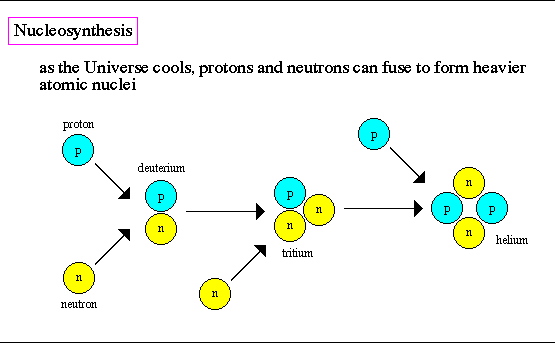
Nucleosynthesis: forming heavier elements by fusion
The term nucleosynthesis refers to the formation of heavier elements, atomic nuclei with many protons and neutrons, from the fusion of lighter elements. The Big Bang theory predicts that the early universe was a very hot place. One second after the Big Bang, the temperature of the universe was roughly 10 billion degrees and was filled with a sea of neutrons, protons, electrons, anti-electrons (positrons), photons and neutrinos. As the universe cooled, the neutrons either decayed into protons and electrons or combined with protons to make deuterium (an isotope of hydrogen). During the first three minutes of the universe, most of the deuterium combined to make helium. Trace amounts of lithium were also produced at this time. This process of light element formation in the early universe is called “Big Bang nucleosynthesis” (BBN).
The creation hypothesis predicts that there will be specific amounts of these light elements formed as the universe cools down. Do the predictions match with observations?
Yes they do:
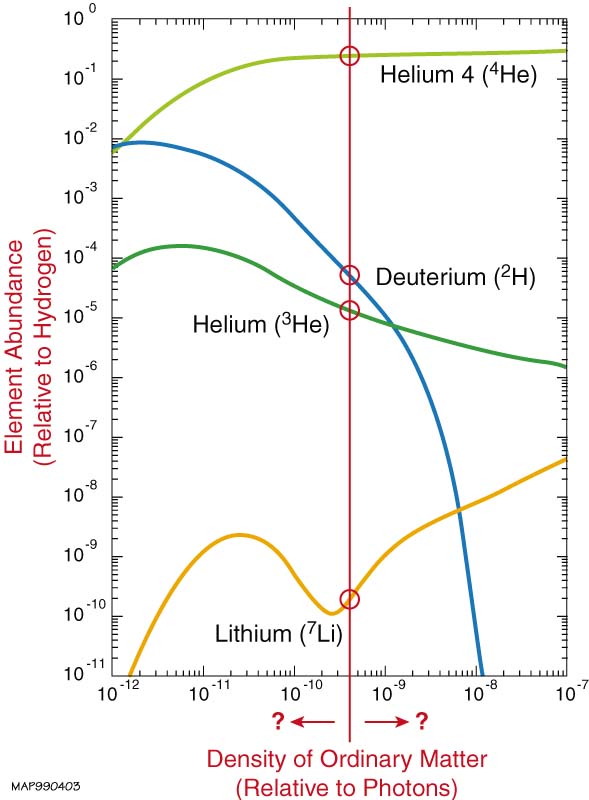
The predicted abundance of deuterium, helium and lithium depends on the density of ordinary matter in the early universe, as shown in the figure at left. These results indicate that the yield of helium is relatively insensitive to the abundance of ordinary matter, above a certain threshold. We generically expect about 24% of the ordinary matter in the universe to be helium produced in the Big Bang. This is in very good agreement with observations and is another major triumph for the Big Bang theory.
Moreover, WMAP satellite measurements of mass density agree with our observations of these light element abundances.
Here are the observations from the WMAP satellite:
Scientific observations match predictions
And here is how those WMAP measurements confirm the Big Bang creation event:
However, the Big Bang model can be tested further. Given a precise measurement of the abundance of ordinary matter, the predicted abundances of the other light elements becomes highly constrained. The WMAP satellite is able to directly measure the ordinary matter density and finds a value of 4.6% (±0.2%), indicated by the vertical red line in the graph. This leads to predicted abundances shown by the circles in the graph, which are in good agreement with observed abundances. This is an important and detailed test of nucleosynthesis and is further evidence in support of the Big Bang theory.
“An important and detailed test”.
For completeness, we should learn how elements heavier than these light elements are formed:
Elements heavier than lithium are all synthesized in stars. During the late stages of stellar evolution, massive stars burn helium to carbon, oxygen, silicon, sulfur, and iron. Elements heavier than iron are produced in two ways: in the outer envelopes of super-giant stars and in the explosion of a supernovae. All carbon-based life on Earth is literally composed of stardust.
That’s a wonderful thing to tell a young lady when you are on a date: “your body is made of stardust”. In fact, as I have argued before, this star formation, which creates the elements necessary for intelligent life, can only be built if the fundamental constants and quantities in the universe are finely-tuned.
Now, you would think that atheists would be happy to find observations that confirm the origin of the universe out of nothing, but they are not. Actually, they are in denial.
Here’s a statement from the Secular Humanist Manifesto, which explains what atheists believe about the universe:
Religious humanists regard the universe as self-existing and not created.
For a couple of examples of how atheistic scientists respond to the evidence for a cosmic beginning, you can check out this post, where we get responses from cosmologist Lawrence Krauss, and physical chemist Peter Atkins.
You cannot have the creation of the universe be true AND a self-existing, eternal universe ALSO be true. Someone has to be wrong. Either the science is wrong, or the atheist manifesto is wrong. I know where I stand.



 WINTERY KNIGHT