Tag Archives: Europe

Which health care system is better? Canada or the United States?

Story from the Hoover Institute at Stanford University.

The article compares (pre-Obamacare) American health care to health care in other places like Canada, the UK and Europe.

The full article. I almost never cite the full article, but this is a must read. Men, pay close attention to the differences in prostate cancer treatment rates in a for-profit system versus a single-payer system, where bureaucrats decide who gets treatment.

MEDICINE AND HEALTH:

Here’s a Second Opinion

By Scott W. Atlas

Ten reasons why America’s health care system is in better condition than you might suppose. By Scott W. Atlas.

Medical care in the United States is derided as miserable compared to health care systems in the rest of the developed world. Economists, government officials, insurers, and academics beat the drum for a far larger government role in health care. Much of the public assumes that their arguments are sound because the calls for change are so ubiquitous and the topic so complex. Before we turn to government as the solution, however, we should consider some unheralded facts about America’s health care system.1. Americans have better survival rates than Europeans for common cancers.Breast cancer mortality is 52 percent higher in Germany than in the United States and 88 percent higher in the United Kingdom. Prostate cancer mortality is 604 percent higher in the United Kingdom and 457 percent higher in Norway. The mortality rate for colorectal cancer among British men and women is about 40 percent higher.2. Americans have lower cancer mortality rates than Canadians.Breast cancer mortality in Canada is 9 percent higher than in the United States, prostate cancer is 184 percent higher, and colon cancer among men is about 10 percent higher.3. Americans have better access to treatment for chronic diseases than patients in other developed countries. Some 56 percent of Americans who could benefit from statin drugs, which reduce cholesterol and protect against heart disease, are taking them. By comparison, of those patients who could benefit from these drugs, only 36 percent of the Dutch, 29 percent of the Swiss, 26 percent of Germans, 23 percent of Britons, and 17 percent of Italians receive them.

4. Americans have better access to preventive cancer screening than Canadians. Take the proportion of the appropriate-age population groups who have received recommended tests for breast, cervical, prostate, and colon cancer:

  • Nine out of ten middle-aged American women (89 percent) have had a mammogram, compared to fewer than three-fourths of Canadians (72 percent).
  • Nearly all American women (96 percent) have had a Pap smear, compared to fewer than 90 percent of Canadians.
  • More than half of American men (54 percent) have had a prostatespecific antigen (PSA) test, compared to fewer than one in six Canadians (16 percent).
  • Nearly one-third of Americans (30 percent) have had a colonoscopy, compared with fewer than one in twenty Canadians (5 percent).

5. Lower-income Americans are in better health than comparable Canadians. Twice as many American seniors with below-median incomes self-report “excellent” health (11.7 percent) compared to Canadian seniors (5.8 percent). Conversely, white, young Canadian adults with below-median incomes are 20 percent more likely than lower-income Americans to describe their health as “fair or poor.”

6. Americans spend less time waiting for care than patients in Canada and the United Kingdom. Canadian and British patients wait about twice as long—sometimes more than a year—to see a specialist, have elective surgery such as hip replacements, or get radiation treatment for cancer. All told, 827,429 people are waiting for some type of procedure in Canada. In Britain, nearly 1.8 million people are waiting for a hospital admission or outpatient treatment.

7. People in countries with more government control of health care are highly dissatisfied and believe reform is needed. More than 70 percent of German, Canadian, Australian, New Zealand, and British adults say their health system needs either “fundamental change” or “complete rebuilding.”

8. Americans are more satisfied with the care they receive than Canadians. When asked about their own health care instead of the “health care system,” more than half of Americans (51.3 percent) are very satisfied with their health care services, compared with only 41.5 percent of Canadians; a lower proportion of Americans are dissatisfied (6.8 percent) than Canadians (8.5 percent).

9. Americans have better access to important new technologies such as medical imaging than do patients in Canada or Britain. An overwhelming majority of leading American physicians identify computerized tomography (CT) and magnetic resonance imaging (MRI) as the most important medical innovations for improving patient care during the previous decade—even as economists and policy makers unfamiliar with actual medical practice decry these techniques as wasteful. The United States has thirty-four CT scanners per million Americans, compared to twelve in Canada and eight in Britain. The United States has almost twenty-seven MRI machines per million people compared to about six per million in Canada and Britain.

10. Americans are responsible for the vast majority of all health care innovations. The top five U.S. hospitals conduct more clinical trials than all the hospitals in any other developed country. Since the mid- 1970s, the Nobel Prize in medicine or physiology has gone to U.S. residents more often than recipients from all other countries combined. In only five of the past thirty-four years did a scientist living in the United States not win or share in the prize. Most important recent medical innovations were developed in the United States.

Despite serious challenges, such as escalating costs and care for the uninsured, the U.S. health care system compares favorably to those in other developed countries.

This essay appeared on the website of the National Center for Policy Analysis on March 24, 2009. An earlier version was published in the Washington Times.Available from the Hoover Press is Power to the Patient: Selected Health Care Issues and Policy Solutions, edited by Scott W. Atlas. To order, call 800.935.2882 or visit www.hooverpress.org.

Scott W. Atlas is a senior fellow at the Hoover Institution and a professor of radiology and chief of neuroradiology at Stanford University Medical School.

Please forward this article to all of your friends! It’s important!

Correcting four myths about the Crusades

Here is an interesting article from First Principles Journal. (H/T First Things)

Intro:

The verdict seems unanimous. From presidential speeches to role-playing games, the crusades are depicted as a deplorably violent episode in which thuggish Westerners trundled off, unprovoked, to murder and pillage peace-loving, sophisticated Muslims, laying down patterns of outrageous oppression that would be repeated throughout subsequent history. In many corners of the Western world today, this view is too commonplace and apparently obvious even to be challenged.

But unanimity is not a guarantee of accuracy. What everyone “knows” about the crusades may not, in fact, be true. From the many popular notions about the crusades, let us pick four and see if they bear close examination.

The four myths:

  • Myth #1: The crusades represented an unprovoked attack by Western Christians on the Muslim world.
  • Myth #2: Western Christians went on crusade because their greed led them to plunder Muslims in order to get rich.
  • Myth #3: Crusaders were a cynical lot who did not really believe their own religious propaganda; rather, they had ulterior, materialistic motives.
  • Myth #4: The crusades taught Muslims to hate and attack Christians.

Here’s the most obvious thing you should know. The Crusades were defensive actions:

In a.d. 632, Egypt, Palestine, Syria, Asia Minor, North Africa, Spain, France, Italy, and the islands of Sicily, Sardinia, and Corsica were all Christian territories. Inside the boundaries of the Roman Empire, which was still fully functional in the eastern Mediterranean, orthodox Christianity was the official, and overwhelmingly majority, religion. Outside those boundaries were other large Christian communities—not necessarily orthodox and Catholic, but still Christian. Most of the Christian population of Persia, for example, was Nestorian. Certainly there were many Christian communities in Arabia.

By a.d. 732, a century later, Christians had lost Egypt, Palestine, Syria, North Africa, Spain, most of Asia Minor, and southern France. Italy and her associated islands were under threat, and the islands would come under Muslim rule in the next century. The Christian communities of Arabia were entirely destroyed in or shortly after 633, when Jews and Christians alike were expelled from the peninsula.6 Those in Persia were under severe pressure. Two-thirds of the formerly Roman Christian world was now ruled by Muslims.

What had happened? Most people actually know the answer, if pressed—though for some reason they do not usually connect the answer with the crusades. The answer is the rise of Islam. Every one of the listed regions was taken, within the space of a hundred years, from Christian control by violence, in the course of military campaigns deliberately designed to expand Muslim territory at the expense of Islam’s neighbors. Nor did this conclude Islam’s program of conquest. The attacks continued, punctuated from time to time by Christian attempts to push back. Charlemagne blocked the Muslim advance in far western Europe in about a.d. 800, but Islamic forces simply shifted their focus and began to island-hop across from North Africa toward Italy and the French coast, attacking the Italian mainland by 837. A confused struggle for control of southern and central Italy continued for the rest of the ninth century and into the tenth. In the hundred years between 850 and 950, Benedictine monks were driven out of ancient monasteries, the Papal States were overrun, and Muslim pirate bases were established along the coast of northern Italy and southern France, from which attacks on the deep inland were launched. Desperate to protect victimized Christians, popes became involved in the tenth and early eleventh centuries in directing the defense of the territory around them.

This is always good to know for when you are answering Muslims.

Unemployment rate in socialist Spain now above 20%

Map of Europe
Map of Europe

Here’s the story from Yahoo News.

Excerpt:

Spain announced Friday its jobless rate surged to a 13-year record above 20 percent at the end of 2010, the highest level in the industrialized world, as the economy struggled for air.

It was more bad news for an economy fighting to regain the trust of financial markets and avoid being trapped in a debt quagmire that has engulfed Greece and Ireland and now menaces Portugal.

Another 121,900 people joined Spain’s unemployment queues in the final quarter of the year, pushing the total to 4.697 million people, said the national statistics institute INE.

The resulting unemployment rate was 20.33 percent for the end of the year — easily exceeding Prime Minister Jose Luis Rodriguez Zapatero’s target of 19.4 percent.

Spain appears to be stuck in a rut of staggeringly high levels of unemployment.

After posting a jobless rate of 18.83 percent in 2009 and now 20.33 percent in 2010, the government is forecasting 19.3 percent for 2011 and 17.5 percent in 2012.

The Spanish economy, the European Union’s fifth biggest, slumped into recession during the second half of 2008 as the global financial meltdown compounded the collapse of a labour-intensive construction boom

It emerged with tepid growth of just 0.1 percent in the first quarter of 2010 and 0.2 percent in the second but then stalled with zero growth in the third.

Zapatero has said the fourth quarter will show positive growth which would pick up steam in 2011 but he warned that job creation would be “far from what we need and desire. It will be slow and progressive.”

Remember that Spain elected Jose Luis Rodriguez Zapatero in April 2004, who is a member of the Spanish Socialist Workers’ Party, which is very similar in policy to Barack Obama and the Democrats.  Let’s see what has happened in Spain. (H/T Spain Economy Watch)

Unemployment:

Spain Unemployment Rate

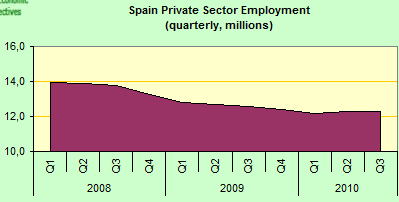
Private sector employment:

Spain Employment Rate - Private Sector
Spain Employment - Private Sector

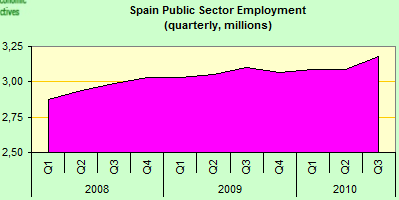
Public sector employment:

Spain Employment - Public Sector

So what do we learn from this?

Well, the public sector doesn’t really sell any products or services, so they don’t really have any customers to please, nor do they have any revenue. They exist by confiscating the wealth of other people (in the private sector) who do have products and services to sell, and do have customers to please. The governments job is to HELP the people in the private sector and not to raise their taxes, or control them, or get in their way except to make sure that they compete fairly and honestly with other people in the private sector. When government oversteps their bounds by raising taxes too high and spending too much, they stop acting like a REFEREE and start acting more like a PARASITE.

You’ll note that Obama is also spending trillions of dollars on government boondoggles – and where is our unemployment rate now?