
Tag Archives: Europe

Top ten foreign policy and national security issues for 2012

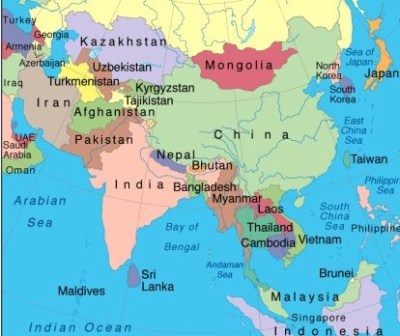
Map of Asia
Map of Asia

From the American Enterprise Institute.

Here’s the list:

  1. Iran, and the American retreat from Iraq
  2. Dealing with Islam and China in South Asia
  3. America’s strategy for Pakistan
  4. Defense spending priorities
  5. American support for Israel
  6. The Islamization of Turkey
  7. Collapse of the European economies
  8. Demographic crisis in Europe
  9. Demographic crisis in Russia
  10. Strategy for the Middle East

They have one article linked for each topic, so I chose the Islamization of Turkey.

Full text:

Turkey was a key American ally throughout the Cold War. As one of only two NATO countries to share a border with the Soviet Union, Turkey proved pivotal not only to the defense of Europe but also for American interests in Asia. The Turkish army fought alongside U.S. troops in Korea. Americans embraced Turkey not only for its strategic role, but also for its values. The Turkish government was decidedly Western-leaning. Turkey may have been majority Muslim, but most Turks saw their future tied more to the West than the Middle East.

Over the past nine years, however, Turkey has changed. No longer can Turkey be called a democracy. The Pew Global Attitudes Project now ranks Turkey as the most anti-American country it surveys. Reporters Without Frontiers ranks Turkish press freedom below even Zimbabwe and Venezuela. Turkey has imprisoned more journalists than even China and Iran. As Prime Minister Recep Tayyip Erdoğan has sought to Islamize society, Turkish women have lost both their equality and safety: The murder rate of women has increased 1,400 percent since Erdoğan’s Justice and Development Party took power.

Erdoğan has reoriented Turkey’s foreign policy as well. Turkey now not only embraces the Arab world, but it allies itself with its more radical factions: Turkey endorses Hamas, Hezbollah, Sudan’s genocidal dictator Omar al-Bashir, and the Islamic Republic of Iran. Whereas a decade ago, the alliance between Turkey and Israel stabilized the Eastern Mediterranean, today diplomats worry that Turkey’s antagonism toward both Israel and Cyprus could lead to military conflict in the region. In September 2010, Turkey raised eyebrows at the Pentagon when it held secret war games with the Chinese air force without first alerting Washington. Because Turkey increasingly is the obstacle to NATO consensus, its future in the defensive alliance may now be open to question.

Any new president will be faced with serious decisions regarding Turkey. Should Turkey remain in NATO? If so, should the United States share its next generation F-35 Joint Strike Fighters, Predators, and AWACS aircraft with Turkey? Lastly, if Erdoğan fulfills his promise to use the Turkish navy to challenge Israel’s blockade of Gaza, leading to a fight between two traditional American allies, on whose side will the White House be, and what actions would the new president take?

This is a primer, so the articles are fairly short. Just enough to give you background information on the hot spots that the next President will have to deal with. Can you think of any issues they left out? I think that we should also be concerned with the drug cartels in Mexico, the continuous sabre-rattling from Venezuela, threats to our Asian allies from China, and whether we still need to have so many troops in Europe and South Korea.

It’s good for Christians to have some awareness of national security and foreign policy issues. It only takes an hour to read a few articles and to have some understanding of the issues we are facing, so that we can discuss them with others and vote properly. There’s going to be a foreign policy debate for the GOP primary on November 22, 2011, so it would be good for us to study up so we can understand what they are talking about.
Economists: Jobs outlook the worst since January 2010

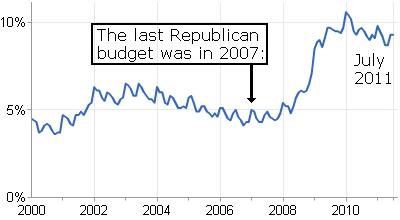
Unemployment Rate (Not seasonally adusted)

From Bloomberg Businessweek.

Excerpt:

U.S. companies’ hiring plans reflect the worst employment outlook since January 2010 as demand slows in the world’s largest economy, a private survey showed.

Fewer companies project payrolls to rise in the next six months compared with a July survey, while more plan to cut workers, the National Association for Business Economics said today in Washington. The share of firms planning to raise prices was the smallest in almost two years.

Businesses are concerned about the European debt crisis, with 30 percent of participants anticipating it will cause a decline in sales through early 2012, the survey showed. While companies said they expect the U.S. will keep expanding, they trimmed projections for the pace of growth and pared capital spending plans, helping explain why the recovery has failed to gain momentum.

“Expectations are muted,” Shawn DuBravac, chief economist at the Consumer Electronics Association in Arlington, Virginia, who analyzed the results, said in a statement. The latest survey’s “respondents remain cautiously confident.”

Within the employment outlook, 29 percent of companies said they would increase hiring, down from 43 percent in July, while 59 percent reported they plan no change in staff, a 10-point jump.

[…]The dimming outlook for employment and investment stems from the slowdown in growth. Eighty-five percent of companies surveyed said that the economy may expand 2 percent or less in the period ending this quarter compared with the final three months of 2010. In the prior survey, just one of every five economists polled predicted growth would be that slow.

The debt crisis in Europe already is hurting U.S. firms and is likely to continue, according to a special question in the latest survey, conducted between Sept. 20 and Oct. 5. Twenty percent of participants reported developments in Europe have led to as much as a 10 percent drop in sales so far this year.

This is not a surprise. Aside from signing the three free trade deals with Colombia, Panama and South Korea, the Obama administration has done everything wrong with respect to stimulating economic growth – the necessary precursor for private sector job creation.

Were the Crusades unprovoked attacks against peaceful Muslims?

Here’s an article from a historian specialized in the history of the Crusades.

Excerpt:

For starters, the Crusades to the East were in every way defensive wars. They were a direct response to Muslim aggression—an attempt to turn back or defend against Muslim conquests of Christian lands.

Christians in the eleventh century were not paranoid fanatics. Muslims really were gunning for them. While Muslims can be peaceful, Islam was born in war and grew the same way. From the time of Mohammed, the means of Muslim expansion was always the sword. Muslim thought divides the world into two spheres, the Abode of Islam and the Abode of War. Christianity—and for that matter any other non-Muslim religion—has no abode. Christians and Jews can be tolerated within a Muslim state under Muslim rule. But, in traditional Islam, Christian and Jewish states must be destroyed and their lands conquered. When Mohammed was waging war against Mecca in the seventh century, Christianity was the dominant religion of power and wealth. As the faith of the Roman Empire, it spanned the entire Mediterranean, including the Middle East, where it was born. The Christian world, therefore, was a prime target for the earliest caliphs, and it would remain so for Muslim leaders for the next thousand years.

With enormous energy, the warriors of Islam struck out against the Christians shortly after Mohammed’s death. They were extremely successful. Palestine, Syria, and Egypt—once the most heavily Christian areas in the world—quickly succumbed. By the eighth century, Muslim armies had conquered all of Christian North Africa and Spain. In the eleventh century, the Seljuk Turks conquered Asia Minor (modern Turkey), which had been Christian since the time of St. Paul. The old Roman Empire, known to modern historians as the Byzantine Empire, was reduced to little more than Greece. In desperation, the emperor in Constantinople sent word to the Christians of western Europe asking them to aid their brothers and sisters in the East.

That is what gave birth to the Crusades. They were not the brainchild of an ambitious pope or rapacious knights but a response to more than four centuries of conquests in which Muslims had already captured two-thirds of the old Christian world. At some point, Christianity as a faith and a culture had to defend itself or be subsumed by Islam. The Crusades were that defense.

Pope Urban II called upon the knights of Christendom to push back the conquests of Islam at the Council of Clermont in 1095. The response was tremendous. Many thousands of warriors took the vow of the cross and prepared for war. Why did they do it? The answer to that question has been badly misunderstood. In the wake of the Enlightenment, it was usually asserted that Crusaders were merely lacklands and ne’er-do-wells who took advantage of an opportunity to rob and pillage in a faraway land. The Crusaders’ expressed sentiments of piety, self-sacrifice, and love for God were obviously not to be taken seriously. They were only a front for darker designs.

During the past two decades, computer-assisted charter studies have demolished that contrivance. Scholars have discovered that crusading knights were generally wealthy men with plenty of their own land in Europe. Nevertheless, they willingly gave up everything to undertake the holy mission. Crusading was not cheap. Even wealthy lords could easily impoverish themselves and their families by joining a Crusade. They did so not because they expected material wealth (which many of them had already) but because they hoped to store up treasure where rust and moth could not corrupt. They were keenly aware of their sinfulness and eager to undertake the hardships of the Crusade as a penitential act of charity and love. Europe is littered with thousands of medieval charters attesting to these sentiments, charters in which these men still speak to us today if we will listen. Of course, they were not opposed to capturing booty if it could be had. But the truth is that the Crusades were notoriously bad for plunder. A few people got rich, but the vast majority returned with nothing.

Since this question comes up in apologetics, and even William Lane Craig screws it up by calling the Crusades evil, I thought it might be a good idea for us to have some background so that we would be able to set the record straight if it’s called into question. It’s important to know this because a lot of people appeal to the Crusades to take shots at Christianity and introduce a kind of moral equivalence that excuses real wars of aggression and real terrorism.

The article also includes some of the real mistakes made by some of the Crusaders, so be ready to own up to those.