Tag Archives: Europe

Why do so many people vote for the Democrat party?

ECM sent me this article from National Review that explains why so many people vote Democrat.

Excerpt:

First, we should recognize that the War on Poverty is now a huge budget item. According to calculations by the Congressional Research Service and the Senate Budget Committee, taxpayers coughed up over $1 trillion in federal and state-provided benefits in 2011. These benefits flow to tens of millions of voters and cover the waterfront, offering low-income Americans everything from cash assistance to food, housing, and medical care, not to mention help with education, transportation, home-heating costs, and child care. Spending on these programs has soared more than 40 percent since 2007. That’s an unsustainable trajectory.

Then we get some facts from a Wall Street Journal article on the topic:

  • The percentage of the American labor force drawing disability benefits from the government has doubled since 1992, from 3 percent to 6 percent. They further note: “The number of workers qualifying for disability since the recession ended in 2009 has grown twice as fast as private employment.”
  • During the last four years, the Obama administration’s aggressive promotion of the food-stamp program has increased the number of recipients by 18.5 million.
  • Unemployment insurance that lasted no longer than 55 weeks in 1980 and 72 weeks in 1992 now can last 99 weeks. Some 40 percent of unemployed workers have been out of work for more than half a year.

And how does it affect voting?:

The Battleground Polls conducted by the Tarrance Group on behalf of George Washington University and Politico make this level of detail readily available. The poll helpfully divides its sample of likely voters into, among other things, those who self-identify as either “low income” or “middle class.”

So, what do we know about these voters?

  • Those who self-identify as “low income” are more likely to be unemployed, frustrated over the state of the economy, and pessimistic over the general direction of our country than are those with higher incomes. Yet the Battleground Poll indicates they are more Why do people likely than those who identify as middle class to believe the country is heading in the right direction (42 percent vs. 35 percent).
  • Do welfare benefits insulate these voters from the sort of economic concerns that plague middle-class voters? Apparently so. Compared with their middle-class counterparts, far fewer low-income voters cite pocketbook issues as their number-one concern (53 percent vs.74 percent). Middle-class voters are, almost by definition, far more likely to pay taxes than low-income voters. Unsurprisingly, they are much more likely to list the economy and the level of spending and deficits as their most important concern (28 percent and 17 percent, respectively) than low-income Americans. Among the latter group, only 20 percent say the economy is most important, and a mere 7 percent worry about spending and deficits. Again, this is not surprising, considering that, for most low-income Americans, government benefits come with no strings attached, and at little or no cost in taxes.
  • In contrast, low-income Americans cite Medicare, Social Security, and education benefits as their number-one issue (29 percent in all) more than twice as frequently as do middle-class voters (only 13 percent).
  • If the receipt of welfare benefits affects voters’ views of the economy and alters the equation they use to judge candidates, one would expect them to give the president high marks for how he has handled the most stagnant and underperforming economy in over half a century. And, indeed, that is the case. By a margin of 51 percent to 37 percent low-income voters prefer Obama over Romney on this measure. They prefer Obama by an even more lopsided margin, 55 percent to 37 percent, on the issue of jobs. In contrast, Romney wins big among middle-class voters on these concerns (56 percent to 41 percent on handling the economy, and 54 percent to 43 percent on jobs).

These people aren’t voting for any high and noble reason. They want money. It’s just greed. Greed is why people vote Democrat.

Elusive Wapiti adds:

It makes sense, really. The 47% vote their pocketbook too… the issue comes from the pocketbook being oriented in the opposite direction. Government largesse fills their wallet, whilst draining the bankbooks of the 53%. They are the “zero liability” voter; they are insulated from the costs of the programs and candidates they vote for… but they are understandably quite concerned with ensuring the payouts continue.

You need to get out there today and vote for Mitt Romney to stop the downward spiral into dependency and bankruptcy that we can see in countries like Greece, Spain and Italy. We can see it happening over there, don’t let it happen here.
On wargames, history and heroes: “this story shall the good man teach his son”

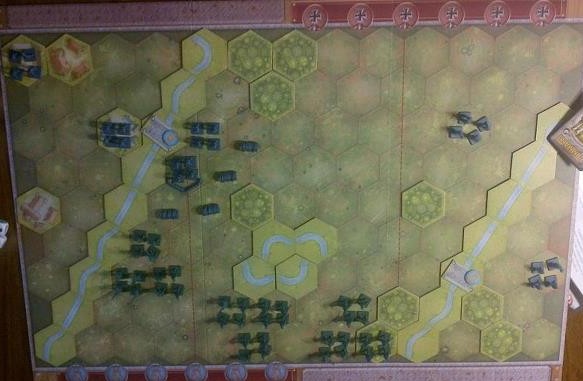
Memoir '44: Pegasus Bridge setup
Memoir ’44: Pegasus Bridge setup

Last night, I played through the Pegasus Bridge scenario from the Memoir ’44 wargame with Dina a few times. We actually played the online version of the game, using Steam. She was very gracious to play a wargame with me, which I don’t think is necessarily the first thing on most women’s lists of things to do on a Thursday night! I appreciated her agreeing to learn how to play and then playing with me several times. I think that Christians need to plan and execute more “together” activities like that – activities that involve interaction, co-operation, communication and engagement. We try to avoid doing things where we are both spectators. Playing wargames is not the only thing we do – we also do Bible study and cooking lessons (for me), for example.

Anyway, the point of this post is to express the deeper meaning behind playing wargames. I think that it is important to recognize and celebrate those who have demonstrated good character, whether it be now, or in the past. I think that it is important for us to search out the best role models ourselves, so that they will influence the way we act in our own lives. The second world war was a clear example of good versus evil. Anyone on the Allied side who demonstrated bravery and courage should be celebrated for safeguarding the security, liberty and prosperity that we enjoy today. In the case of Pegasus bridge, the hero is Major John Howard of the British paratroops.

Here is a quick re-cap of his exploits that day from the New York Times:

Maj. John Howard, the commander of glider-borne British infantrymen who seized the strategically vital Pegasus Bridge in the first battle of the D-Day invasion of Normandy, died Wednesday in a hospital in Surrey, England. He was 86 and had lived in Burford, near Oxford.

Under cover of night on June 6, 1944, six gliders carrying 181 officers and men of the Second Oxfordshire and Buckinghamshire Light Infantry landed on the eastern flank of a 60-mile invasion front on the northern coast of France. The regiment had a heritage going back to the battles of Bunker Hill and New Orleans, to Waterloo and to World War I. Now its soldiers were in the vanguard of the invasion of Hitler’s Europe.

Major Howard’s D Company was ordered to seize two bridges, one over the Caen Canal and the other spanning the parallel Orne River. If the Germans held on to those bridges, panzer units could move across them in a counterattack isolating 10,000 British paratroopers jumping behind the British invasion beach known as Sword, where infantry forces would arrive at daybreak. And Major Howard’s men sought to strike swiftly to prevent the Germans from blowing up the bridges if they were overwhelmed; the British needed those bridges to resupply their airborne units.

British Halifax bombers towed the gliders over the English Channel, then cut them loose.

Major Howard’s lead glider landed at 12:16 A.M., only 50 yards from the Caen Canal bridge, but the glider’s nose collapsed on impact, knocking everybody aboard unconscious for a few seconds. The soldiers quickly emerged, and over the next five minutes the men directly under Major Howard killed the surprised German defenders.

The nearby Orne River bridge was captured by other troops in Major Howard’s unit, and soon the words ”Ham and Jam,” signifying mission accomplished, were radioed to the airborne.

Two British soldiers were killed and 14 wounded in the operation.

Over the next 12 hours, British paratroopers and commandos reinforced Major Howard’s men, and British forces were able to move toward the city of Caen, their flank having been protected by the capture of the bridges.

On July 16, Major Howard received the Distinguished Service Order, Britain’s second-highest award for valor. On the 10th anniversary of D-Day, he received the Croix de Guerre Avec Palme from the French Government, which had renamed the Caen Canal span Pegasus Bridge, for the flying horse symbolizing the British airborne. The road crossing the bridge was later renamed Esplanade Major John Howard.

Why is this important? Well, it’s important to think on the things that are excellent. There are so many things in the culture that are not excellent that we are confronted with every day. We have to make it our business to do things together where goodness is celebrated. Especially when manly virtues like courage are celebrated. We don’t do that much anymore. And I think there’s a connection between wargames and Christian apologetics that we need to deliberately encourage.

Here’s an excellent passage from Shakespeare’s “Henry V” that makes the point:

This day is called the feast of Crispian:
He that outlives this day and comes safe home,
Will stand a tip-toe when this day is named,
And rouse him at the name of Crispian.
He that shall live this day, and see old age,
Will yearly on the vigil feast his neighbours,
And say, ‘To-morrow is Saint Crispian:’
Then will he strip his sleeve and show his scars,
And say, ‘These wounds I had on Crispin’s day.’
Old men forget: yet all shall be forgot,
But he’ll remember with advantages
What feats he did that day. Then shall our names,
Familiar in his mouth as household words,
Harry the King, Bedford and Exeter,
Warwick and Talbot, Salisbury and Gloucester,
Be in their flowing cups freshly remembered.
This story shall the good man teach his son;
And Crispin Crispian shall ne’er go by,
From this day to the ending of the world,
But we in it shall be rememberèd;
We few, we happy few, we band of brothers;
For he to-day that sheds his blood with me
Shall be my brother; be he ne’er so vile
This day shall gentle his condition:
And gentlemen in England, now a-bed
Shall think themselves accursed they were not here,
And hold their manhoods cheap whiles any speaks
That fought with us upon Saint Crispin’s day. (4.3.43)

This is from the famous speech in which King Henry charges his men to fight well before the famous Battle of Agincourt.

You can read more about the history of the British Airborne division and Pegasus bridge. The famous historian of the second world war Stephen E. Ambrose also wrote a history of the Pegasus bridge battle, called “Pegasus Bridge: June 6, 1944“. You won’t find many military historians better than Stephen E. Ambrose!

You might be surprised how many men are interested in military history and wargames, precisely because men instinctively look up to men like John Howard who embody qualities like bravery and courage. We have a dearth of moral character in this society. And we don’t do much to teach young men about manly virtues, even in the church. I think that it is important for us to think of creative ways for us to present good character to our young men. Young women should also learn about good character, because they must separate out the good men from the bad when they are courting.

Thanks to Dina for helping me to edit this post!

NHS horror story: neglected patient calls police for water, dies of thirst

I spotted this UK Daily Mail story on my FB feed from bioethicist Wesley J. Smith.

Excerpt:

A young patient who died of dehydration at a leading teaching hospital phoned police from his bed because he was so thirsty, an inquest heard yesterday.

Officers arrived at Kane Gorny’s bedside, but were told by nurses that he was in a confused state and were sent away.

The keen footballer and runner, 22, died of dehydration a few hours later.

A coroner had such grave concerns about the case that she referred it to police.

Yesterday an inquest was told how Mr Gorny died after blunders and neglect by ‘lazy and careless’ medical staff at St George’s Hospital in Tooting, South London.

His mother Rita Cronin, a civil servant told Westminster Coroner’s Court that staff tutted at her and repeatedly refused to listen to her concerns that her son hadn’t been given vital medication.

At one point he became so desperate and upset that staff sedated and restrained him – and on the night before his death, his mother said, he was not checked on by medical staff, despite being in a room on his own.

[…]When he arrived at hospital for the hip operation, nurses assured the family they would give him his medication and said: ‘Don’t worry, he’s in good hands – we’ll look after him.’

But, despite the repeated reminders and insistence by both Mr Gorny and his family, staff failed to give him the tablets and he became severely dehydrated after being refused water.

In an interview with the Daily Mail in 2010, Miss Cronin said of the nurses who treated him: ‘They were lazy, careless and hadn’t bothered to check his charts and see his medication was essential. He was totally dependent on the nurses to help him and they totally betrayed him.’

Yesterday Miss Cronin told the inquest she received a distressed phone call from her son on May 27, 2009, in which he told her he’d called the police because he was so desperate for a drink.

[…]She then went to the hospital where she found him ‘confused and angry’, shouting at staff and behaving in an uncharacteristically abusive manner.

Despite this, one doctor asked if he was ‘coming off the booze’ and another asked if he was ‘always like this’. Miss Cronin said: ‘He sounded really, really distressed. He said “They won’t give me anything to drink”. ‘He also said “I’ve called the police. You better get here quickly: they’re all standing around the bed getting their stories straight”.’

When Miss Cronin arrived, she recalled: ‘They weren’t doing anything. They seemed out of their depth. It felt like the two locum doctors were nervous about calling anyone more senior than them.’

The inquest heard Mr Gorny was restrained by security guards and sedated with strong medication to calm him down. Later, he was put into a side room and left alone.

Miss Cronin said she sat in his room for three hours the night before he died without a single nurse checking on him or giving him vital medicine.

Dr. Smith also linked to this article where doctors have to prescribe water to patients in order to ensure that they do not die of dehydration in the NHS. This is what you get in a secular socialist system of health care where you pay through your working life and then when you ask for health care, you get in line, because they spent your money buying votes from people with “free” breast implants, sex changes, abortions, contraceptives and IVF.  Is that health care?

The benefit of the free enterprise system with respect to health care is that you keep your money in your pocket and you pay for quality health care at the best price. No one complains about Amazon.com, they only complain about the Department of Motor Vehicles. There is a reason for that. Amazon has to compete for your business, but government monopolies don’t. You have no choice when it comes to government monopolies. They don’t care. They get paid anyway.