
Tag Archives: Europe

Arthur Brooks: Europe’s core problems are demographic, not economic

AEI President Arthur C. Brooks writes about Europe’s most pressing problem in the far-left New York Times, of all places.

He writes:

According to the United States Census Bureau’s International Database, nearly one in five Western Europeans was 65 years old or older in 2014. This is hard enough to endure, given the countries’ early retirement ages and pay-as-you-go pension systems. But by 2030, this will have risen to one in four. If history is any guide, aging electorates will direct larger and larger portions of gross domestic product to retirement benefits — and invest less in opportunity for future generations.

Next, look at fertility. According to the Organization for Economic Cooperation and Development, the last time the countries of the European Union were reproducing at replacement levels (that is, slightly more than two children per woman) was the mid-1970s. In 2014, the average number of children per woman was about 1.6. That’s up a hair from the nadir in 2001, but has been falling again for more than half a decade. Imagine a world where many people have no sisters, brothers, cousins, aunts or uncles. That’s where Europe is heading in the coming decades. On the bright side, at least there will be fewer Christmas presents to buy.

There are some exceptions. France has risen to exactly two children per woman in 2012, from 1.95 in 1980, an increase largely attributed to a system of government payments to parents, not a change in the culture of family life. Is there anything more dystopian than the notion that population decline can be slowed only when states bribe their citizens to reproduce?

Finally, consider employment. Last September, the United States’ labor force participation rate — the percentage of adults who are either working or looking for work — reached a 36-year low of just 62.7 percent.

Yet as bad as that is, the United States looks decent compared with most of Europe. Our friends across the Atlantic like to say that we live to work, while they work to live. That might be compelling if more of them were actually working. According to the most recent data available from the World Bank, the labor force participation rate in the European Union in 2013 was 57.5 percent. In France it was 55.9 percent. In Italy, just 49.1 percent.

[…]It is true that good monetary and fiscal policies are important. But the deeper problems in Europe will not be solved by the European Central Bank. No matter what the money supply and public spending levels, a country or continent will be in decline if it rejects the culture of family, turns its back on work, and closes itself to strivers from the outside.

Either people keep their own money and run their own lives, or bureaucrats take their money and make the decisions about social programs. In America, we used to prefer the former, but Europe has been preferring the latter for decades. Would I get married and have kids in a society run by European bureaucrats? Do I want secular leftist public schools to tell my children what to believe? It doesn’t sound very exciting to me. And I’ll bet it doesn’t sound very exciting to a lot of men in Europe. Men don’t want to be taxed, so that they can be replaced by the state’s social programs. We want to chart our own course, and guide our own families. But that’s not OK with people who want to replace men with government social programs.
As Christianity declines in Europe, churches are put up for sale

This sad story is from the Wall Street Journal.

Excerpt:

Two dozen scruffy skateboarders launched perilous jumps in a soaring old church building here on a recent night, watched over by a mosaic likeness of Jesus and a solemn array of stone saints.

This is the Arnhem Skate Hall, an uneasy reincarnation of the Church of St. Joseph, which once rang with the prayers of nearly 1,000 worshipers.

It is one of hundreds of churches, closed or threatened by plunging membership, that pose a question for communities, and even governments, across Western Europe: What to do with once-holy, now-empty buildings that increasingly mark the countryside from Britain to Denmark?

[…]The closing of Europe’s churches reflects the rapid weakening of the faith in Europe, a phenomenon that is painful to both worshipers and others who see religion as a unifying factor in a disparate society.

[…]The Church of England closes about 20 churches a year. Roughly 200 Danish churches have been deemed nonviable or underused. The Roman Catholic Church in Germany has shut about 515 churches in the past decade.

But it is in the Netherlands where the trend appears to be most advanced. The country’s Roman Catholic leaders estimate that two-thirds of their 1,600 churches will be out of commission in a decade, and 700 of Holland’s Protestant churches are expected to close within four years.

[…]As communities struggle to reinvent their old churches, some solutions are less dignified than others. In Holland, one ex-church has become a supermarket, another is a florist, a third is a bookstore and a fourth is a gym. In Arnhem, a fashionable store called Humanoid occupies a church building dating to 1889, with racks of stylish women’s clothing arrayed under stained-glass windows.

In Bristol, England, the former St. Paul’s church has become the Circomedia circus training school. Operators say the high ceilings are perfect for aerial equipment like trapezes.

In Edinburgh, Scotland, a Lutheran church has become a Frankenstein-themed bar, featuring bubbling test tubes, lasers and a life-size Frankenstein’s monster descending from the ceiling at midnight.

Jason MacDonald, a supervisor at the pub, says he has never heard complaints about the reuse. “It’s for one simple reason: There are hundreds and hundreds of old churches and no one to go to them,” Mr. MacDonald said. “If they weren’t repurposed, they would just lie empty.”

Many churches, especially smaller ones, are becoming homes, and that has spawned an entire industry to connect would-be buyers with old churches.

The churches of England and Scotland list available properties online, with descriptions worthy of a realty firm. St. John’s church in Bacup, England, for example, is said to feature “a lofty nave as well as basement rooms with stone-vaulted ceilings,” and can be had for about $160,000.

There are many reasons why Christianity has declined in Europe, but surely the widespread embrace of left-wing economic policies – even by evangelical Christians – is one of the largest.

Here’s a fairly recent paper (PDF) that explains it:

What accounts for cross-national variation in religiosity as measured by church attendance and non-religious rates? Examining answers from both secularization theory and the religious economy perspective, we assert that cross-national variation in religious participation is a function of government welfare spending and provide a theory that links macro-sociological outcomes with individual rationality. Churches historically have provided social welfare. As governments gradually assume many of these welfare functions, individuals with elastic preferences for spiritual goods will reduce their level of participation since the desired welfare goods can be obtained from secular sources. Cross-national data on welfare spending and religious participation show a strong negative relationship between these two variables after controlling for other aspects of modernization.

I have many friends in the UK who classify themselves as evangelical Christians. They almost all embrace moderate to leftist economics, and they complain to me about why the church is in decline, why there is no interest in apologetics, why they can’t find Christian girlfriends, why they can’t get speaking engagements. The answer is, of course, that by majoring only in theology and apologetics, they have crafted the rope that their secular allies in government are using to hang them. Leftism is embraced by European Christians in part because they don’t want to be like those dastardly Americans with their free enterprise system and their rule of law and their private property and their law-abiding gun ownership.

It just goes to show you why Christianity suffers when we focus on piety at the expense of practicality. Too much A. W. Tozer, not enough F.A. Hayek. I doubt my well-meaning UK Christian friends – who are so proud of their laughable NHS health care – even know who F.A. Hayek is. To think that Lady Thatcher ones brandished “The Constitution of Liberty” by F.A. Hayek and declared “this is what we believe!”. But ordinary UK Christians do not believe what she believes, and now they must reap what they sowed with their knee-jerk rejection of the free enterprise system. Ignorance of economics killed Christianity in Europe, and pious, risk-averse Christians were willing participants in the murder.

On wargames, history and heroes: “this story shall the good man teach his son”

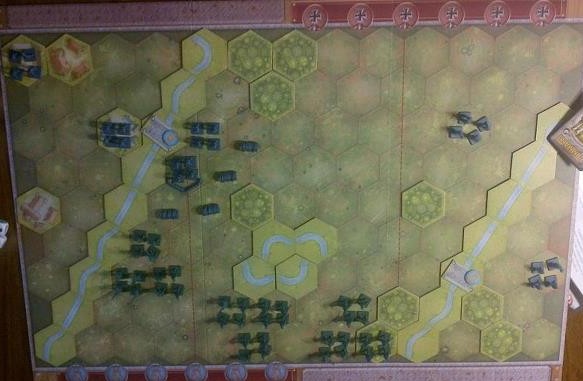
Memoir '44: Pegasus Bridge setup
Memoir ’44: Pegasus Bridge setup

Reposting this old post because Dina and I spent Friday night playing games again! And this is one of my favorite posts. Last night was Portal 2 and Orcs Must Die! 2.

Last night, I played through the Pegasus Bridge scenario from the Memoir ’44 wargame with Dina a few times. We actually played the online version of the game, using Steam. She was very gracious to play a wargame with me, which I don’t think is necessarily the first thing on most women’s lists of things to do on a Thursday night! I appreciated her agreeing to learn how to play and then playing with me several times. I think that Christians need to plan and execute more “together” activities like that – activities that involve interaction, co-operation, communication and engagement. We try to avoid doing things where we are both spectators. Playing wargames is not the only thing we do – we also do Bible study and cooking lessons (for me), for example.

Anyway, the point of this post is to express the deeper meaning behind playing wargames. I think that it is important to recognize and celebrate those who have demonstrated good character, whether it be now, or in the past. I think that it is important for us to search out the best role models ourselves, so that they will influence the way we act in our own lives. The second world war was a clear example of good versus evil. Anyone on the Allied side who demonstrated bravery and courage should be celebrated for safeguarding the security, liberty and prosperity that we enjoy today. In the case of Pegasus bridge, the hero is Major John Howard of the British paratroops.

Here is a quick re-cap of his exploits that day from the New York Times:

Maj. John Howard, the commander of glider-borne British infantrymen who seized the strategically vital Pegasus Bridge in the first battle of the D-Day invasion of Normandy, died Wednesday in a hospital in Surrey, England. He was 86 and had lived in Burford, near Oxford.

Under cover of night on June 6, 1944, six gliders carrying 181 officers and men of the Second Oxfordshire and Buckinghamshire Light Infantry landed on the eastern flank of a 60-mile invasion front on the northern coast of France. The regiment had a heritage going back to the battles of Bunker Hill and New Orleans, to Waterloo and to World War I. Now its soldiers were in the vanguard of the invasion of Hitler’s Europe.

Major Howard’s D Company was ordered to seize two bridges, one over the Caen Canal and the other spanning the parallel Orne River. If the Germans held on to those bridges, panzer units could move across them in a counterattack isolating 10,000 British paratroopers jumping behind the British invasion beach known as Sword, where infantry forces would arrive at daybreak. And Major Howard’s men sought to strike swiftly to prevent the Germans from blowing up the bridges if they were overwhelmed; the British needed those bridges to resupply their airborne units.

British Halifax bombers towed the gliders over the English Channel, then cut them loose.

Major Howard’s lead glider landed at 12:16 A.M., only 50 yards from the Caen Canal bridge, but the glider’s nose collapsed on impact, knocking everybody aboard unconscious for a few seconds. The soldiers quickly emerged, and over the next five minutes the men directly under Major Howard killed the surprised German defenders.

The nearby Orne River bridge was captured by other troops in Major Howard’s unit, and soon the words ”Ham and Jam,” signifying mission accomplished, were radioed to the airborne.

Two British soldiers were killed and 14 wounded in the operation.

Over the next 12 hours, British paratroopers and commandos reinforced Major Howard’s men, and British forces were able to move toward the city of Caen, their flank having been protected by the capture of the bridges.

On July 16, Major Howard received the Distinguished Service Order, Britain’s second-highest award for valor. On the 10th anniversary of D-Day, he received the Croix de Guerre Avec Palme from the French Government, which had renamed the Caen Canal span Pegasus Bridge, for the flying horse symbolizing the British airborne. The road crossing the bridge was later renamed Esplanade Major John Howard.

Why is this important? Well, it’s important to think on the things that are excellent. There are so many things in the culture that are not excellent that we are confronted with every day. We have to make it our business to do things together where goodness is celebrated. Especially when manly virtues like courage are celebrated. We don’t do that much anymore. And I think there’s a connection between wargames and Christian apologetics that we need to deliberately encourage.

Here’s an excellent passage from Shakespeare’s “Henry V” that makes the point:

This day is called the feast of Crispian:
He that outlives this day and comes safe home,
Will stand a tip-toe when this day is named,
And rouse him at the name of Crispian.
He that shall live this day, and see old age,
Will yearly on the vigil feast his neighbours,
And say, ‘To-morrow is Saint Crispian:’
Then will he strip his sleeve and show his scars,
And say, ‘These wounds I had on Crispin’s day.’
Old men forget: yet all shall be forgot,
But he’ll remember with advantages
What feats he did that day. Then shall our names,
Familiar in his mouth as household words,
Harry the King, Bedford and Exeter,
Warwick and Talbot, Salisbury and Gloucester,
Be in their flowing cups freshly remembered.
This story shall the good man teach his son;
And Crispin Crispian shall ne’er go by,
From this day to the ending of the world,
But we in it shall be rememberèd;
We few, we happy few, we band of brothers;
For he to-day that sheds his blood with me
Shall be my brother; be he ne’er so vile
This day shall gentle his condition:
And gentlemen in England, now a-bed
Shall think themselves accursed they were not here,
And hold their manhoods cheap whiles any speaks
That fought with us upon Saint Crispin’s day. (4.3.43)

This is from the famous speech in which King Henry charges his men to fight well before the famous Battle of Agincourt.

You can read more about the history of the British Airborne division and Pegasus bridge. The famous historian of the second world war Stephen E. Ambrose also wrote a history of the Pegasus bridge battle, called “Pegasus Bridge: June 6, 1944“. You won’t find many military historians better than Stephen E. Ambrose!

You might be surprised how many men are interested in military history and wargames, precisely because men instinctively look up to men like John Howard who embody qualities like bravery and courage. We have a dearth of moral character in this society. And we don’t do much to teach young men about manly virtues, even in the church. I think that it is important for us to think of creative ways for us to present good character to our young men. Young women should also learn about good character, because they must separate out the good men from the bad when they are courting.

Thanks to Dina for helping me to edit this post!