
Tag Archives: Environmentalism

Are polar ice caps really melting due to global warming?

This post is old, please take a look at some of my newer posts

Are global warming alarmists wrong?

Consider this article from The Australian: (H/T Watts Up With That)

ICE is expanding in much of Antarctica, contrary to the widespread public belief that global warming is melting the continental ice cap.

The results of ice-core drilling and sea ice monitoring indicate there is no large-scale melting of ice over most of Antarctica, although experts are concerned at ice losses on the continent’s western coast.

Antarctica has 90 per cent of the Earth’s ice and 80 per cent of its fresh water. Extensive melting of Antarctic ice sheets would be required to raise sea levels substantially, and ice is melting in parts of west Antarctica. The destabilisation of the Wilkins ice shelf generated international headlines this month.

However, the picture is very different in east Antarctica, which includes the territory claimed by Australia.

East Antarctica is four times the size of west Antarctica and parts of it are cooling. The Scientific Committee on Antarctic Research report prepared for last week’s meeting of Antarctic Treaty nations in Washington noted the South Pole had shown “significant cooling in recent decades”.

And here’s the graph that goes with the findings:
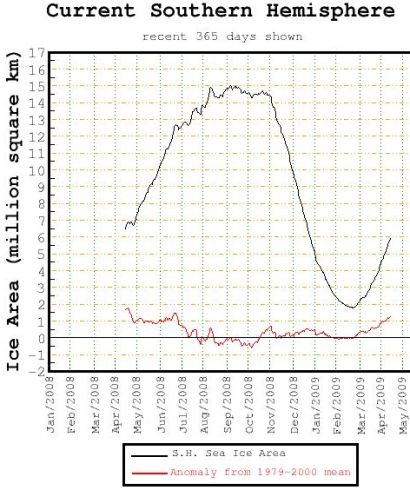
Source: Cryosphere Today

Why are global warming alarmists wrong?

Now we know that they’re wrong. Why are they wrong? Well, maybe I should start by showing that the media is cherry-picking data in order to delude the public. This post by Anthony Watts which explains how the media deliberately recycles the images and stories about imminent climate catastrophes. This time, it’s about a vast antarctic shelf that’s about to collapse.

Only one problem. It was just about to collapse last year, but the media is re-using the the same scary stock photo and story again this year and telling us again that it’s just about to collapse.

Excerpt:

Those masters of disaster are at it again, and it appears our friendly scientists at that National Snow and Ice Data Center (NSIDC) help this story along each year.

…It seems that not only is the photography recycled, so is the storyline. It seems to happen every year, about this time. Note the photos show shear failure and cracks, not melted ice. Shear failure is mostly mechanical-stress related, though ice does tend to be more brittle at colder temperatures.

National Geographic reported this story headline last year, March 25th 2008.

…From the Nat Geo story:

“[It’s] an event we don’t get to see very often,” Ted Scambos, lead scientist at the U.S. National Snow and Ice Data Center in Boulder, Colorado, said in a press statement.

Now, how is it that an ice shelf breaks up in the spring of 2008 and again in the spring of 2009 and it’s “not very often”? Hmmm.

Watts goes on in his post to take a look at how much the ice shelf has really changed over the years (it hasn’t) and whether the air temperatures have gotten warmer (theyhaven’t) such that the air would be causing cracks. So all we really have is a scary re-used photo and a lot of propaganda.

What are the economic effects of policies based on global warming alarmism

Well, to start with, we’re going to lose a lot of jobs, due to increase taxation and regulation of “the rich” and “greedy corporations”. And, the EPA is going to raise consumer energy prices and put American money in the pockets of terrorists, by curtailing domestic energy production. And, we’re going to waste tons and tons of taxpayer money subsidizing corporations to be “green”.

The good news: public opinion is shifting away from global warming alarmism

A recent Rasmussen Reports poll shows that there is hope. (H/T The Chilling Effect)

Global Warming is Primarily Caused By…
Date Human activity Planetary Trends Other Reason
Apr 09 34% 48% 7%
Mar 09 41% 43% 7%
Feb 09 38% 45% 7%
Jan 09 44% 41% 7%
Dec 08 43% 43% 6%
Apr 08 47% 34% 8%

So at least we’re slowly winning the battle for truth. Unfortunately, Obama has got until 2010 until he can be challenged in the mid-term elections.

r.

How government regulations can cost us our jobs

Good post on the effects of government regulation, over at the Competitive Enterprise Institute’s Open Market blog.

Excerpt:

A story in the Star Tribune in Minneapolis St. Paul shows how adverse effects of such needlessly onerous standard can spill over into other areas. In this case, a meat plant had to shut its doors, putting 200 people out of work because their water exceeded EPA’s standard by 8 parts per billion. EPA can’t show that the Clinton era its standard won’t save a soul, but we do know that economic hard times hurt many.

Here’s an excerpt from the Strib piece:

More than 200 workers in a small town 90 minutes west of Minneapolis have lost their jobs after a beef slaughtering plant was forced to shut down because its water contained excessive levels of arsenic, a condition the plant owner said he couldn’t afford to fix in time to avoid federal penalties.

“I’m done,” said William Gilger, owner of North Star Beef Inc. in Buffalo Lake, Minn.

The Heritage Foundation has a good post on how the EPA intends to expand their control of the economy in order to save us from global cooling warming.

In essence, the endangerment finding says that global warming and climate change pose a serious threat to public health and safety and thus almost anything that emits carbon dioxide and other greenhouse gases could be regulated under the Clean Air Act.

The endangerment finding is the first step in a long regulatory process that could lead to EPA requiring different regulations and units of emissions requirements for each gadget that emits carbon dioxide. The first target would be automobiles, but the EPA’s Advanced Notice of Proposed Rulemaking (ANPR) suggested regulations of almost everything that moves, including new regulations smaller items such lawnmowers and forklifts. The ANPR also suggests putting speed limiters on large trucks on the table as a means of reducing carbon dioxide and even suggested sharkskin boats oozing bubbles to reduce emissions from the shipping industry.

…Beyond things that move, the agency could go after things that stand still. More than a million energy using businesses, buildings, and farms could also be hit with crushing administrative burdens and costly controls. And even if EPA decides not to go that far, they will almost certainly be sued into doing so.

And they have a forecast of the potential costs of this regulation:

However, the economic damage would be similar to any carbon capping bill passed by Congress and perhaps even worse. Dr. David Kreutzer and Dr. Karen Campbell of The Heritage Foundation’s Center for Data Analysis found the economic costs of EPA regulations to be:

• Cumulative gross domestic product (GDP) losses are nearly $7 trillion by 2029 (in inflation adjusted 2008 dollars)
• Single-year GDP losses exceed $600 billion (in inflation-adjusted 2008 dollars).
• Annual job losses exceed 800,000 for several years.
• Some industries will see job losses that exceed 50 percent.

If you tax or regulate something, you get less of it. If you cut taxes and remove regulations, you get more of it. The best protection a worker has is not onerous taxes and regulations on their employer. The best protection a worker has is a choice among a huge number of employers. If you want a choice of employers, try creating conditions that employers actually want.

Republicans care about creating conditions that allow businesses to create jobs. We want this because we believe that people should not dependent on the government for their livelihood. Your ability to choose your employer is part of your liberty. Democrats care about inventing a faked crisis using junk science in order to justify government-coerced redistribution of wealth.

At last some honesty on global warming alarmism

You may have read something about the NYT article a while back that discussed the brilliant scientist Freeman Dyson and his opposition to global warming.

Excerpt from the NYT article:

Dyson may be an Obama-loving, Bush-loathing liberal who has spent his life opposing American wars and fighting for the protection of natural resources, but he brooks no ideology and has a withering aversion to scientific consensus.

…IT WAS FOUR YEARS AGO that Dyson began publicly stating his doubts about climate change. Speaking at the Frederick S. Pardee Center for the Study of the Longer-Range Future at Boston University, Dyson announced that “all the fuss about global warming is grossly exaggerated.” Since then he has only heated up his misgivings, declaring in a 2007 interview with Salon.com that “the fact that the climate is getting warmer doesn’t scare me at all” and writing in an essay for The New York Review of Books, the left-leaning publication that is to gravitas what the Beagle was to Darwin, that climate change has become an “obsession” — the primary article of faith for “a worldwide secular religion” known as environmentalism.

Among those he considers true believers, Dyson has been particularly dismissive of Al Gore, whom Dyson calls climate change’s “chief propagandist,” and James Hansen, the head of the NASA Goddard Institute for Space Studies in New York and an adviser to Gore’s film, “An Inconvenient Truth.” Dyson accuses them of relying too heavily on computer-generated climate models that foresee a Grand Guignol of imminent world devastation as icecaps melt, oceans rise and storms and plagues sweep the earth, and he blames the pair’s “lousy science” for “distracting public attention” from “more serious and more immediate dangers to the planet.”

Well, the NYT got a fascinating letter to the editor in response to their profile of Dyson. The letter came from a graduate student at Harvard named Monika Kopacz.

The letter is excerpted in First Things (H/T The Weekly Standard):

It is no secret that a lot of climate-change research is subject to opinion, that climate models sometimes disagree even on the signs of the future changes (e.g. drier vs. wetter future climate). The problem is, only sensational exaggeration makes the kind of story that will get politicians’ — and readers’ — attention. So, yes, climate scientists might exaggerate, but in today’s world, this is the only way to assure any political action and thus more federal financing to reduce the scientific uncertainty.

Remember, in 1975, the leftist magazine Newsweek propped up the global cooling as the crisis-du-jour.

Excerpt from an article from the Business and Media Institute:

It took 31 years, but Newsweek magazine admitted it was incorrect about climate change. In a nearly 1,000-word correction, Senior Editor Jerry Adler finally agreed that a 1975 piece on global cooling “was so spectacularly wrong about the near-term future.”

Even then, Adler wasn’t quite willing to blame Newsweek for the incredible failure. “In fact, the story wasn’t ‘wrong’ in the journalistic sense of ‘inaccurate,’” he claimed. “Some scientists indeed thought the Earth might be cooling in the 1970s, and some laymen – even one as sophisticated and well-educated as Isaac Asimov – saw potentially dire implications for climate and food production,” Adler added.

Journalists, lacking marketable skills, support socialism. They believe that their word-smithing skills are more worthy than the practical skills of engineers and entrepreneurs. Socialism is their way of regaining the accolades they lost once they left the safe confines of the public school classroom.

Any myth that will allow the government to seize control of the free-market must be supported, regardless of the evidence. And the same thing applies to Darwinism. Only in this case, the target is not the free market, but the church. And the goal is not redistribution of wealth, but autonomy from moral judgments and moral constraints.

For more on scientific opposition politics masquerading as science, see here.