
Tag Archives: Energy

Good news: Venezuelan President complains that fracking is “flooding” oil markets

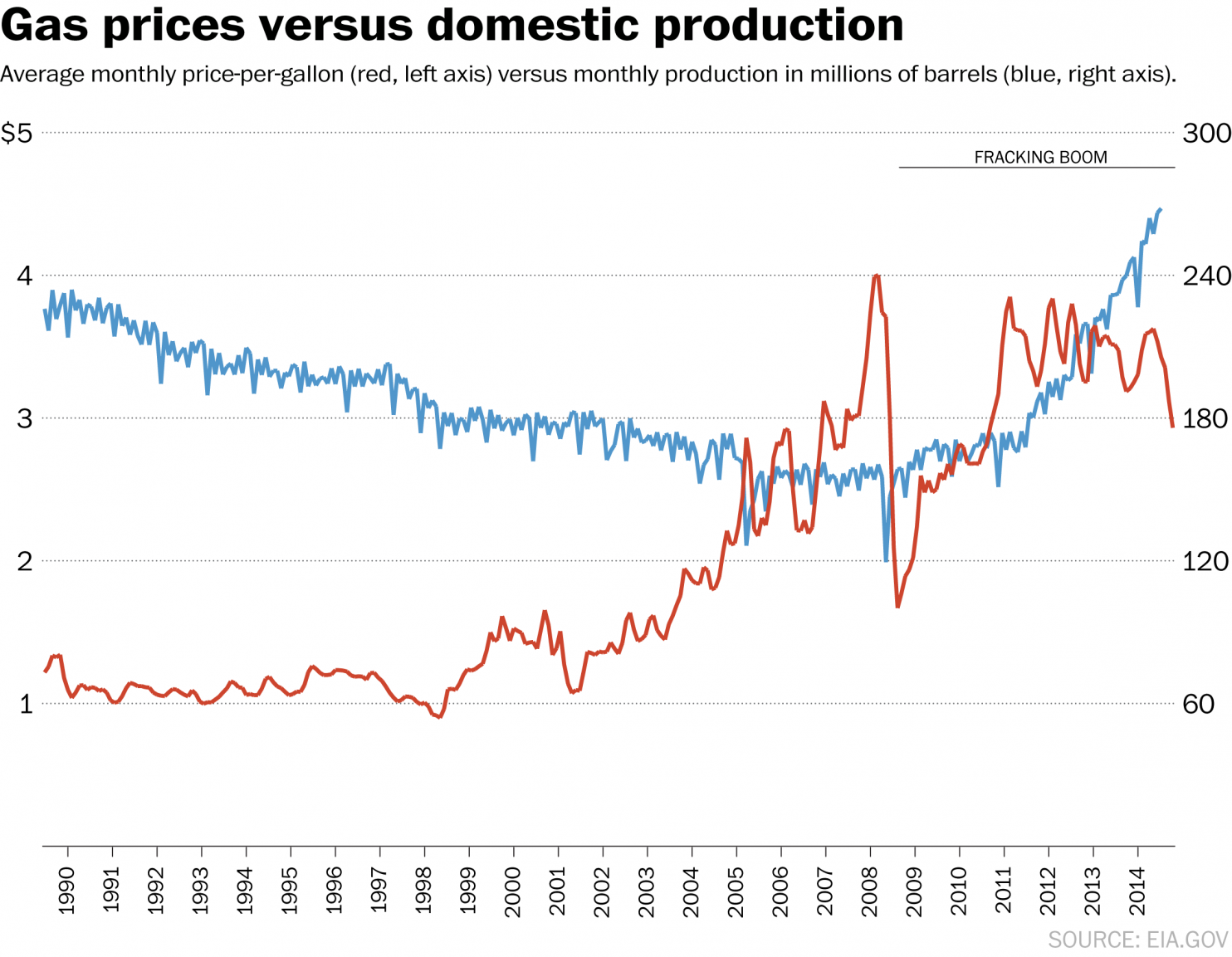
Gas prices vs domestic oil production

(Click for larger image. Source)

Why are gas prices so low all of a sudden?

Well, let’s ask the communist President of Venezuela:

The broadcast networks may not want to give credit to hydraulic fracturing for increasing U.S. oil production and lowering global oil prices, but at least one angry world leader did just that.

Venezuelan President Nicolas Maduro complained that fracking in the U.S. has “flooded” the world market and contributed to lower oil prices, a connection that broadcast networks’ evening news reports barely made recently.

“The oil they’re taking from (shale deposits) and the gas. They’ve flooded the international market to batter the Russian economy …, Iran and to hurt us, Venezuela,” Maduro said in a broadcast on VTV, a state-run TV channel in Venezuela, according to Fox News Latino.

Fracking has been one cause of increased oil production in the U.S. That increased production helped lower oil prices by more than 30 percent since September 29. The decline in oil prices since June has severely impacted Venezuela, since oil exports were a major source of government income. “Some estimates put the break-even price for Venezuela to balance its budget at around $121 a barrel,” CNBC reported on December 7. That’s more than double current oil prices. Oil closed at $59.15-per-barrel on December 11.

As of January 2014, Venezuela’s state-run oil company brought in 96 percent of foreign earnings, according to The Economist. Maduro announced on December 2 that the government would cut spending by 20 percent.

[…]Venezuela was experiencing particular difficulties. That economy was on the verge of collapsing, CNBC said on Dec. 1. If low oil prices continued, Venezuela may face a “game over” situation and “barbarity and people looting.”

Do you know who else is hurt by this? Russia. I sure hope they don’t do anything aggressive to their neighbors while their economy feels the pinch of lower gas prices.

It’s a good thing when villains shake their fists at us, but it’s a better thing when consumers pay less for gas:

Thanks in part to the widespread use of technologies like hydraulic fracturing and horizontal drilling, global oil prices plummeted in 2014. Energy experts even predicted the U.S. could be the top oil producer in the next several years.

[…]Fracking and other advanced technologies helped the U.S. nearly double its average daily output of oil, from 5 million barrels in 2008 to an expected 9.42 million barrels in 2015. The huge supply increase was one factor sending crude oil prices down. Crude fell by more than 32 percent, from $93 to $63 just since Sept. 29. This already drove gas prices down to a national average of $2.66 for regular on Dec. 9, according to AAA.

This is great news for consumers and businesses which could save as much as $1.3 trillion worldwide because of lower oil prices, according to Julian Jessop, chief global economist at Capital Economics in London. Here in the U.S., Americans could save $230 billion if prices remain low for the next year, The Washington Post said on Dec. 1.

The only bad side to this story is that fracking is an expensive way of drilling, so as the price of oil drops, energy companies will be scaling back fracking until it becomes profitable again.

I think this story is important, because it helps to explain what the people who oppose the Keystone XL pipeline are concerned about. They know that there are two results to allowing that pipeline to be built. First, a hell of a lot of jobs will be created, reducing dependency on government. Second, the price of gas at the pump will go down further. That’s what the environmentalists (and their Democrat allies in Washington) are seeking to avoid. They want more government dependency, and higher gas prices.

How do atheists incorporate the Big Bang cosmology into their worldview?

It’s easy! Just watch the video of his debate with William Lane Craig, who responds to Atkins’ explanation.

So, just who is this Peter Atkins, and why is he a good spokesman for atheism?

From his Wikipedia bio.

Peter William Atkins (born August 10, 1940) is an English chemist and a fellow and professor of chemistry at Lincoln College of the University of Oxford. He is a prolific writer of popular chemistry textbooks, including Physical Chemistry, 8th ed. (with Julio de Paula of Haverford College), Inorganic Chemistry, and Molecular Quantum Mechanics, 4th ed. Atkins is also the author of a number of science books for the general public, including Atkins’ Molecules and Galileo’s Finger: The Ten Great Ideas of Science.

[…]Atkins is a well-known atheist and supporter of many of Richard Dawkins’ ideas. He has written and spoken on issues of humanism, atheism, and what he sees as the incompatibility between science and religion. According to Atkins, whereas religion scorns the power of human comprehension, science respects it.

[…]He was the first Senior Member for the Oxford Secular Society and an Honorary Associate of the National Secular Society. He is also a member of the Advisory Board of The Reason Project, a US-based charitable foundation devoted to spreading scientific knowledge and secular values in society. The organisation is led by fellow atheist and author Sam Harris.

Now watch that 6-minute video above. Peter Atkins thinks that nothing exists. He thinks he doesn’t exist. He thinks that you don’t exist.

If you watch the full debate, he also argues that objective morality doesn’t exist, and that moral values and moral obligations are illusory. That’s right: atheists cannot even make rational statements about morality because there is no such thing as an objective moral standard in their worldview. This denial of morality is in addition to denying the mainstream science of the Big Bang cosmology. I don’t have the ability to believe things are true that are obviously false the way Atkins does, so I guess I can’t be an atheist. Oh well, I tried!

Pew survey: evangelical Christians least likely to believe superstitious nonsense

The Pew Research survey is here.

They are trying to see which groups believe in superstitions and new age mysticism.

Here are the parts that I found interesting:

Click for full image.

Click for full image.

Notice the numbers for Republicans vs Democrats, conservatives vs. liberals, and church-attending vs non church-attending. The least superstitious people are conservative evangelical Republicans, while the most superstitious people are Democrat liberals who don’t attend church. I think there is something to be learned from that. It’s consistent with the results of a Gallup survey that showed that evangelical Christians are the most rational people on the planet.

Here’s the Wall Street Journal article about the Gallup survey entitled “Look Who’s Irrational Now“.

Excerpt:

The reality is that the New Atheist campaign, by discouraging religion, won’t create a new group of intelligent, skeptical, enlightened beings. Far from it: It might actually encourage new levels of mass superstition. And that’s not a conclusion to take on faith — it’s what the empirical data tell us.

“What Americans Really Believe,” a comprehensive new study released by Baylor University yesterday, shows that traditional Christian religion greatly decreases belief in everything from the efficacy of palm readers to the usefulness of astrology. It also shows that the irreligious and the members of more liberal Protestant denominations, far from being resistant to superstition, tend to be much more likely to believe in the paranormal and in pseudoscience than evangelical Christians.

The Gallup Organization, under contract to Baylor’s Institute for Studies of Religion, asked American adults a series of questions to gauge credulity.

[…]The answers were added up to create an index of belief in occult and the paranormal. While 31% of people who never worship expressed strong belief in these things, only 8% of people who attend a house of worship more than once a week did.

Even among Christians, there were disparities. While 36% of those belonging to the United Church of Christ, Sen. Barack Obama’s former denomination, expressed strong beliefs in the paranormal, only 14% of those belonging to the Assemblies of God, Sarah Palin’s former denomination, did. In fact, the more traditional and evangelical the respondent, the less likely he was to believe in, for instance, the possibility of communicating with people who are dead.

When I think of the “weird” things that evangelical Christians believe, I think of the origin of the universe, the cosmic fine-tuning, the origin of life and the sudden origin of animal body plans in the Cambrian. All of this is superstition to an atheist, and yet all of it is rooted in mainstream science. Not just that, but they’ve grown stronger as science has progressed. I can accept the fact that an atheist may be ignorant of the science that defeats his atheism, but that’s something that has to be remedied with more studying of the evidence, not less. If you generate a worldview by 1) your desire to dispense with moral judgment and/or 2) your desire to prefer Star Trek and Star Wars to mainstream science, then of course you are going to have an irrational worldview. I’m not saying that all atheists do this, surely someone like Peter Millican does not. But for rank-and-file Dawkins acolytes, I think this is pretty accurate, and it’s why we get the survey results that we do.