
This post is old, please take a look at some of my newer posts
- UN IPCC claim that Himalayan glaciers are melting revealed to be a hoax
- Britain to be hit by coldest winter in 100 years
- Does global warming increase the frequency of hurricanes?
- Will December 2009 be the coldest on record?
- 877 snowfall records were set last week in the USA
- Record snowfall in Oklahoma City, OK and Duluth, MN
- Russian economists accuse CRU of cherry-picking Russian temperature data
- UK Daily Mail summarizes the Climategate scandal
- Armed guard prevents questions on Climategate at UN conference
- Canadian government finds polar bear population up 163% since mid-1980s
- Australian climate data also adjusted to hide the decline
- What does Climategate really prove about global warming?
- Comparison of hockey stick graph data to a larger data set in the same area
- The state of the debate about catastrophic man-made global warming
- Peer-reviewed article in journal Science says solar activity impacts climate
- Famous UN IPCC hockey stick graph is based on cherry-picked data
- Princeton physics professor testifies to Senate about global warming
- Global warming advocates refuse to give their data to skeptics
- Peer-reviewed article in journal Science says prior ice melting caused by solar variation
- Oceans are not warming now
- Polar ice caps are not melting now
- Polar bear populations are not decreasing now
- Global warming is not caused by humans
Are global warming alarmists wrong?
Consider this article from The Australian: (H/T Watts Up With That)
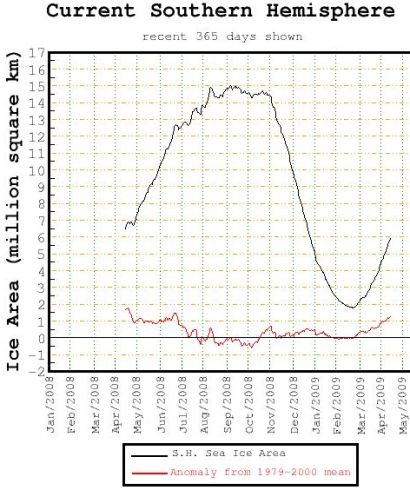
ICE is expanding in much of Antarctica, contrary to the widespread public belief that global warming is melting the continental ice cap.
The results of ice-core drilling and sea ice monitoring indicate there is no large-scale melting of ice over most of Antarctica, although experts are concerned at ice losses on the continent’s western coast.
Antarctica has 90 per cent of the Earth’s ice and 80 per cent of its fresh water. Extensive melting of Antarctic ice sheets would be required to raise sea levels substantially, and ice is melting in parts of west Antarctica. The destabilisation of the Wilkins ice shelf generated international headlines this month.
However, the picture is very different in east Antarctica, which includes the territory claimed by Australia.
East Antarctica is four times the size of west Antarctica and parts of it are cooling. The Scientific Committee on Antarctic Research report prepared for last week’s meeting of Antarctic Treaty nations in Washington noted the South Pole had shown “significant cooling in recent decades”.
And here’s the graph that goes with the findings:
Why are global warming alarmists wrong?
Now we know that they’re wrong. Why are they wrong? Well, maybe I should start by showing that the media is cherry-picking data in order to delude the public. This post by Anthony Watts which explains how the media deliberately recycles the images and stories about imminent climate catastrophes. This time, it’s about a vast antarctic shelf that’s about to collapse.
Only one problem. It was just about to collapse last year, but the media is re-using the the same scary stock photo and story again this year and telling us again that it’s just about to collapse.
Excerpt:
Those masters of disaster are at it again, and it appears our friendly scientists at that National Snow and Ice Data Center (NSIDC) help this story along each year.
…It seems that not only is the photography recycled, so is the storyline. It seems to happen every year, about this time. Note the photos show shear failure and cracks, not melted ice. Shear failure is mostly mechanical-stress related, though ice does tend to be more brittle at colder temperatures.
National Geographic reported this story headline last year, March 25th 2008.
…From the Nat Geo story:
“[It’s] an event we don’t get to see very often,” Ted Scambos, lead scientist at the U.S. National Snow and Ice Data Center in Boulder, Colorado, said in a press statement.
Now, how is it that an ice shelf breaks up in the spring of 2008 and again in the spring of 2009 and it’s “not very often”? Hmmm.
Watts goes on in his post to take a look at how much the ice shelf has really changed over the years (it hasn’t) and whether the air temperatures have gotten warmer (theyhaven’t) such that the air would be causing cracks. So all we really have is a scary re-used photo and a lot of propaganda.
What are the economic effects of policies based on global warming alarmism
Well, to start with, we’re going to lose a lot of jobs, due to increase taxation and regulation of “the rich” and “greedy corporations”. And, the EPA is going to raise consumer energy prices and put American money in the pockets of terrorists, by curtailing domestic energy production. And, we’re going to waste tons and tons of taxpayer money subsidizing corporations to be “green”.
The good news: public opinion is shifting away from global warming alarmism
A recent Rasmussen Reports poll shows that there is hope. (H/T The Chilling Effect)
| Global Warming is Primarily Caused By… | |||
|---|---|---|---|
| Date | Human activity | Planetary Trends | Other Reason |
| Apr 09 | 34% | 48% | 7% |
| Mar 09 | 41% | 43% | 7% |
| Feb 09 | 38% | 45% | 7% |
| Jan 09 | 44% | 41% | 7% |
| Dec 08 | 43% | 43% | 6% |
| Apr 08 | 47% | 34% | 8% |
So at least we’re slowly winning the battle for truth. Unfortunately, Obama has got until 2010 until he can be challenged in the mid-term elections.
r.
 WINTERY KNIGHT