The Supreme Court took a big bite out of the pockets of class-action trial lawyers today, at least in the field of employment discrimination. The court unanimously rejected a class-action lawsuit against Wal-Mart on behalf of 1.6 million female employees that attempted to argue that the retail giant purposefully and systematically discriminated on gender for compensation. But a narrow 5-4 rulingon a companion issue promises to make filing any more such class-action lawsuits nearly impossible:
The justices divided 5-4 on another aspect of the ruling that could make it much harder to mount similar class-action discrimination lawsuits against large employers.
Justice Antonin Scalia’s opinion for the court’s conservative majority said there needs to be common elements tying together “literally millions of employment decisions at once.”
But Scalia said that in the lawsuit against the nation’s largest private employer, “That is entirely absent here.”
Justice Ruth Bader Ginsburg, writing for the court’s four liberal justices, said there was more than enough uniting the claims. “Wal-Mart’s delegation of discretion over pay and promotions is a policy uniform throughout all stores,” Ginsburg said.
The contrasting opinions gives a good indication of what is at stake. In mostcorporations (especially national retail chains), compensation decisions are almost always delegated to individual locations or regional management. For one thing, the labor market varies from region to region, and what amounts to competitive compensation in one region might be insufficient in another, depending on the cost of living, labor availability, and so on.
Ginsburg’s identification of this as a prima facie indication of discrimination would have exposed virtually all US retailers to such class-action lawsuits. Not only would that have sapped retailers of billions in capital, but it doesn’t make any sense on its face anyway. If compensation decisions are decentralized throughout an organization, how can that possibly demonstrate a coordinated, centralized, and explicit effort to discriminate on the basis of anything?
Reining in judicial activism and trial layers is a good way to incentivize corporations to create jobs. If you want to lower unemployment, stop these frivolous class-action lawsuits.
It’s also worth pointing out that lawsuits like this are bogus in a free market, because if people really area being underpaid, they can always go to a different employer to get a higher salary – IF THEY ARE WORTH IT. We really need a national loser-pays law to deter these nuisance lawsuits.
How amusing to watch Democrats wring their hands over what they can do to get businesses to create jobs, when one of the biggest job killers is the minimum wage they keep hiking.
Recall that it was Democrats who raised the federal wage floor a whopping $2.10 an hour in the middle of the recession. The record 41% increase has led to record unemployment among young people, especially black teens.
Congress started ratcheting up the minimum wage from $5.15 an hour in mid-2007, arguing it would help abate poverty. But retailers looking to slash costs eliminated low-skilled, entry-level jobs rather than pay the mandated increases.
Now 1.5 million fewer teens are working. Last year’s unemployment rate for workers ages 16 to 19 shot up to 26% from 2007’s 15%.
As for black teens, their joblessness soared to a record 43% after the final raise to $7.25 took effect in mid-2009. It helped put more than half of young black men out of work — a first.
The president proposes cranking the minimum wage even higher to $9.50. Then he wants to raise it every year thereafter as a “living wage” indexed to inflation.
Yes, this is the problem that happens when you elect someone who knows nothing whatsoever about economics. And when I say nothing, I mean he is in disagreement with virtually all economists across the ideological spectrum.
Here’s Greg’s list, together with the percentage of economists who agree:
A ceiling on rents reduces the quantity and quality of housing available. (93%)
Tariffs and import quotas usually reduce general economic welfare. (93%)
Flexible and floating exchange rates offer an effective international monetary arrangement. (90%)
Fiscal policy (e.g., tax cut and/or government expenditure increase) has a significant stimulative impact on a less than fully employed economy. (90%)
The United States should not restrict employers from outsourcing work to foreign countries. (90%)
The United States should eliminate agricultural subsidies. (85%)
Local and state governments should eliminate subsidies to professional sports franchises. (85%)
If the federal budget is to be balanced, it should be done over the business cycle rather than yearly. (85%)
The gap between Social Security funds and expenditures will become unsustainably large within the next fifty years if current policies remain unchanged. (85%)
Cash payments increase the welfare of recipients to a greater degree than do transfers-in-kind of equal cash value. (84%)
A large federal budget deficit has an adverse effect on the economy. (83%)
A minimum wage increases unemployment among young and unskilled workers. (79%)
The government should restructure the welfare system along the lines of a “negative income tax.” (79%)
Effluent taxes and marketable pollution permits represent a better approach to pollution control than imposition of pollution ceilings. (78%)
From CNBC, we get this article showing that any increase in the minimum wage will raise the unemployment rate for young people.
Excerpt:
A quarter of teenagers were jobless in March, representing a surprising increase from February, even as the unemployment rate for the rest of the population decreased.
This figure may only get worse if budget-strapped states raise the minimum wage, and it could also be a sign of greater structural damage underlying our economy, analysts said.
The unemployment rate for 16- to 19-year olds jumped back up to 24.5 percent in March, up from 23.9 percent the prior month, according to the latest jobs data from the Labor Department.
[…]“Even when comprehending that teen employment is volatile in nature, the data that exists serves up some shock and awe,” said Brian Sozzi, a retail research analyst with Wall Street Strategies, in a note Wednesday. “If these (wage) increases do go through, the prospect for teen employment will remain grim as employers search for workers with advanced skills to fill positions.”
Twelve states, including Illinois and Pennsylvania, are considering a hike in the minimum wage. While this has been the subject of a long-running debate, many economists and analysts say raising this pay bar may cause more teen layoffs, even as it helps teens who manage to stay employed make more.
“Minimum wage increases over the past few years has definitely made it worse,” said Peter Boockvar, chief equities strategist at Miller Tabak. “In fact, there should be zero minimum wage for teenagers, or at most, something much less than the current rate.”
Teens typically are the first to be fired and the last to be hired back in a normal economic cycle, so this rate can be considered a kind of leading indicator of employment.
* The minimum wage encourages employers to hire illegal aliens.
Beranek (1982).
* Few workers are permanently stuck at the minimum wage.
Brozen (1969), Smith and Vavrichek (1992).
* The minimum wage has reduced employment in foreign countries.Canada: Forrest (1982); Chile: Corbo (1981); Costa Rica: Gregory (1981); France: Rosa (1981).
This is why it is important for voters to understand economics. When you raise the price of labor, fewer employers will purchase labor. Supply and demand.
President Barack Obama heads to an energy plant in North Carolina on Monday to talk once again about the job-creating power of a green economy.
The catch? Nearly three years into Obama’s presidency, the White House can’t point to much solid evidence that significant numbers of Americans are scoring the green jobs the president has been touting.
Monthly Labor Department employment reports say nothing about the new clean energy workforce, while an effort to document how many Americans actually make a living in the “green collar” field may not be done by November 2012.
Obama’s Council of Economic Advisers suggests 225,000 clean energy jobs were either created or preserved through the third quarter of 2010 thanks to more than $80 billion in the economic stimulus package. But those are estimates at best.
White House officials say asking about the connection between the 9.1 percent unemployment rate and the administration’s concerted green jobs campaign is the wrong question.
Pajamas Media has received a leaked internal assessment produced by Spain’s Zapatero administration. The assessment confirms the key charges previously made by non-governmental Spanish experts in a damning report exposing the catastrophic economic failure of Spain’s “green economy” initiatives.
[…]Unsurprisingly for a governmental take on a flagship program, the report takes pains to minimize the extent of the economic harm. Yet despite the soft-pedaling, the document reveals exactly why electricity rates “necessarily skyrocketed” in Spain, as did the public debt needed to underwrite the disaster. This internal assessment preceded the Zapatero administration’s recent acknowledgement that the “green economy” stunt must be abandoned, lest the experiment risk Spain becoming Greece.
The government report does not expressly confirm the highest-profile finding of the non-governmental report: that Spain’s “green economy” program cost the country 2.2 jobs for every job “created” by the state. However, the figures published in the government document indicate they arrived at a job-loss number even worse than the 2.2 figure from the independent study.
Green jobs programs don’t work. They haven’t worked anywhere.
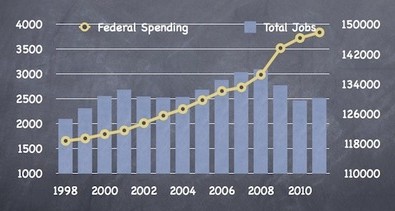
Does Obama look around the world and evaluate what policies work and what policies don’t work? Or does he just decide how to spend private sector money based on what makes him feel good, and what makes him look good? Is that what being President is about? Wasting tons of taxpayer money and bankrupting the country so that you can feel good about yourself because people think you are doing something good?

 WINTERY KNIGHT