Tag Archives: Employment

John Boehner says no to Obama’s plan to raise taxes by 2 trillion

Republican Speaker John Boehner
Republican House Speaker John Boehner

From the leftist Washington Post.

Excerpt:

Senate Democrats have drafted a sweeping debt-reduction plan that would slice $4 trillion from projected borrowing over the next decade without touching the expensive health and retirement programs targeted by President Obama.

Instead, Senate Democrats are proposing to stabilize borrowing through sharp cuts at the Pentagon and other government agencies, as well as $2 trillion in new taxes…

[…]Republicans dismissed the Democratic blueprint, saying higher taxes would be devastating to an economy already weighed down by a 9.2 percent unemployment rate. In their spending plan, House Republicans proposed to save $4 trillion entirely through spending cuts; they would also eliminate Medicare as an open-ended entitlement after 2021.

“If they’re calling for $2 trillion in tax hikes in the middle of a jobs crisis, it’s little wonder that it’s been 800 days since Senate Democrats passed a budget,” said McConnell spokesman Don Stewart.

Since early this year, Senate Democrats have struggled to draft a spending plan. Moderates refused to endorse any blueprint that included big annual budget deficits or big tax hikes. Liberals, meanwhile, opposed sharp cuts to social programs. Sen. Jeff Sessions (R-Ala.), the senior Budget Committee Republican, has relentlessly hammered Democrats for their failure to adopt a budget.

Although the new document is unlikely to be officially adopted, it was embraced by a majority of Senate Democrats when Conrad presented it at a closed-door luncheon earlier this week, aides said.

Under the blueprint, the top income tax rate would rise to 39.6 percent for individuals earning more than $500,000 a year and families earning more than $1 million. That group, which constitutes the nation’s richest 1 percent of households, would also pay a 20 percent rate on capital gains and dividends, rather than the 15 percent rate now in effect.

John Boehner says no way.

Excerpt:

Speaker John A. Boehner told President Obama on Saturday night he will not agree to the president’s most ambitious plan for deficit reduction, citing the administration’s pursuit of tax increases as one of the main hurdles.

The Democrats want to tax investors and job creators. Is it any wonder that this administration has been unable to create jobs? They keep taxing and regulating the small businesses and investors who enable the creation of the majority of new private sector jobs, then are shocked to find that no new jobs are being created. When will they learn that “taxing the rich” just means “taxing the job creators”?

Why are companies not hiring?

Companies are not hiring because the Democrats spent too much, and now they want to raise taxes. Higher taxes makes companies not hire workers.

Look at this diagram:

Republican control of House = low unemployment

Compare the unemployment rates when Republican Newt Gingrich was in charge of the House, to when Nancy Pelosi was in charge:

Gingrich versus Pelosi unemployment graph
Unemployment: Gingrich ('95-'99) vs Pelosi ('07-'10)

Nancy Pelosi added 5.34 trillion to the national debt in 4 years! If you are running a business, then you STOP hiring when you see that the government is spending so much that new taxes are inevitable. You cannot argue with these facts – more spending means higher unemployment, BECAUSE more spending raises fears of higher taxes on job creators. And that’s exactly what Obama is now threatening, and why the unemployment rate is going UP not DOWN. Newt Gingrich added only ONE TRILLION to the national debt between 1994 and 1999. ONE TRILLION. That’s bad, but it’s not FIVE TRILLION as under Pelosi.

Prior to January 2007, George W. Bush’s unemployment rate was down below 5%. Job creators knew that he wasn’t going to come after them with tax hikes and burdensome regulations. You can’t create jobs by punishing job creators. The trade-off of low tax rates for the wealthy is a low unemployment rate. Those are the facts, and we have to live with reality as it is.

How the Obama administration opposes the creation of 100,000 jobs

Comparison of unemployment rates - Bush vs Obama

The Wall Street Journal reports on how Obama’s Environmental Protection Agency is trying to block a pipeline from Alberta that would create 100,000 jobs and lower oil prices at the pump.

Excerpt:

With 9.1% unemployment and gasoline prices in the stratosphere, President Obama must sometimes wish that some big corporation would suddenly show up and offer a shovel-ready, multibillion-dollar project to create 100,000 jobs and reduce U.S. reliance on oil from dictatorships.

Oh, wait. His Secretary of State has had that offer sitting on her desk since she was sworn in. The trouble is that the Administration can’t approve it without upsetting its anti-fossil fuel constituency. And so the proposal sits.

In September 2008 TransCanada applied to build a new pipeline—the Keystone XL—to bring diluted bitumen from the oil-rich tar sands of Alberta to thirsty American refineries on the Gulf Coast. It is hardly a radical proposal. Canadian crude has been flowing to the U.S. for decades. Another Canadian company—Enbridge—operates the Clipper pipeline across the Canadian border to Chicago. In July 2010 TransCanada began operating its Keystone pipeline from Alberta to Cushing, Oklahoma, which is a major storage and pricing depot.

The Keystone XL would cut a slightly different path, through the American heartland to Port Arthur, Texas. Judging from its past experience and that of Enbridge, TransCanada expected that permitting would take roughly 23 months. Thirty-three months, two State Department studies and 208,000 public comments later, TransCanada is still waiting. On current trend, the company will be lucky to get its permit by January, or after 40 months. But even that is far from certain.

If Mr. Obama were drawing up a plan from scratch to boost union employment and deflate Iranian-ally Hugo Chávez of Venezuela, it might look like the Keystone XL. TransCanada estimates that building the pipeline will mean more than $20 billion—$13 billion from TransCanada itself—in investment and 13,000 new American jobs in construction and related manufacturing. The company also expects more than 118,000 “spin-off” jobs during the two years of construction.

TransCanada says it has signed building contracts with four major U.S. unions. It projects that construction will generate $600 million in new state and local tax revenue and that over its life the pipeline will generate another $5.2 billion in property taxes. The Energy Policy Research Foundation in Washington estimates that by linking to the XL, oil producers in North Dakota’s Bakken region will enjoy efficiency gains of between $36.5 million and $146 million annually. Lower transport costs will mean savings for Gulf Coast refiners of $473 million annually if the pipeline meets conservative expectations of shipping 400,000 barrels per day.

Today those refineries are highly dependent on imports from Mexico and Venezuela, which have decreased output in recent years. TransCanada would help to provide Gulf Coast refiners with a more reliable source of supply from a U.S. ally.

Obama wants to create jobs – he just wants to create jobs in Mexico, Venezuela and the Middle East.

Do right-to-work or forced union states create more high-paying jobs?

Neil Simpson writes about a CNBC report entitled “America’s Top States for Business 2011“. At the top of the list: right-to-work states where workers are not forced to join unions that collect union dues to support Democrat policies like amnesty for illegal immigrants, taxpayer-funded abortion and legalizing same-sex marriage.

Here are the criteria used to rank states in the CNBC survey:

  • Cost of Doing Business
  • Workforce
  • Quality of Life
  • Economy
  • Transportation & Infrastructure
  • Technology & Innovation
  • Education
  • Business Friendliness
  • Access to Capital
  • Cost of Living

Red State writes:

When it comes to America’s Top States for Business 2011, when it comes to a quality workforce, 18 out of the top 20 states are Right-to-Work states. Moreover, all 22 Right-to-Work states are in the top 25 states for having the best workforces.

CNBC defines its criteria as this:

Many states point with great pride to the quality and availability of their workers, as well as government-sponsored programs to train them. We rated states based on the education level of their workforce, as well as the numbers of available workers. We also considered union membership. While organized labor contends that a union workforce is a quality workforce, that argument, more often than not, doesn’t resonate with business. We also looked at the relative success of each state’s worker training programs in placing their participants in jobs.

Since nine out of 10 of the states cited for having the best education are not right to work states, it appears that those who receive their educations in forced-union states get smart, pack up and leave, leaving the not-so-smart union extremists to invent myths about their own superiority while they pay their forced union dues.

And here’s a map of right to work states:

Right to Work State Map

Notice that they are mostly Republican states, because are the states that are run by economists and people with business experience – people who know how to create jobs, as opposed to giving speeches that demonize and threaten the people who create jobs.

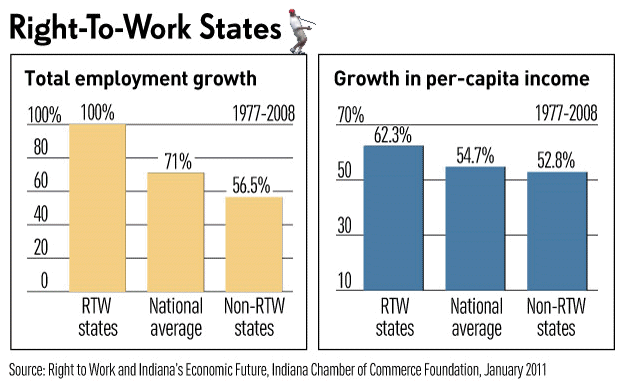
Doug Ross posted these charts a while back that show that employees also do better in right to work states. There are more jobs being created, and the income growth is higher than the forced union states.

Employment growth:

Right To Work States: Employment Growth

Income growth:

Right To Work States: Income Growth

The only losers are the unions. In right to work states, businesses and workers WIN.