
Tag Archives: Education

Homeschooling family from Alabama gets 7 of their 10 kids into college by age 12

They call them the Brainy Bunch

Here’s a wonderful story to cheer everyone up from the Christian Post.

They write:

An impressive seven of 10 homeschooled children from a Christian family in Montgomery, Alabama, which now boasts a doctor and New York City architect among them, all started college by the time they were 12; and now their parents have written a book about how they managed to pull off such staggering academic success.

The parents of the 10 children, Mona Lisa and Kip Harding, are described as high school sweethearts on a website dedicated to The Brainy Bunch Book.

“After four kids, they decided to turn to homeschooling, and their success paved the way for their children to start college by the age of 12, and go on to great careers in medicine, engineering, architecture and more,” explaines the website.

Hannah, 26, is the oldest Harding child. She earned her bachelor of science in mathematics from Auburn University Montgomery and a master’s degree in mathematics by the time she was 19. She is now working on a PhD in material science.

Rosanna, 24, is now an architect in New York City and became the youngest member in the American Institute of Architects at age 23. Serena, 22, earned her bachelor’s degree in biology from Huntingdon College at 17, and became one of America’s youngest female doctors at 22. She is now a resident at the Naval Hospital in Bethesda.

Their brother Heath, 17, has an master’s in computer science. He earned a BA in English at 15, and he is currently working at building his tutoring and online computer business. Keith, who is 15, is pursuing a bachelor’s in music at Faulkner University. Seth, just 13, is a history major at Huntingdon College, while Katrinnah, 10, is a student at Faulkner University.

Their other siblings, Mariannah, 8; Lorennah, 5, and Thunder, 3, are still being homeschooled.

In an interview with KSL Kip and Mona Lisa noted that their children aren’t geniuses. They simply found a way to accelerate their learning by making it fun. One-on-one sessions with the mother who is working on her bachelor’s degree at home also helped immensely.

“One teacher has 30 students on average,” said Kip. “We can do better than that. Kids get left behind in a classroom. … This is where homeschooling really takes off because those kids are getting extra attention. And who’s more loving than a mom and dad teaching them things?”

And for parents considering homeschooling, Mona Lisa had some sage advice.

“I personally would like to tell the moms that if moms read, they can teach their child to read,” she said.

“Then their kids have the ability to teach themselves. I basically teach them to love reading and the basics of math, and from there, they can have a lot of their own answers. … The model at home is more a tutoring model.”

Despite their success, however, Kip acknowledged the importance of teachers in a traditional classroom setting.

“Teaching is a hard job and teachers still have a place,” said Kip. “But government money comes with strings attached. … We’re just relying on God and he keeps coming through and it’s working out well. Truly, we’re just average.”

Sigh! I would really like to have executed a plan like this, but before you can, you have to find a woman who thinks that marriage and children are more important than binge-drinking, hooking-up, and flying around the world to be photographed with malnourished children, etc. I think Christian men do have a plan for making their marriages into a project that gets results like this, but you can’t do it unless you find a woman who is willing to do the work that’s required. Finding one who wants to have kids and manage their progress so that they will have an influence in the world is much harder than it ought to be.
Bobby Jindal’s education reform vs Jeb Bush’s big government Common Core

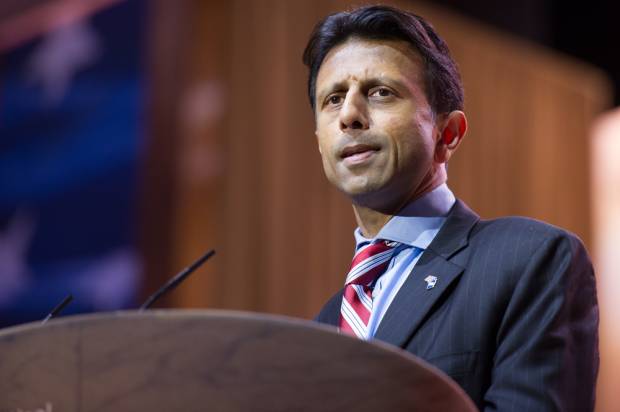
Louisiana Governor Bobby Jindal

The radically leftist National Journal compares and contrasts the education policies of Louisiana Governor Bobby Jindal with former Florida Governor Jeb Bush.

They write:

Louisiana Gov. Bobby Jindal is in Washington Monday to unveil a series of education reforms as part of his 2016 presidential preparations. But his proposals call for scaling back Washington’s role in education while promoting increased parental choice for children’s schools, better measures to assess teacher performance, and more autonomy for individual schools over their own operations.

[…]Through his policy-focused nonprofit AmericaNext, Jindal will be delivering his education proposals at a Christian Science Monitor Breakfast Monday morning, speaking at an educational forum hosted by South Carolina GOP Sen. Tim Scott and meeting with conservative writers to discuss the plan at the Heritage Foundation. He has previously released detailed policy papers on health care, foreign policy, and energy.

Jindal’s education report is a balancing act between calling for higher standards and improved accountability, while limiting the role of the federal government to offer policies to solve the problem. Jindal argues that if parents have more choice in where to send their kids to school—be it local public schools, charter schools, or using vouchers for private or parochial education—the renewed competition will itself force public schools to do a better job. His report calls for less-regimented testing requirements, even as he supports stronger state accountability measures so parents can determine the best schools for their children.

“The federal government should absolutely not be offering incentives, mandates, or coercing states to adopt a national curriculum—whether it’s Common Core or the next iteration of it,” Jindal said. “We don’t think curriculum decisions should be made at the national level. I’m all for rigor, I’m all for standards, but ultimately, I trust parents. I trust choice and competition. I don’t want a top-down, one-size-fits-all approach.” To that end, Jindal said he favors rolling back the mandates in George W. Bush’s No Child Left Behind law.

If he runs for president, Jindal is expected to make education a central part of his message. In the report, he touts the success of the New Orleans school system as a model of his school-choice pitch. After Hurricane Katrina, the city’s educational system was entirely revamped and turned over to the state-run Recovery School District. They allowed schools to be run independently; now more than 90 percent of students in the city attend charter schools. The results have been one of the country’s biggest educational success stories—the graduation rates have skyrocketed and the city’s passing rate on state tests now rival the statewide averages.

Many of Jindal’s school-choice proposals are an extension of the New Orleans experience. He calls for expanding the number charter schools, urges states to remove the caps on the number of charter schools allowed, and argues that principals should play a more active role in their schools’ direction than local school boards.

“Those on the left who believe in government power don’t trust the American people. In terms of education, the best way to drive excellence is to trust the parents. Parents know their kids best, they want what’s best for their children, and if you allow them to vote with their feet, they will then have the chance to give the best education for their kids. And we’ve seen that in New Orleans,” Jindal said.

All told, Jindal’s preferred policies are in line with what many leading educational reformers are arguing. He believes strongly that teacher quality is the strongest school-based factor in a student’s education, and he believes talented teachers should be rewarded for their work. He rails against the seniority system that keeps the most veteran teachers protected from scrutiny. He is dismissive of requiring teachers to hold educational degrees, preferring recruits that have expertise in the areas they teach. And he is bullish about the role technology can play in improving educational outcomes.

[…]But the political red meat of his proposals is directed squarely at Bush. The biggest differences between the two come from the federal role in education and over testing—two areas where the educational establishment is growing disconnected from public opinion. By calling for less testing, Jindal is taking the sides of parents who believe the sheer number of tests is crowding out time for creative endeavors—like art and music—and forcing teachers to drily teach to the test. On that front, Jindal’s critiques echo many liberals on the issue and contrast with the Bush view that progress is best measured through standardized tests.

So it’s ironic that, despite the report’s depth, Jindal’s advisers are hoping to reap the biggest political gain from conservatives by attacking Common Core and calling “the federal government [not to] touch curricula with a 10,000-foot pole.” It’s designed to clearly contrast his version of educational reform with Jeb Bush’s. “Our fundamental disagreement is on who is or should be in control of testing and curriculum. Locals v. federal. And make no mistake, the federal role in education is a huge fault line [between Jindal and Bush],” said a senior Jindal adviser.

If Jeb Bush gets the nomination, it will be like electing a Democrat on education issues – he favors big government control of education, and standardized tests controlled at the federal level. We would be much better off choosing a small-government approach like Bobby Jindal’s approach, an approach that is consistent with conservative principles and is proven to work.

Republicans propose expansion of 529 college savings plans

I guess by now everyone has heard about Obama’s plan to eliminate college savings plans.

The left-leaning New York Times reported on it:

President Obama is proposing a radical change to the 529 college savings plans held by millions of families, which would require those who use them to rethink their approach to college savings.

As part of his plan to simplify the tax code and help the middle class, one of the 529 plan’s most attractive benefits would be eliminated: Money could no longer be withdrawn tax-free. (The new rules would apply only to new contributions.)

The accounts, many of which are run by the states, allow people to make contributions that grow tax-free. The money can be withdrawn without the paying of capital gains taxes as long as the proceeds are used for education expenses. Many states provide state income tax deductions for contributions as well.

The proposal has now been withdrawn after a huge uproar. The real question is, why would he propose such a stupid thing?

First, it’s important to understand that government raises the cost of higher education with subsidies, which the Democrats favor:

A new study by Dennis Epple, Richard Romano, Sinan Sarpca and Holger Sieg for the National Bureau of Economic Research suggests that the impact of these aid programs is clearly different from what federal policy makers intended. “We show that private colleges game the federal financial aid system,” they conclude. Every dollar in new financial aid to students leads to about 40 cents less spent by the colleges on institutional financial aid — so students benefit far less than federal policy makers intended.

In 1987, Secretary of Education William Bennett argued that more federal aid leads to higher tuitions, enabling schools to increase spending. This seems broadly consistent with the latest research results. The net attendance impact of these federal programs, according to the study for NBER, is “modest.” In short, these programs haven’t substantially spurred student access to colleges, all the while burdening taxpayers and student borrowers.

The ballooning federal aid increases schools’ spending. The researchers don’t analyze changes in university spending, but an examination of other evidence suggests that money isn’t going primarily into improving instruction. Colleges have gone on a building spree (financed in part by amassing large debt — more than $220 billion at schools whose bonds are rated by Moody’s alone), and pay and perquisites for top university administrators has risen sharply.

The Democrats already want higher education to be out of reach – that’s why they keep increasing subsidies. So, eliminating college savings plans is in line with this goal of putting higher education out of reach. It’s another way to cause people to have fewer children, something that Democrats are very passionate about. After all, if you can’t pay for higher education for four kids, you’ll only have two. Democrats have this terrible fear of over-population, and it drives a lot of their policies, including abortion.

But that’s not all – there’s another reason to stop people from saving for college.

Second, it stops people from saving their own money:

Megan McArdle suggests, quite reasonably, that this is a desperate move by those who need to finance ever bigger government and are simply going where the money is: the vast American middle class. You can understand why the champions of big government would be slavering over the very thing that defines the middle class, its savings. As she points out, 529s are not the first target. There have already been trial balloons about raiding 401(k)s and IRAs. The truly committed leftist looks upon our private savings as a vast reserve of capital unfairly withheld from its proper function of servicing the needs of the state.

I think that’s the real explanation. This is not so much a rational calculation about how to finance the behemoth state. This is an admission by a man who has no more election campaigns to run, and therefore no pragmatic constraints, about his real outlook and real preferences. A president who just a few weeks ago hailed the triumph of a supposed “middle-class economics” is revealing his hatred and contempt for the middle class.

Republicans would like to see people saving more and more money so that they are less and less dependent on the government. This is because the more independent you are, the more fre you are – and Republicans are for personal liberty.

This is GOP Congressman Lynn Jenkins:

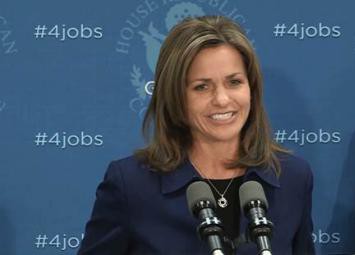
Kansas Congresswoman Lynn Jenkins

Here is her Republican response to Obama’s proposal to eliminate 529s:

Good morning. I’m Lynn Jenkins, Congresswoman from the Second District of Kansas and Vice-Chair of the House Republican Conference.

This is the time of year when high school seniors are putting the final touches on their college applications. That means it’s also the time when families are preparing to start paying for that education — whether it’s a 4-year college, community college, or a technical school. (Scroll down for video of these remarks.)

As a parent with two children in college, I know this can be one of the most rewarding, and at the same time challenging, aspects of being a parent — particularly at a time when costs are going up while wages stay about the same. All told, Americans now owe more than $1 trillion in student loan debt.

And so in the new Congress, Republicans are working to lower costs for middle-class families and empower folks with bottom-up solutions that help prepare you for the future.

That’s why, this week, I introduced a bipartisan plan to expand popular 529 college savings accounts.

As you know, these 529 plans were created to help middle-class families save and plan for college. Many parents open them not long after their children are born. And ever since Congress allowed folks to withdraw from these accounts tax-free for college expenses, 1 million account holders have turned into 12 million.

Unfortunately, instead of expanding 529s, the president recently proposed raising taxes on college savings. If implemented his scheme would have turned back the clock on middle-class families, and taken money from your savings to pay for more government. This would have discouraged families from using 529s, meaning less savings, more debt, and more government dependence.

This proposal increases middle-class independence from the government, and makes people more free to work, earn, save and chart their own course. It’s different from the Democrat proposals which increase dependence on government and reduces liberty.