
Tag Archives: Education

Economist Walter Williams explains how to not be poor

Economist Walter Williams

Here is his article on wealth and poverty on Creators.

First, there is no real poverty in the United States:

There is no material poverty in the U.S. Here are a few facts about people whom the Census Bureau labels as poor. Dr. Robert Rector and Rachel Sheffield, in their study “Understanding Poverty in the United States: Surprising Facts About America’s Poor”, report that 80 percent of poor households have air conditioning; nearly three-quarters have a car or truck, and 31 percent have two or more. Two-thirds have cable or satellite TV. Half have one or more computers. Forty-two percent own their homes. Poor Americans have more living space than the typical non-poor person in Sweden, France or the U.K. What we have in our nation are dependency and poverty of the spirit, with people making unwise choices and leading pathological lives aided and abetted by the welfare state.

Second, the “poverty” is not caused by racism, but by poor choices:

The Census Bureau pegs the poverty rate among blacks at 35 percent and among whites at 13 percent. The illegitimacy rate among blacks is 72 percent, and among whites it’s 30 percent. A statistic that one doesn’t hear much about is that the poverty rate among black married families has been in the single digits for more than two decades, currently at 8 percent. For married white families, it’s 5 percent. Now the politically incorrect questions: Whose fault is it to have children without the benefit of marriage and risk a life of dependency? Do people have free will, or are they governed by instincts?

There may be some pinhead sociologists who blame the weak black family structure on racial discrimination. But why was the black illegitimacy rate only 14 percent in 1940, and why, as Dr. Thomas Sowell reports, do we find that census data “going back a hundred years, when blacks were just one generation out of slavery … showed that a slightly higher percentage of black adults had married than white adults. This fact remained true in every census from 1890 to 1940”? Is anyone willing to advance the argument that the reason the illegitimacy rate among blacks was lower and marriage rates higher in earlier periods was there was less racial discrimination and greater opportunity?

Third, avoiding poverty is the result of good choices:

No one can blame a person if he starts out in life poor, because how one starts out is not his fault.

If he stays poor, he is to blame because it is his fault. Avoiding long-term poverty is not rocket science. First, graduate from high school. Second, get married before you have children, and stay married. Third, work at any kind of job, even one that starts out paying the minimum wage. And finally, avoid engaging in criminal behavior. It turns out that a married couple, each earning the minimum wage, would earn an annual combined income of $30,000. The Census Bureau poverty line for a family of two is $15,500, and for a family of four, it’s $23,000. By the way, no adult who starts out earning the minimum wage does so for very long.

Fourth, what stops people from making good choices is big government:

Since President Lyndon Johnson declared war on poverty, the nation has spent about $18 trillion at the federal, state and local levels of government on programs justified by the “need” to deal with some aspect of poverty. In a column of mine in 1995, I pointed out that at that time, the nation had spent $5.4 trillion on the War on Poverty, and with that princely sum, “you could purchase every U.S. factory, all manufacturing equipment, and every office building. With what’s left over, one could buy every airline, trucking company and our commercial maritime fleet. If you’re still in the shopping mood, you could also buy every television, radio and power company, plus every retail and wholesale store in the entire nation”. Today’s total of $18 trillion spent on poverty means you could purchase everything produced in our country each year and then some.

Walter Williams is one of my two favorite economists, the other being Thomas Sowell. By sheer coincidence, they both happen to have grown up poor, and they both happen to be black. They understand what causes poverty very well. I recommend their books to you if you want to understand economics.
Reversing the American trend of borrowing and spending too much

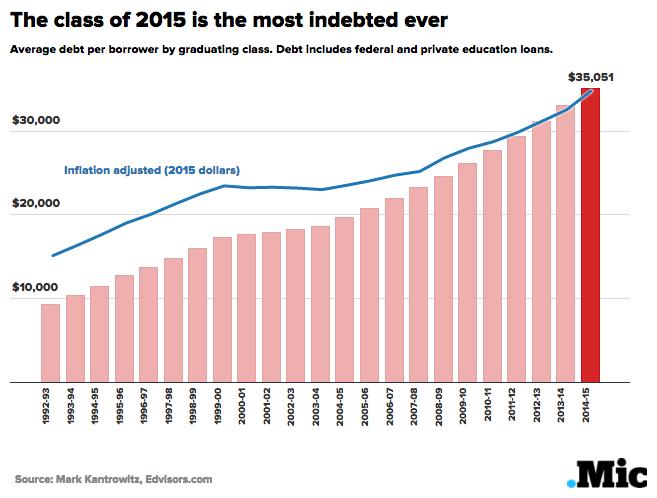
Average college debt is now up to $35,000 and usually for a useless non-STEM degree
Average debt is now up to $35,000, often for a useless non-STEM degree

First, the problem, using this article from New Zealand. It is authored by a self-made millionaire to young people.

Excerpt:

A young property tycoon has hit out at Generation Y claiming they need to stop travelling and spending money on overpriced food if they want to save for their first home.

Tim Gurner, 35, is worth nearly half a billion dollars since buying his first investment property at the age of 19.

The Melbourne millionaire believes it’s time his generation change their spending and lifestyle habits.

“When I was trying to buy my first home, I wasn’t buying smashed avocado for $19 and four coffees at $4 each,” he told Channel Nine’s 60 Minutes program.

“We’re at a point now where the expectations of younger people are very, very high. They want to eat out every day, they want travel to Europe every year.

“This generation is watching the Kardashians and thinking that’s normal – thinking owning a Bentley is normal.”

And how did the millennials respond? With immature, ignorant rebellion:

Gurner’s comments have been met with a backlash on social media will many criticising how he started out in the property – with a loan from his grandfather.

One social media comment read: “Maybe the new home buyers would stand more of a chance if they were given 34K by their grandad… that’s a fair few smashed avos.’

Another added: ‘Nice if you can get it,’ while one commented: ‘Much like Trump’s dad gave him a “small loan of $1Mil.’

Of course, the average college graduate HAS actually borrowed that much money (see graphic above), but they just preferred to blow it all on alcohol, birth control and a degree in English literature.

Speaking of a degree in English literature…

This woman complained to her boss because she wasn’t making enough money. She graduated with a non-STEM degree (English literature), and lives in one of the most expensive cities in America. (The cities that are all run by leftist Democrats who love to spend money on public works and welfare). She didn’t even have roommates to split the rent!

I see this in so many young people – complete disregard for the future in order to have fun, thrills and frivolous travel right now. And all their same-age friends support their decision-making. Young people don’t listen to grown-ups who have experience and real achievements. They listen to their friends. I know one woman who literally flew off to be a missionary in Europe for two years, on the advice of two Christian students, neither of which had ever worked a full-time job or saved money. They were proudly living off their parent’s incomes into their late-20s, and she looked to them for advice on education, career and finances.

Low-income earners can still save money

You don’t have to have a great job to make choices that lead to growing your wealth.

Here is an article from Business Insider about how to build wealth on a minimum wage salary.

Excerpt:

Here are the key expenses that someone on minimum wage can consider cutting, to make an immediate impact:

  • Moving to a more affordable city can cut living expenses considerably. It’s hard to accumulate wealth in Manhattan or San Francisco, but is much more likely in Buffalo or Memphis.
  • Eliminate commuting. Cars are expensive, and it is possible to get a place close enough to work to bike.
  • Cut some wires, particularly cable. After all, it’s 2017 – just go with internet and Netflix.
  • Don’t eat out, unless it’s absolutely necessary.
  • Skip most purchases of new clothes. Instead, make thrift stores your new best friend, and don’t be afraid to mend holes in clothing.
  • Cut expensive activities, and rediscover that the best things in life are free. Playing many sports can be free (or cheap), and public libraries are free (or cheap).

Once that’s done – it’s all about investing in yourself.

The Obama administration set interest rates low for the last eight years, encouraging people to borrow more and more money – money that they could not pay back. Thankfully, the private sector has ways of encouraging people to save money.

This article is from the far-left The Atlantic.

Excerpt:

Late last summer, Dawn Paquin started keeping her money on a prepaid debit card from Walmart instead of in a traditional checking account. The wages from her factory job—she works from 9 p.m. to 5 a.m., inspecting blades on industrial bread-slicing machines—now go directly onto the Visa-branded card, which she can use like a regular debit card, though unlike most debit cards, it is not linked to a checking or savings account.

[…]The card is more convenient, Paquin said, and she doesn’t have to worry about monthly statements; she tracks her money, and pays all her bills, with the card’s associated phone app.

[…]In a 2015 Federal Reserve Board survey, 46 percent of respondents reported that they would have trouble coming up with $400 in an emergency; living paycheck to paycheck is now a commonplace middle-class experience. So while Paquin noticed that her Walmart MoneyCard app asked her from time to time whether she wanted to “stash” some money, she didn’t bother to figure out what that actually meant, let alone respond.

Then, late last year, she got an email saying that a “prize savings” feature had been added to her card. If she kept some of her balance in a virtual “vault,” meaning that it would not show up in her available funds, she would be eligible to win a cash prize in a monthly drawing—up to $1,000. Every dollar in the MoneyCard Vault would equal an entry in that month’s drawing. This caught her interest. A prize would go a long way toward her being able to buy a car. It also made her focus on what all those “stash” requests were about. “Oh, cool, this can work as a savings account, too,” she remembers realizing. So when she got paid, she started setting aside “10 bucks, 20 bucks, whatever I could.”’

[…]The program was launched to a limited number of MoneyCard holders in August, offering 500 prizes a month—one for $1,000, the rest $25 each. In December, the company reported that the number of Vault users had grown more than 130 percent, to more than 100,000, and that the average savings had grown from $413 to $572, a 38 percent increase.

Paquin actually did end up winning the $1000 prize for stashing some of her earnings. And she saved most of it, of course. Because she learned from the incentives.

Men on strike: the social changes that caused men to opt out of marriage

SurveyMonkey election poll cross tabs for unmarried women Nov 2016
SurveyMonkey election poll cross tabs for unmarried women only Nov 2016

I read and enjoyed Dr. Helen Smith’s book “Men on Strike” last year. The book explains a few of the developments that have led to men underperforming in school and in the workplace, and opting out of marriage and fatherhood.

Dr. Helen comes to this problem as a secular libertarian, not as a Christian conservative.

A review of Dr. Helen’s book appeared in Salvo magazine. The review is written by Terrell Clemmons, who has the best Christian worldview of any woman I know – I frequently rely on her advice.

Terrell writes:

While the feminist movement may originally have been about equal respect for both sexes, what it has morphed into, she argues, is female privilege. From rape laws that empower women but not the men they may falsely accuse, to divorce laws tilted in favor of the wife, to the feminization of the U.S. education system, men have become the sex under the gun, while women enjoy the status of a protected class.

But unlike their mothers or grandmothers, men today are not taking to the streets burning their undergarments and shrieking demands (thank God). They’re doing just the opposite, which is far worse. They’re going on strike. The strike zones are manifold:

Higher Education.In addition to the enrollment imbalance, which is approaching a 60/40 ratio of women to men, college has become, in the words of one professor, “a hostile working environment [in which] males increasingly feel emasculated.” Smith quotes a student named John, who had this to say about his college experience: “I had already been cautious around women, having grown up with Tawana Brawley in my backyard and daily stories of sexual harassment; I played it safe and passive every time. But it doesn’t matter. The only way not to lose is to not play. So I’m out.”

Work,including community involvement. With higher female graduation rates and salaries, men today are falling behind their fathers economically and professionally. Consequently, their efforts to prove themselves worthy mates through hard work and higher earnings don’t win female attention the way they used to. Discouraged, too many retreat to a man cave, and inertia sets in from there.

Marriage.Marriage rates are down, and honest men opting out will tell you why. Smith cites a Rutgers University study of single heterosexual men which turned up the top reasons they hadn’t married. They can get sex and the companionship of cohabitation without marriage more easily than in times past, and they don’t want to open themselves up to the risk of divorce and financial loss. It really isn’t that complicated a decision. In fact, it’s often not an actual decision at all. It just happens.

The simplest explanation for the difficulties that boys face in an education system that is dominated by women (teachers and administrators) is discrimination. And in the workplace, the government requires employers to report on male and female head counts, and promote women who are not qualified. I have seen receptionists with tattoos and no college degrees promoted to six-figure manager jobs in companies where I worked.

There is one more which to me was the most surprising one in the book – paternity fraud, and the laws that support paternity fraud:

Take the following cases of nonconsensual insemination: Nathaniel from California, age 15, had sex with 34-year-old Ricci, which, due to his age, was legally considered nonconsensual. Emile from Louisiana was visiting his parents in the hospital when a nurse offered him oral sex, if he wore a condom, which she conveniently offered to dispose of for him afterward. S. F. from Alabama passed out drunk at the home of a female friend and awoke undressed the following morning. In all three cases, including the one involving the minor, a woman got sperm and, nine months later, a child, and the man got ordered by a court of law to pay support for eighteen years.

Less devious, but similarly amiss, are those cases in which a man, having been betrayed by his wife or girlfriend, was nevertheless held financially responsible for a child genetically proven to be another man’s offspring. While not as sensational as sperm-jacking, it is another form of paternity extortion.

In each of those cases, the man was found liable to pay child support – including the case of the 15-year-old boy, who was forced to pay child support to his statutory rapist when he turned 18. This is how the court system works, and more and more men are understanding the risks.

I often encounter “pro-marriage” people while gathering stories for the blog. These pro-marriage people come in two varieties.

On the one end of the spectrum are people like Terrell Clemmons and Jennifer Roback Morse, who understand marriage, but who also understand the social changes that have made marriage unattractive for men. Both Clemmons and Morse have a background in STEM fields, so they are able to understand incentives and tradeoffs. They understand that society has to rollback the changes to education, divorce laws, etc. if they expect men to be interested in marriage again. They understand that men are not just accessories of women, but instead have their own desires, feelings and reasons for marrying.

On the other end of the spectrum are feminist men, who are not able to understand the changing incentives that face men in a world that has evolved under the influence of radical feminism. It is just simpler (less thinking) for these men to accept the radical feminism as a given, and then urge men to “man up”. I think a much better idea would be for the “man up” crowd to realize how marriage has changed, and how the schools and the workplace have changed, then make all of these things more attractive to men. It doesn’t do any good to try to “dare” men into jumping off a cliff. Men aren’t stupid, and they do what is in their own best interests. If the man-up crowd wants younger men to marry, then they need to change the incentives offered to men. And that means changing women first.