Tag Archives: Education

Porkulus-2 bill would destroy school choice in Washington D.C.

I already blogged about the new 410 billion dollar omnibus bill here, but on John Boehner’s blog, I found out more about it. It’s not just that it contains 9000 earmarks, as Michelle Malkin noted. On John Boehner’s blog, he argues that the bill also contains a hidden provision that would destroy the voucher program in Washington, D.C..

This post states:

Congressional Democrats are scheming to deny low-income parents and students in the nation’s capital a popular school choice program by inserting a provision mandating Congress renew the program before more money is spent on it.  While this may sound innocuous enough, it would serve as a death blow to the groundbreaking D.C. school choice program – a goal Congressional Democrats have sought since taking control of Congress in 2007.

The post also links to a video produced by the Heritage Foundation that shows some of the affected students pleasing with Obama to let them attend private schools using vouchers, instead of attending defective public schools.

You may have heard that Washington, D.C. spends the most amount of money per pupil, but gets the least return on their investment. Andrew Coulson of the libertarian Cato Institute calculates the cost per student per year as $24,600. That is not a typo. The Washington Times notes that the voucher system cost only $7500 per year, and produced far better results than the government-run, union-staffed public schools.

The Opportunity Scholarship Program that Congress established allows more than 1,900 low-income D.C. children to receive vouchers so they can attend the private school of their parents’ choosing. The scholarships are good for up to $7,500. So, the best bet is obvious: a $7,500 voucher that caters to children – not a one-size-fits-all $24,600 per-pupil plan. The former has measurable academic success and incredible parental demand; the latter consistently places children at the bottom rungs of the academic ladder. In fact, D.C. ranked the lowest in math and reading, according to results of the National Assessment of Educational Progress tests released in September.

The Boston Globe summarizes the numbers on reading and math here:

According to the authoritative National Assessment of Education Progress, only one in seven fourth-graders is ranked at grade-level (“proficient”) or better in reading and math. Among eighth-graders, only one in eight is proficient in reading; only one in 12 can handle eighth-grade math.

John Boehner is quote in his blog post as follows:

The D.C. school choice program has provided hope for thousands of low-income children in the District of Columbia since it was established, and has been demonstrating results when it comes to parental satisfaction and increased parental involvement.  Eliminating this program would represent an irresponsible and shameful act on the part of the Democratic leadership in Congress, and the children of the District of Columbia deserve better.

If the Barack Obama is willing to take away school-choice from the poorest students in the nation in order to satisfy the teachers unions that got him elected, then what hope do the rest of us have of keeping our liberty?
Split decision on Texas evolution standards favors academic freedom

Over at the Discovery Institute’s Evolution News blog, they recently reported that the Texas State Board of Education reached a split decision on the state standards for teaching evolution.

Evolution News says this in their post:

Kudos to the New York Times for filing a story on the actions of the Texas State Board of Education that actually describes what happened last week. Unlike much of the rest of the newsmedia, the Times doesn’t tell only half of what happened or play up the hysterics. The story’s even-handed title is telling: “Split Outcome in Texas Battle on Teaching of Evolution.”

The NYT article they mentioned explains the compromise reached by the Texas State Board of Education.

First, the bad news:

…the board voted to drop a 20-year-old mandate that science teachers explore with their students the “strengths and weaknesses” of all theories.

But the board also passed some good amendments, among them this one:

…one that would compel science teachers to instruct students about aspects of the fossil record that do not neatly fit with the idea of species’ gradually changing over time, like the relatively sudden appearance of some species and the fact that others seem to remain unchanged for millions of years.

Let me explain why this is a big win for ID. One of my previous employers was a major academic publishing company. By major, I mean my alma mater’s campus library featured academic publication databases that I helped to code. In this company, it was well known that California and Texas were the two most important states, because their textbook standards set the guidelines for the other states.

The NYT article explains:

Whatever the 15-member board decides then will have consequences far beyond Texas, since the state is one of the largest buyers of textbooks in the nation. The new standards will be in place for the next decade, starting in 2010, and will influence the writing of the next generation of biology texts, which the state will order this summer.

John G. West of the Discovery Institute evaluates the board’s decision as positive:

“They did something truly remarkable today,” John G. West of the Discovery Institute, a group that questions Darwinism, said in a statement. “They voted to require students to analyze and evaluate some of the most important and controversial aspects of modern evolutionary theory.”

I actually have podcasts for you of the testimonies of pro-ID scholars given to the Texas Board. If you want to learn how scientists argue for academic freedom on issues of origins, you should listen to these three 15-minute podcasts.

  1. My favorite ID scholar Stepen C. Meyer testified on the Cambrian explosion and the fossil record, (podcast, article). Meyer holds a Ph.D in the Philosophy of Science from Cambridge University. I once saw him explain biological information using colorful lock-blocks, live. (He stole them from his children). I often draw it up for my co-workers on a white board, just like he does!
  2. Microbiologist Ralph Seelke testified about how his lab research that shows clear limits on how far bacteria can evolve, (podcast, article). Seelke holds a Ph.D in Microbiology from the University of Minnesota and the Mayo Graduate School of Medicine. He is a Professor in the Department of Biology and Earth Sciences at the University of Wisconsin-Superior.
  3. Biochemist Charles Garner testified on the chirality problem in chemical evolution, (podcast, article). He also discussed the importance of not glossing over the weaknesses of scientific theories. Garner holds a Ph.D. in Organic Chemistry from University of Colorado, Boulder. Garner is now a Associate Professor in the Department of Chemistry & Biochemistry at Baylor University.

For those looking for a definition of what intelligent design is, look here. I highly recommend the work of Canadian journalist Denyse O’Leary, who is probably the foremost expert on why there is an ID controversy. Her main blog on ID is called Post-Darwinist.

As a supporter of academic freedom, I sent a donation to the Discovery Institute’s Center for Science and Culture yesterday. The CSC is currently offering a free book with donations received before February 28th, 2009. For my annual donation, I chose Stephen C. Meyer’s forthcoming book “Signature in the Cell: DNA and the Evidence for Intelligent Design“.

On another note, I am also excited about Jay Richards’ forthcoming book, “Money, Greed, and God: Why Capitalism Is the Solution and Not the Problem“. Jay did a great lecture on basic economics for Christians and another great lecture on what Christians should think about global warming. Maybe his employer, the Acton Institute, will give me a free book if I send them a donation?

UPDATE: Casey Luskin just posted audio of Stephen C. Meyer responding to questions after is presentation at the hearing.

Bobby Jindal pushes education reform in Lousiana

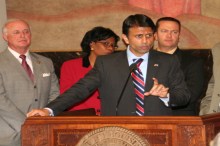
Governor Jindal speaks about budget reform

Last year, my favorite Governor, Bobby Jindal, passed several laws to address discipline problems in the schools. One bill’s goal was to re-establish discipline in classrooms by empowering teachers. Another bill sought to protect teachers from frivolous lawsuits. A third toughens penalties for students who are absent or tardy. That was a great start, especially since it was miles away from the typical teacher union plan to spend more money without any guarantee of better student achievement.

But he goes even further here, in a post dated 2/17/2009. First, he expands the laws governing discipline in the classroom even further.

We will give teachers more authority to remove students from the classroom for unruly behavior, require that parents be notified when their child is removed, and administrators will have to give their teachers feedback and management skills to help them work with misbehaving students.

Additional plans to increase discipline include requiring that suspended students make up missed work, permitting courts to help our schools hold parents accountable for attending mandatory intervention programs with their kids, and to allow schools to work with the courts to enforce truancy penalties. These steps will ensure that not only teachers and administrators will be taking a more active role in discipline – parents will be held accountable as well.

He also proposes to strengthen charter schools.

…we will require that our public elementary and secondary education boards use a high-quality third party review process for approving charter school applications. By ensuring that all applications are measured by the same high-quality standards, we can make certain that only the best applications are approved.

The regulation of charter schools is OK because as I understand it, charter schools are public schools. And lastly, he proposes something that the teacher unions and children will hate, but that parents and taxpayers will love: teacher and student evaluation criteria.

…we will work to implement a comprehensive value-added assessment model, which will aid our schools in better determining teacher effectiveness and student improvement. Our state has completed nationally recognized research, which was recently praised by the National Council on Teacher Quality, dealing with the use of value-added data well-positions in teacher preparation programs to improve our current system. This model takes student achievement into account, which better informs our parents, teachers, and kids on the progress our students are making.

The article also mentions a dropout prevention program that is coming out soon. The press release goes on to discuss budget reforms and coastal infrastructure. He proposes web sites to make budget expenditures transparent to the taxpayers, as well as subjecting all spending to accountability standards.

Bobby Jindal, along with Mark Sanford in South Carolina, are my two favorite governors. Being a person of color myself, it is a real joy for me to see an Indian-American man universally regarded as the savior of the Republican party. In the Republican primaries of 2008, I favored Fred Thompson, because he had good ideas. But Jindal is a policy genius. And at 38 years old, he has youth, charisma and passion. What we need in the Republican party are compelling ideas, and people who are willing to debate with our opponents in order to convince them.

To find out more about Bobby Jindal, check out these links:

Interview with Michael Medved (audio, 25 minutes)
Interview with Rush Limbaugh (PDF)
The American Spectator: Hope Floats on the Bayou
RedState.com: Bobby Jindal Saves Louisiana
Townhall.com: The Future of Conservatism (Isn’t Running for President)
The Weekly Standard: Jindal All the Way
The National Review: The Governor Is Right
The Wall Street Journal: Bayou Boy Wonder
Townhall.com: Want real hope and change? Try Louisiana