
Tag Archives: Economy

Paul Ryan declares war on Obama’s record 1.56 trillion dollar budget deficit

Rep. Paul Ryan

Conservative Republican Paul Ryan’s response to Obama’s new 2010 budget.

Excerpt:

“For the duration of the Administration’s 10-year budget, the deficit never falls below $700 billion, and never falls below 3.6 percent of GDP – a level the Administration’s own budget director has called ‘unsustainable.’ Debt held by the public doubles over 5 years, triples over 10,   and exceeds 60 percent of GDP as a share of the economy this year – surpassing last year’s 50-year high. Debt continues to rise to consume 77.2 percent of our economy by the end of the budget window. Even the countries of the European Union, hardly exemplars of fiscal rectitude, are required to keep their debt levels below 60 percent of GDP.

“The Administration will attempt to focus attention on a handful of proposals supposedly aimed at tempering the Federal Government’s explosive growth. But these have far more to do with calming Americans’ concerns than with doing anything to address them. His pay-as-you-go proposal has been waived or circumvented and only locks in deficits at their current high levels. His non-binding commission simply punts on the critical budget decisions that Members of Congress got elected to make. Finally, his so-called ‘freeze’ on some discretionary spending follows an 84-percent increase – and has no clear means of enforcement.

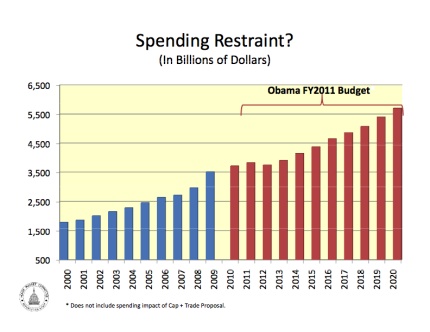
These charts accompany Paul Ryan’s statement. (H/T Michelle Malkin)

First, government spending:
Second, debt held by public as % of GDP:
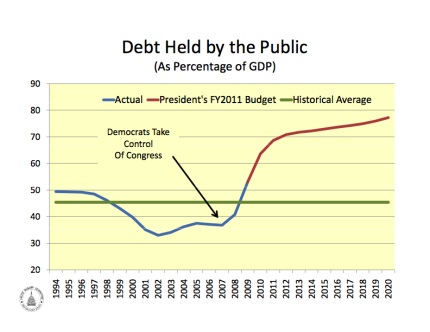
The problems started when the Democrats got control of Congress in late 2006. (The House controls spending) Talking about “spending freezes” on tiny amounts of the budget now has no effect because we are losing a trillion dollars-and-a-half dollars a year now. It’s just politics meant to deceive the people who still believe Obama’s honeyed words.

More details about Obama’s budget are here on the Republican House Budget Committee web site.

What is Paul Ryan’s alternative?

Neil Simpson posted a link to an overview of Paul Ryan’s plan.

Excerpt:

Health Care
•    Provides a refundable tax credit — $2,300 for individuals and $5,700 for families — to purchase coverage in any state, and keep it with them if they move or change jobs.
•    Allows Medicaid recipients to take part in the same variety of options by using the tax credit to purchase high-quality care.

Medicare
•    Establishes and fully funds Medical Savings Accounts for low-income beneficiaries to cover out-of-pocket costs, while continuing to allow all beneficiaries, regardless of income, to set up tax-free MSAs.

Social Security
•    Offers workers under 55 the option of investing over one third of their current Social Security taxes into personal retirement accounts, similar to the Thrift Savings Plan available to federal employees.

Tax Reform
•    Provides taxpayers a choice of how to pay their income taxes – through existing law, or through a highly simplified income tax system that fits on a postcard with just two rates and virtually no special tax deductions, credits or exclusions (except the health care tax credit).
•    Promotes saving by eliminating taxes on interest, capital gains and dividends and eliminates the death tax.

Read the rest, and see if these ideas that promote saving and investing, instead of borrowing and spending, make more sense to you than Obama’s spending millions of taxpayer dollars on turtle tunnels.

How Democrat policies cause unemployment to increase

Consider this article from the Washington Post. (H/T Belmont Club via ECM)

How Democrats prevent job creation

Most of the article talks about how Obama’s temporary hand-outs will not create any lasting jobs – they’ll simply go away as soon as the government stops taking money from the private sector to pay for these public works projects. But then the article talks about free trade and how free trade creates jobs. Is Obama in favor of free trade?

Excerpt:

More promising is the president’s call for a renewed national emphasis on exports, which currently support about 10 million jobs in the United States. It’s a sound concept, especially at a time when the weak dollar improves this country’s global competitiveness. But the goal he set in his State of the Union address — doubling exports to $3 trillion per year over the next half-decade — is unreachable via the laudable but modest policies that he has been willing to embrace so far, such as greater trade promotion efforts and relaxed controls on national security-related export controls. Though he called for “strengthened” trade relations with South Korea, Panama and Colombia, he did not challenge Congress to approve pending free-trade agreements with those three countries. That would require defying labor unions and other interest groups in his party. But it would create hundreds of thousands of jobs.

Free trade creates jobs by allowing our businesses to buy cheaper materials from abroad, and to sell their products into foreign markets. Consumers also benefit by being able to buy cheaper foreign goods, which allows them to save, invest or buy other things.

The only people who suffer are labor unions, who are paid salaries and benefits far in excess of what their skills really warrant. For example, a unionized GM auto worker in Detroit may be paid $70/hour in salary and benefits, while a non-unionized Honda auto worker in Ohio may be paid $40/hour. Unfortunately, these unions play a big role in getting Democrats elected, sometimes by using violence, etc., to get their man elected.

How Democrats cause jobs to be shipped overseas

Here is the latest from the Heritage Foundation. (dated 01/12/10)

Excerpt:

According to an Associated Press analysis reviewed by independent economists at five universities, the $20 billion spent nationwide on infrastructure so far “has had no effect on local unemployment rates.” And this was just the most recent embarrassing headline for the White House’s signature economic policy. Since the first reporting deadline in October, newspapers and other media outlets across the country have identified 94,341 fake jobs reported by the Obama administration as jobs “created or saved” by the stimulus. After the Government Accountability Office issued a report finding “significant reporting and processing problems that need to be addressed,” Obama administration spokesman Ed Pound offered this defense of the Obama administration’s jobs numbers: “Who knows, man, who really knows.”

Now Office of Management and Budget Director Peter Orszag issued a little-noticed memo last month ending the “saved or created” metric and instead directing agencies to count only jobs “funded” by stimulus dollars. But as Harvard University labor economist Lawrence Katz tells ProPublica, this is not really an improvement: “I just think it’s a silly exercise.” Instead Katz says a more accurate way to account for the effect of the stimulus is to look at the unemployment numbers put out by the Bureau of Labor Statistics.

That is a great idea. The latest BLS report issued last Friday found that the U.S. economy dropped 85,000 jobs in December, bringing the jobs lost total to 2.7 million since the stimulus was passed and 3.4 million since Obama became President. In contrast, the President’s White House Council of Economic Advisers had promised total employment of at least 138.6 million by 2010. Actual employment as of December was reported to be 130.9 million, leaving the Obama jobs deficit at 7.7 million.

The problem with infrastructure spending as stimulus, and really government spending as stimulus, is that Congress does not have a vault of money waiting to be distributed. Every dollar Congress injects into the economy must first be taxed or borrowed out of the economy. No new spending power is created. It is merely redistributed from one group of people to another. Businesses are telling pollsters that among the biggest reasons they are not creating jobs is the prospect of new tax and regulatory burdens. A better solution to reduce unemployment is to simplify and reduce the barriers to business success.

The problem is that Obama is associated with special interests who are hostile to business, like unions, trial lawyers, and environmentalists, so he won’t do what needs to be done. Whenever Democrats tax, regulate, intimidate, and demonize business, they cause unemployment to increase. Fancy that. All this complaining by Democrats about “greedy corporations” and “global warming” cost you your job.

Obama promised that his policies would create jobs, but his policies failed. He predicted that his policies would work, but they did not work. He prescribed pixie dust to fix the economy, and it failed. He failed. And his only response to his failure is to blame his predecessor who embraced tax cuts and free trade, and presided over a 5.2% average unemployment rate over 8 years. George W. Bush didn’t attack businesses, and we all had jobs. Remember that?

Related posts

Does 5.7% GDP growth help to alleviate the 17% effective unemployment rate?

Consider this article from Bloomberg News. (H/T ECM)

Excerpt:

New York University Professor Nouriel Roubini, who anticipated the financial crisis, called the fourth quarter surge in U.S. economic growth “very dismal and poor” because it relied on temporary factors.

Roubini said more than half of the 5.7 percent expansion reported yesterday by the government was related to a replenishing of inventories and that consumption depended on monetary and fiscal stimulus. As these forces ebb, growth will slow to just 1.5 percent in the second half of 2010, he said.

Investors Business Daily explains:

So let’s deconstruct that 5.7% a bit. For one thing, most of the gain — nearly two-thirds, in fact — was a result of an end to the panicked inventory liquidation that took place at U.S. firms last year. Remove that, and a different picture emerges — a 2.2% rise in GDP.

Most economists agree that GDP growth of 3% or so is needed to boost employment. That may in part explain why GDP could grow 2.2% in the third quarter and 5.7% in the fourth quarter, while businesses slashed 735,000 jobs over the same six months.

More meaningful is year-over-year growth. By that measure, we barely grew — real GDP rose just 0.1% in the fourth quarter from last year, virtually flat. Worse, real nonresidential fixed investment — a proxy for business investment in future output — plunged 14.6% from last year. That’s a shocking vote of “no confidence” in Obamanomics by America’s entrepreneurs and businesses.

We wish that was all, but it isn’t. According to the Labor Department, wages and benefits rose in 2009 by just 1.5%, the smallest rise in history. Meanwhile, weekly earnings for nonmanagement workers fell 1.6% last year, the worst since the 1991 recession.

These subpar numbers only underscore the weakness of our job market. In just two years, we’ve destroyed almost 8 million jobs and watched as the unemployment rate surged to 10%.

One quarter of growth isn’t going to change anything – we still have 10% unemployment, which is actually 17% when you consider the people who are no longer actively looking for work. Obamanomics wrecked the economy, starting in late 2006 when the Democrats got control of the House.