In celebrating Ohio’s comeback, Obama is unintentionally repudiating his own policies. It turns out that, in spite of Obama, Ohio is 4th in the nation in job creation and tops in the Midwest. In the previous four years before Republican Gov. Kasich came into office, Ohio was 48th.
Even the states that are ahead of Ohio in job creation are far larger. Check out the other members of the top five job-creating states: Texas, New York, California and Florida. All are far more populous than Ohio. Florida, for instance, has 6.5 million more people, yet Ohio edged it out in job creation.
In fact, February’s BLS data showed that Ohio created more jobs than any other state. When was the last time that happened? Can’t tell, because the BLS doesn’t offer data prior to the Clinton era, so it’s been at least that long.
In short, Ohio proves that conservative fiscal policies work in spite of Barack Obama. While Obama’s “leadership” destroyed America’s pristine AAA credit rating, S&P was simultaneously upgrading Ohio’s rating.
[…]Kasich has a damn good record when it comes to fiscal policies. Bill Clinton won’t ever admit it in public, but the real architect of the much-ballyhooed ‘Clinton Surplus’ was none other than John Kasich, the Paul Ryan of Newt Gingrich’s House of Representatives.
John Kasich is one of three governors that I am watching closely. The other two really good ones are Scott Walker in Wisconsin and Bobby Jindal in Louisiana. I personally think that Kasich is the best governor in the United States of America. And Ohio has a great Senate candidate too, named Josh Mandel.
The Canadian government released details Tuesday of its plan to dramatically streamline reviews for big energy and mining projects, capping the timeline for federal reviews and ceding more regulatory oversight to the country’s provinces.
The Conservative government of Prime Minister Stephen Harper has said for months it would move to speed up the regulatory review of big energy, mining and infrastructure projects. It has expressed frustration at the sometimes-lengthy review timelines for big projects.
Mr. Harper’s government said in its annual budget announcement last month that it would cap federal reviews. Resources Minister Joe Oliver released details Tuesday, saying that federally-led hearings would be applied only to major initiatives that risk some environmental harm.
Further, the government said it was prepared to hand over more responsibility for the review to Canadian provinces, so long as their regulations meet or exceed federal standards. Canadian provinces already enjoy considerable regulatory oversight.
“It is counterproductive to have the federal and provincial governments completing separate reviews of the same project,” Oliver said in a speech in Toronto.
[…]The government had previewed in its budget last month that reviews for major projects would be limited to 24 months. Meanwhile, regular inter-provincial pipeline reviews, as conducted by the National Energy Board, would be limited to 18 months.
Oliver said Tuesday that Enbridge Inc.’s (ENB) proposed Northern Gateway pipeline – which envisions shipping oil from Alberta to Canada’s West Coast — would benefit from the quicker review. The line has been mired in stiff opposition from native groups in British Columbia, and the government has accused foreign-funded environmental groups of tying up the project in regulatory hearings. Government officials said the new rules would also limit who could participate as intervenors in the review process.
[…]In Toronto, Oliver said the current process is unworkable, with over 40 federal departments involved in reviews. He said he would pare that back to only three federal agencies: the Canadian Environmental Assessment Agency; the National Energy Board; and the Canadian Nuclear Safety Commission.
The Canadian process, as it stands, forces investors to go “through hoops and hurdles as far as the eye can see,” Oliver said. “We simply have to turn that around.”
Canadians don’t want to scare businesses away from Canada – they want the jobs to come to Canada. That’s the exact opposite of what Obama’s socialist “Environmental Protection Agency” does – they regulate energy development, in order to block it or slow it down.
And Canada lowered corporate taxes to 15% compared to our 35% – and their revenues held steady.
Canada: Corporate tax cuts, not stimulus spending
They cut their corporate tax rate, but then businesses saw the lower rate and just kept on expanding in order to make more money. As businesses grow, they pay more in taxes. So government revenues from taxes haven’t dropped at all, even with the lower corporate tax rates! More businesses moved in to Canada to capitalize on the lower tax rates, generating revenue for the government. More workers moved off of unemployment and welfare as demand for labor grew, and they started paying income taxes and sales taxes, generating even more revenue for the government. Do you know what makes consumers more confident, so that they spend more? Having a job. Not being dependent on government.
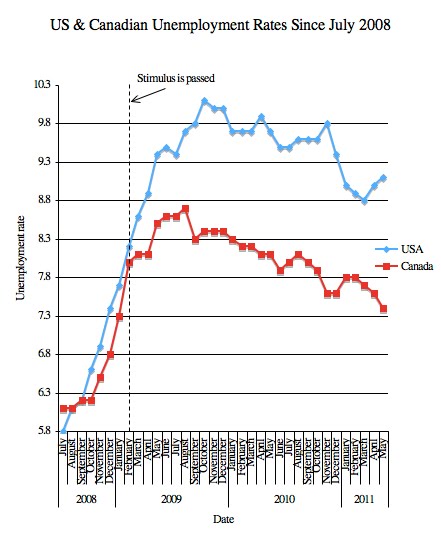
Look at their unemployment rate:
Canada and US unemployment rates
When we embraced “stimulus” spending, they went for the corporate tax cuts. Our unemployment rate used to be LOWER than theirs, before Pelosi and Reid took over Congress in January 2007. Now we are HIGHER than they are. That’s not rhetoric – that’s data. Even though Canada’s economy is linked to ours, and has suffered as a result of that, they have been signing free trade deals left, right and center. They did this in order to decouple themselves from our collapsing economy, massive debt and devalued currency. Barack Obama, of course, opposes free trade. He has to – he’s in the back pocket of the socialist labor unions.
Free trade empire: (click for larger image)
Canada: Free Trade Empire
What a contrast Canada’s energy policy makes with Obama’s politicized “Cash for Cronies” energy policy. But then again, Canada hired a conservative right-wing capitalist economist to run their country. We could have just done the same and put in economists like Thomas Sowell or Walter Williams to run our economy, but we put in an unqualified community organizer instead.
Practicing Catholic Paul A. Rahe explains why he thinks that the Catholic Church made a mistake by supporting Obamacare.
Excerpt:
In the 1930s, the majority of the bishops, priests, and nuns sold their souls to the devil, and they did so with the best of intentions. In their concern for the suffering of those out of work and destitute, they wholeheartedly embraced the New Deal. They gloried in the fact that Franklin Delano Roosevelt made Frances Perkins – a devout Anglo-Catholic laywoman who belonged to the Episcopalian Church but retreated on occasion to a Catholic convent – Secretary of Labor and the first member of her sex to be awarded a cabinet post. And they welcomed Social Security – which was her handiwork. They did not stop to ponder whether public provision in this regard would subvert the moral principle that children are responsible for the well-being of their parents. They did not stop to consider whether this measure would reduce the incentives for procreation and nourish the temptation to think of sexual intercourse as an indoor sport. They did not stop to think.
In the process, the leaders of the American Catholic Church fell prey to a conceit that had long before ensnared a great many mainstream Protestants in the United States – the notion that public provision is somehow akin to charity – and so they fostered state paternalism and undermined what they professed to teach: that charity is an individual responsibility and that it is appropriate that the laity join together under the leadership of the Church to alleviate the suffering of the poor. In its place, they helped establish the Machiavellian principle that underpins modern liberalism – the notion that it is our Christian duty to confiscate other people’s money and redistribute it.
At every turn in American politics since that time, you will find the hierarchy assisting the Democratic Party and promoting the growth of the administrative entitlements state. At no point have its members evidenced any concern for sustaining limited government and protecting the rights of individuals. It did not cross the minds of these prelates that the liberty of conscience which they had grown to cherish is part of a larger package – that the paternalistic state, which recognizes no legitimate limits on its power and scope, that they had embraced would someday turn on the Church and seek to dictate whom it chose to teach its doctrines and how, more generally, it would conduct its affairs.
I would submit that the bishops, nuns, and priests now screaming bloody murder have gotten what they asked for. The weapon that Barack Obama has directed at the Church was fashioned to a considerable degree by Catholic churchmen. They welcomed Obamacare. They encouraged Senators and Congressmen who professed to be Catholics to vote for it.
Now, when I think of Catholics, I think of fiscal conservatives like Jay Richards, Robert Scirocco and Jennifer Roback Morse. There are Catholics who understand the relationship between fiscal policy and religious liberty. But many lay Catholics who listen to the bishops, nuns and priests don’t understand how fiscal policy relates to religious liberty. And I think that this is a good opportunity for lay Catholics to consider the fact that the church can sometimes be wrong – because they can be too liberal not because they are conservative! Imagine that. Sometimes, it’s not a good idea to just take the word of “experts” on some matters. It’s better to puzzle things out for ourselves by reading the Bible and studying things like economics, and then deciding how to reconcile the goals of the Bible with the way the world works. I think that it’s the case that we can help the poor by keeping government small, and by letting individuals and families have more freedom – not less.




 WINTERY KNIGHT