Tag Archives: Economy

Quebec court orders Dunkin’ Donuts to pay $16.4 million to failed franchise owners

Political map of Canada

ECM sent me this story about the most immoral and socialist province in Canada.

Excerpt:

Former Dunkin’ Donuts franchisees have been awarded a total of $16.4-million in damages from the company for losses suffered because of the “Tim Hortons phenomenon,” in which the donut shop saw almost all of its Quebec stores close in less than a decade as it lost market share, according to a superior court decision released Thursday.

The Quebec Superior Court ruled that Dunkin Donuts Canada Ltd. failed to protect and enhance its brand at the cost of the 21 franchisees and misled owners to get them to buy into a new strategy that ultimately failed.

“In this case, you have a very large franchisor with a successful chain and it’s facing a competitive threat by another large chain, i.e. Tim Hortons,” said Toronto-based franchise lawyer David Sterns of Sotos LLP. “And the judge’s view is that the franchisor couldn’t just cede the territory to the competitor, that it was incumbent on the franchisor to hold the ground for the system.”

There are currently 11 Dunkin’ Donuts stores left in Quebec, from a high of more than 200 in 1998.

In 2003 the franchisees launched the suit against Dunkin’ Brands — formerly Allied Domecq Retailing International Canada Ltd. — claiming they were induced under false pretenses to join a remodelling program that would boost sales by 15% in the first year and several subsequent years, which never happened.

The company also failed to live up to a promise to invest $40-million, half of which would come from franchise fees.

The lesson here for business owners and job creators is clear: never, ever start a business or expand a business in Quebec. They’re not just secular and anti-family, they’re socialist and anti-business.

Here’s an interesting post about Quebec’s fiscal situation:

Quebec’s austerity measures which include the raising of tuition fees for its post-secondary students have been headline news in Canada for the past month. In light of that, I thought that it was time to do a brief posting on Quebec’s financial situation.

Let’s start by looking at Quebec’s debt. Quebec is Canada’s second-most indebted province after Ontario and has the misfortune of having a bond credit rating that is in the lower middle of the pack, well below Alberta, Saskatchewan and British Columbia, Manitoba and below New Brunswick and Ontario at A+ (Standard and Poor’s), the same rating as Nova Scotia. This poor rating makes it more expensive for Quebec to service its debt. Quebec’s total debt in fiscal 2011 – 2012 is estimated to be $170.9 billion; this compares to Ontario’s estimated debt of $237.6 billion. Quebec’s debt nearly twice the size of all other provinces combined (excluding Ontario).

Quebec’s debt-to-GDP is estimated to be 51.2 percent in 2011 – 2012, the highest in Canada by a very wide margin with Ontario coming in second place at 37.2 percent and Nova Scotia coming in third place at 35.2 percent.

[…]If the Harper government follows through with its plans to wean Canada’s have-not provinces from the federal teat, Quebec may find it impossible to meet its fiscal goals. As well, when interest rates return to normal levels, Quebec’s expenditures on debt interest payments will become an ever-increasing portion of its overall spending. Since Quebec is already Canada’s most highly taxed regime, if the province hopes to meet its targets, it has only one choice – cut spending now.

It’s a worthless, backwards province that exists only by stealing money from hard-working provinces like Alberta and Saskatchewan. I hope Harper cuts them off – it’s not like they vote for him anyway. Let them eat grass and leaves for a few years.
As Greece’s private sector dies, so does government-provided health care

From Reuters. (H/T ECM)

Excerpt:

Greece’s rundown state hospitals are cutting off vital drugs, limiting non-urgent operations and rationing even basic medical materials for exhausted doctors as a combination of economic crisis and political stalemate strangle health funding.

With Greece now in its fifth year of deep recession, trapped under Europe’s biggest public debt burden and dependent on international help to keep paying its bills, the effects are starting to bite deeply into vital services.

[…]Greece, a member of the euro zone that groups some of the richest nations on earth, has descended so far that drugmakers are even working on emergency plans to keep medicines flowing into the country should it crash out of the currency bloc.

The emergency has grown out of a tangle of unpaid bills, with pharmacists and doctors complaining of being unable to pay suppliers until competing health insurers clear a growing backlog of unfilled state payments.

[…]Greeks have long had to give medical staff cash “gifts” to ensure good treatment. Nevertheless the health system was considered “relatively efficient” before the crisis despite a variety of problems including a fragmented organization and excess bureaucracy, according to a 2009 report for the Organisation for Economic Cooperation and Development.

But it has been unable to respond to the growing crisis. The European Union and International Monetary Fund, which provided a 130 billion euro lifeline to Greece in March, have demanded big cuts to the system as part of a wider package of austerity measures.

But powerful medical lobbies and unions have resisted fiercely. Caretaker Prime Minister Panagiotis Pikrammenos, in office until a new government is formed after the elections, has pleaded for a solution but been powerless to force a change.

What’s the lesson here? The lesson is that government programs have no money of their own – they don’t make anything or do anything that people want of their own free will. Only private companies do that because they have to compete with other sellers to please the customer. Government is a parasite on the private sector – everything they do is funded from taxes taken from workers and employers. When the economy goes bad, it’s not just private sector jobs that are lost, it’s public sector health care programs. That’s why no one should want government to go beyond the minimal functions set out in the Constitution.

UPDATE: On Sunday, Greece voted to reject Obamanomics and to live within their means.

Obama: private sector job creation is “doing fine”

From CNS News.

Excerpt:

“The private sector is doing fine,” Obama said at a press conference on Friday. “Where we’re seeing weaknesses in our economy, have to do with state and local government — oftentimes, cuts initiated by governors or mayors who are not getting the kind of help that they have in the past from the federal government and who don’t have the same kind of flexibility as the federal government in dealing with fewer revenues coming in.”

State and local leaders were not the only ones to blame for a bad economy, as the president also blamed Republicans in Congress.

What are the facts? Is Obama right?

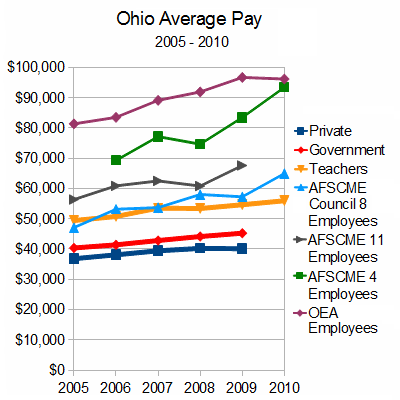
Here is a comparison of public and private pay in Ohio, for example:

Ohio Average Pay: Public vs. Private

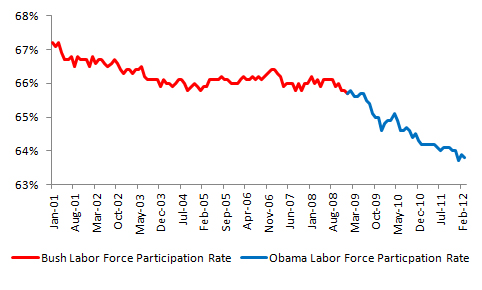
Does Obama know how to create jobs? Let’s compare him to Bush:

Labor Force Participation 2012 (click for larger image)

There is no recovery. We haven’t created any jobs. We’ve actually lost 5 million jobs since the Democrats took over the House and Senate in January 2007.

When George W. Bush was President, we had unemployment around 4 or 5 percent for 8 years, which deficits as low as $160 billion in 2007. Barack Obama has had four budget deficits of a trillion or more in a row, and his unemployment rate has been double Bush’s rate. Bush has an MBA from Harvard and had private sector job creation experience. Obama doesn’t know anything about economics. He’s a lawyer who benefited from affirmative action, and who has never released his grades. You can’t elect an unqualified person and get performance.