
Tag Archives: Economy

526 economists, including 5 Nobel prize winners, grade Romney and Obama plans

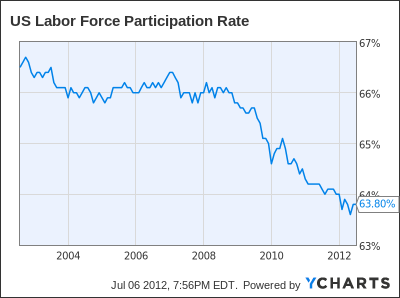
Labor Force Participation Rate

From the Daily Caller:

The 526 economists — including Nobel laureates Gary Becker, Robert Lucas, Robert Mundell, Edward Prescott, and Myron Scholes — point to six facets of Romney’s economic approach that they see as beneficial to future economic success.

  • Reduce marginal tax rates on business and wage incomes and broaden the tax base to increase investment, jobs, and living standards.
  • End the exploding federal debt by controlling the growth of spending so federal spending does not exceed 20 percent of the economy.
  • Restructure regulation to end “too big to fail,” improve credit availability to entrepreneurs and small businesses, and increase regulatory accountability, and ensure that all regulations pass rigorous benefit-cost tests.
  • Improve our Social Security and Medicare programs by reducing their growth to sustainable levels, ensuring their viability over the long term, and protecting those in or near retirement.
  • Reform our healthcare system to harness market forces and thereby reduce costs and increase quality, empowering patients and doctors, rather than the federal bureaucracy.
  • Promote energy policies that increase domestic production, enlarge the use of all western hemisphere resources, encourage the use of new technologies, end wasteful subsidies, and rely more on market forces and less on government planners.

Seven of the signatories are from Harvard University and five from Columbia University — two of President Barack Obama’s alma maters.

The economists’ statement of support pillories Obama’s economic record, claiming that his expansion of the federal government has resulted in “anemic economic recovery and high unemployment,” which will continue if his future plans are implemented.

Among the Obama policies with which the 526 economists take issue include:

  • Relied on short-term “stimulus” programs, which provided little sustainable lift to the economy, and enacted and proposed significant tax increases for all Americans.
  • Offered no plan to reduce federal spending and stop the growth of the debt-to-GDP ratio.
  • Failed to propose Social Security reform and offered a Medicare proposal that relies on a panel of bureaucrats to set prices, quantities, and qualities of healthcare services.
  • Favored a large expansion of economic regulation across many sectors, with little regard for proper cost-benefit analysis and with a disturbing degree of favoritism toward special interests.
  • Enacted health care legislation that centralizes health care decisions and increases the power of the federal bureaucracy to impose one-size-fits-all solutions on patients and doctors, and creates greater incentives for waste.
  • Favored expansion of one-size-fits-all federal rulemaking, with an erosion of the ability of state and local governments to make decisions appropriate for their particular circumstances.

We can’t afford four more years of incompetence and failure. We need to ask ourselves what economists like Thomas Sowell and Walter Williams would do. And they wouldn’t give Obama four more years. We need a change.
Left-wing Newsweek’s cover story recommends dumping Barack Obama

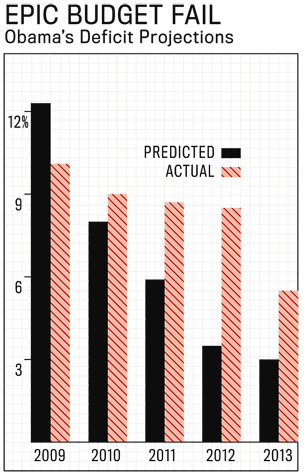
Epic Budget Fail
Epic Budget Fail

From the radically left-wing Newsweek, of all places. (H/T Defeating Obama)

Excerpt:

[T]he total number of private-sector jobs is still 4.3 million below the January 2008 peak. Meanwhile, since 2008, a staggering 3.6 million Americans have been added to Social Security’s disability insurance program. This is one of many ways unemployment is being concealed.

In his fiscal year 2010 budget—the first he presented—the president envisaged growth of 3.2 percent in 2010, 4.0 percent in 2011, 4.6 percent in 2012. The actual numbers were 2.4 percent in 2010 and 1.8 percent in 2011; few forecasters now expect it to be much above 2.3 percent this year.

Unemployment was supposed to be 6 percent by now. It has averaged 8.2 percent this year so far. Meanwhile real median annual household income has dropped more than 5 percent since June 2009. Nearly 110 million individuals received a welfare benefit in 2011, mostly Medicaid or food stamps.

Welcome to Obama’s America: nearly half the population is not represented on a taxable return—almost exactly the same proportion that lives in a household where at least one member receives some type of government benefit. We are becoming the 50–50 nation—half of us paying the taxes, the other half receiving the benefits.

And all this despite a far bigger hike in the federal debt than we were promised. According to the 2010 budget, the debt in public hands was supposed to fall in relation to GDP from 67 percent in 2010 to less than 66 percent this year. If only. By the end of this year, according to the Congressional Budget Office (CBO), it will reach 70 percent of GDP. These figures significantly understate the debt problem, however. The ratio that matters is debt to revenue. That number has leapt upward from 165 percent in 2008 to 262 percent this year, according to figures from the International Monetary Fund. Among developed economies, only Ireland and Spain have seen a bigger deterioration.

Not only did the initial fiscal stimulus fade after the sugar rush of 2009, but the president has done absolutely nothing to close the long-term gap between spending and revenue.

His much-vaunted health-care reform will not prevent spending on health programs growing from more than 5 percent of GDP today to almost 10 percent in 2037. Add the projected increase in the costs of Social Security and you are looking at a total bill of 16 percent of GDP 25 years from now. That is only slightly less than the average cost of all federal programs and activities, apart from net interest payments, over the past 40 years. Under this president’s policies, the debt is on course to approach 200 percent of GDP in 2037—a mountain of debt that is bound to reduce growth even further.

And even that figure understates the real debt burden. The most recent estimate for the difference between the net present value of federal government liabilities and the net present value of future federal revenues—what economist Larry Kotlikoff calls the true “fiscal gap”—is $222 trillion.

[…][T]he Patient Protection and Affordable Care Act (ACA) of 2010 did nothing to address the core defects of the system: the long-run explosion of Medicare costs as the baby boomers retire, the “fee for service” model that drives health-care inflation, the link from employment to insurance that explains why so many Americans lack coverage, and the excessive costs of the liability insurance that our doctors need to protect them from our lawyers.

[…]The president pledged that health-care reform would not add a cent to the deficit. But the CBO and the Joint Committee on Taxation now estimate that the insurance-coverage provisions of the ACA will have a net cost of close to $1.2 trillion over the 2012–22 period.

The president just kept ducking the fiscal issue. Having set up a bipartisan National Commission on Fiscal Responsibility and Reform, headed by retired Wyoming Republican senator Alan Simpson and former Clinton chief of staff Erskine Bowles, Obama effectively sidelined its recommendations of approximately $3 trillion in cuts and $1 trillion in added revenues over the coming decade. As a result there was no “grand bargain” with the House Republicans—which means that, barring some miracle, the country will hit a fiscal cliff on Jan. 1 as the Bush tax cuts expire and the first of $1.2 trillion of automatic, across-the-board spending cuts are imposed. The CBO estimates the net effect could be a 4 percent reduction in output.

The failures of leadership on economic and fiscal policy over the past four years have had geopolitical consequences. The World Bank expects the U.S. to grow by just 2 percent in 2012. China will grow four times faster than that; India three times faster. By 2017, the International Monetary Fund predicts, the GDP of China will overtake that of the United States.

This is a must-read article, and please share it with your friends, as well. It does cover Obama’s disastrous foreign policy as well, but the focus is on fiscal policy. The article ends with an assessment of Paul Ryan’s ability to fix the economic crisis that Obama created.

UPDATE: Niall Ferguson responds to a critique of this piece by Paul Krugman.

UPDATE: Niall Ferguson responds to critiques by shrill-shrieking left-wing bloggers.

Peter Robinson interviews Paul Ryan on fixing Washington

Here’s a 47-minute interview with the Republican candidate for Vice President.

Topics:

  • health care reform
  • patient-centered health care
  • patient choice
  • price and quality competition
  • reducing costs
  • empowering states
  • education reform
  • separate health care from the employer and attach it to the worker
  • the root cause of rising health costs
  • the moral hazard caused by government spending “makers vs. takers”
  • fixing dependency on the government by changing incentives
  • how Republicans can get votes from Democrats and Independents
  • how far is America from becoming Greece?
  • is the debt crisis avoidable?
  • the importance of the 2012 election
  • reforming Social Security

Best quote: “we need to kick this thing upstairs to the American people” (on letting the people decide instead of government).

H/T Rocking With Hawking.