
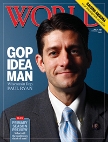
This is the best evangelical news magazine out there. The same one that profiled Michele Bachmann a while back.
Here’s the cover story. (H/T Muddling Toward Maturity)
Excerpt:
While a student at Miami University in Ohio, Ryan thought he’d become an economist. He read the likes of Milton Friedman and Ayn Rand and envisioned a life of theories. But he eventually learned that public policy is the arena where ideas really live or die. “That is what built this country—good ideas,” he says.Post-graduation stints as a speechwriter for Jack Kemp, at a conservative think tank, and as legislative director for Sen. Sam Brownback of Kansas led to Ryan’s successful run for an open House seat in 1998. He was just 28.
After almost a decade of near anonymity in Congress, Ryan’s 2007 ascension as the ranking Republican on the House Budget Committee gave him the staff resources and the clout to let out his inner economist. He now also is senior member of the tax-writing House Ways and Means Committee. From those perches he has crafted a roadmap to privatize Medicare and Medicaid, provide vouchers for many federal programs, replace employee-sponsored health insurance plans with individual tax credits, and impose tough controls on federal spending.
The Congressional Budget Office, the nonpartisan number crunchers, determined that Ryan’s roadmap delivered on its promises of balanced budgets and smaller deficits (unlike its projections for Obamacare). Under current policies, the CBO concludes that the nation in 2080 will devote 34 percent of its gross domestic product (GDP) to government spending; under Ryan’s plan, the CBO predicts that federal spending in 2080 would fall to less than 14 percent of the GDP while the government would enjoy a 5 percent annual surplus. And all without raising taxes. In fact, Ryan proposes a flat tax of two rates: 10 percent and 25 percent.
Better read it quick, before it goes behind the pay firewall.
Lately, I have been busy working my way through the Indivisible e-book that the Heritage Foundation published. The e-book is about 85 pages long, and features leading fiscal and social conservatives, writing from the point of view that they do not normally adopt! In the e-book, Paul Ryan, a huge fiscal conservative, writes about the right to life. Check it out. I just ordered 5 more copies of Indivisible from the Heritage Foundation along with some of their new booklet on Regulations.

 WINTERY KNIGHT