
Tag Archives: Economics

My conversation with a leftist friend about basic economics and rent control

My conversation with a leftist friend about “Basic Economics: A Common Sense Guide to the Economy, 4th Edition“, by Thomas Sowell.

Him: I remember why I stopped reading that book when you asked me to read it.

Me: Why did you stop reading it?

Him: Because of the chapter on rent control.

Me: Chapter 3 is the chapter on price controls. It talks about rent control.

Him: I expect an economist to present both sides of rent control. He has to present the arguments for and against rent control.

Me: There are not two sides to rent control. There is only one side to rent control. He chose that because it is a clear cut example of the problems caused by price controls. Economists universally condemn rent control, across the ideological spectrum.

Him: No they don’t.

Me: The chair of the Department of Economics at Harvard University, Greg Mankiw, reports in his economics textbook that 93% of professional economists agree that rent control reduces housing supply and housing quality. It is the most agreed upon position among economists across the ideological spectrum, number one in his list of facts on which professional economists agree. And obviously they have reasons for agreeing on that, specifically the experience of trying rent control policies in different times and places. It has always failed.

Him: Somebody must like rent control, because they have it in New York city.

Me: Politicians and low-information voters support rent control. It makes politicians feel good, and it gets them elected, too – if the voters are economically illiterate enough, as they are in New York city.

Him: But what about global warming then? Isn’t the consensus against you there?

Me: There has been no global warming in the last 17 years, according to the New York Times. They were reporting on findings by the UN IPCC in 2013.

Him: The UN never said that. The New York Times never wrote that.

Me: Yes, they did. And I have the sources I can send them to you.

Him: I’ll bet you do. (walks away in a huff)

This is the relevant quote from the Greg Mankiw post from his survey of economists that appears in his textbook:

  1. A ceiling on rents reduces the quantity and quality of housing available. (93%)
  2. Tariffs and import quotas usually reduce general economic welfare. (93%)
  3. Flexible and floating exchange rates offer an effective international monetary arrangement. (90%)
  4. Fiscal policy (e.g., tax cut and/or government expenditure increase) has a significant stimulative impact on a less than fully employed economy. (90%)
  5. The United States should not restrict employers from outsourcing work to foreign countries. (90%)
  6. The United States should eliminate agricultural subsidies. (85%)
  7. Local and state governments should eliminate subsidies to professional sports franchises. (85%)
  8. If the federal budget is to be balanced, it should be done over the business cycle rather than yearly. (85%)
  9. The gap between Social Security funds and expenditures will become unsustainably large within the next fifty years if current policies remain unchanged. (85%)
  10. Cash payments increase the welfare of recipients to a greater degree than do transfers-in-kind of equal cash value. (84%)
  11. A large federal budget deficit has an adverse effect on the economy. (83%)
  12. A minimum wage increases unemployment among young and unskilled workers. (79%)
  13. The government should restructure the welfare system along the lines of a “negative income tax.” (79%)
  14. Effluent taxes and marketable pollution permits represent a better approach to pollution control than imposition of pollution ceilings. (78%)

And this is the relevant quote from the New York Times article, dated September 2013:

The global warming crowd has a problem. For all of its warnings, and despite a steady escalation of greenhouse gas emissions into the atmosphere, the planet’s average surface temperature has remained pretty much the same for the last 15 years.

As you might guess, skeptics of warming were in full attack mode as the Intergovernmental Panel on Climate Change gathered in Sweden this week to approve its latest findings about our warming planet. The skeptics argue that this recent plateau illustrates what they always knew — that complex global climate models have no predictive capability and that, therefore, there is no proof of global warming, human-caused or not.

The author of the NYT article (a leftist) goes on to attempt to explain he is not concerned by the 17 year period of no significant warming, but the point is that the 17 year (not 15 year) period of no significant warming is A FACT acknowledged by the UN IPCC that has to be explained by those who believe in catastrophic man-made global warming. The IPCC may not like the temperature measurements, but those facts are not in doubt. The global warming crowd might make predictions about the future, but they made predictions about the past before, and we now know for a fact that those predictions (polar ice caps melting, Himalayans melting, significant global warming, etc.) were FALSE. They have been falsified by evidence, and that’s not in doubt.

Economic illiteracy is the problem

When people on the left voted for Barack Obama in 2012, they did not know based on evidence that they could keep their doctors and keep their health plans and that insurance premiums would drop $2500. They did not know it because the economic studies contradicted Obama’s words. They even believed Obama when he said that the Benghazi incident was caused by a Youtube video. Obama-supporters had a sincere belief in the words of his passionate speeches. They were impressed by the visuals of him talking to large crowds of young people. They believed him because they had feelings about him. And voting for him made them have good feelings about themselves. They felt that they were going to achieve good things by voting for this good man. They meant well, but they did not know. They did not have evidence.

Before the 2012 election, people on the right pointed to evidence from studies (like this one) showing that Obama was lying, but his supporters were apparently not interested in economic studies. They want to preserve the feelings of being good people. They want to preserve the belief that you can embrace policies that sound good, and that words that sound good will necessarily lead to good results for people who are at a disadvantage. I don’t question the motives of people on the left – they mean well. But meaning well doesn’t produce good results without knowledge of economics. In economics, policies that sound appealing to well-meaning liberals (rent control, tariffs, protectionism, minimum wage, trillion-dollar deficits) actually produce bad results for poor people. And we know this for a fact from our experience across different times and places.

If we can get people to accept the authority of our observations of policy experimentation in different times and places over and above their feelings and intuitions, then we can save this country.
New study: Obama’s proposed minimum wage hike could destroy 1 million jobs

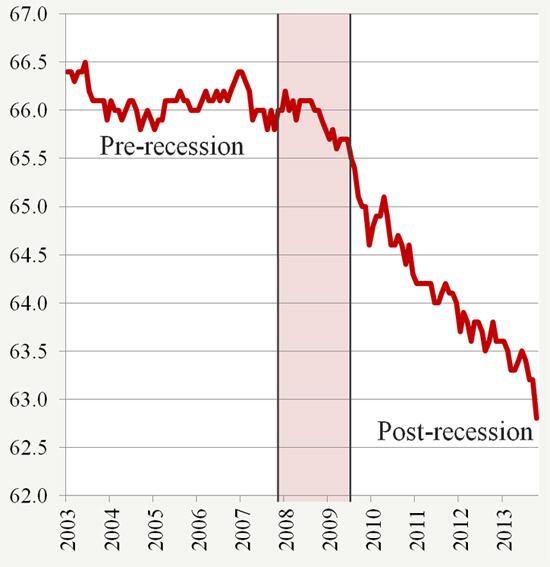
Labor Force Participation down to 62.8%

From the Daily Caller. (H/T Conway)

Excerpt:

The Obama administration’s proposal to raise the minimum wage to $10.10 an hour could result in as many 1,084,000 jobs eliminated from the work force, according to a new study conducted by the Employment Policies Institute (EPI)

“No amount of denial by the president and his political allies — and no number of ‘studies’ published by biased researchers — can change the fact that minimum wage hikes eliminate jobs for low-skill and entry-level employees. Non-partisan economists have agreed on this consensus for decades, and the laws of economics haven’t changed,” Michael Saltsman, research director at EPI, said in a statement.

He offered an alternative to the president’s plan: “Instead of raising small businesses’ labor costs and creating more barriers to entry-level employment, the president and the Senate should focus on policies that help reduce poverty and create jobs.”

The  study was released in the wake of an expected vote on a Senate bill that aims to raise the federal minimum wage from the current $7.25 an hour to $10.10 an hour — a nearly 40 percent increase.

Many Democrats argue that increasing the federal minimum will reduce poverty without having an adverse effect on unemployment.

EPI’s report, which used analysis from economists at Miami and Trinity University, reached a different conclusion.

Researchers used recently updated Census Bureau data from 2012 and 2013 to calculate how each individual state would be impacted by the proposed wage hikes. As a lump sum, Americans would see a loss of at least 360,000 jobs, and perhaps even over one million if hourly wages are increased to $10.10.

The number of job losses would be the most dramatic in large states, such as California and Texas. Economists found that California could lose as many as 100,016 jobs and Texas could see up to 128,617 jobs disappear from its economy.

This article from Investors Business Daily, written by the famous economist Thomas Sowell has more on the effects of raising the minimum wage.

Excerpt:

Switzerland is one of the few modern nations without a minimum-wage law. In 2003, the Economist magazine reported: “Switzerland’s unemployment neared a five-year high of 3.9% in February.”

In February of this year, Switzerland’s unemployment rate was 3.1%. A recent issue of the Economist showed Switzerland’s unemployment rate as 2.1%.

Most Americans today have never seen unemployment rates that low. However, there was a time when there was no federal minimum-wage law in the United States.

The last time was during the Coolidge administration, when the annual unemployment rate went as low as 1.8%. When Hong Kong was a British colony, it had no minimum-wage law. In 1991 its unemployment rate was under 2%.

[…]Most people in the lower income brackets are not an enduring class. Most working people in the bottom 20% in income at a given time do not stay there over time. More of them end up in the top 20% than remain behind in the bottom 20%.

There is nothing mysterious about the fact that most people start off in entry-level jobs that pay much less than they will earn after they get some work experience.

But when minimum-wage levels are set without regard to their initial productivity, young people are disproportionately unemployed — priced out of jobs.

In European welfare states where minimum wages, and mandated job benefits to be paid for by employers, are more generous than in the United States, unemployment rates for younger workers are often 20% or higher, even when there is no recession.

Unemployed young people lose not only the pay they could have earned but, at least equally important, the work experience that would enable them to earn higher rates of pay later on.

Minorities, like young people, can also be priced out of jobs. In the United States, the last year in which the black unemployment rate was lower than the white unemployment rate — 1930 — was also the last year when there was no federal minimum-wage law.

Inflation in the 1940s raised the pay of even unskilled workers above the minimum wage set in 1938. Economically, it was the same as if there were no minimum-wage law by the late 1940s.

In 1948 the unemployment rate of black 16-year-old and 17-year-old males was 9.4%. This was a fraction of what it would become in even the most prosperous years from 1958 on, as the minimum wage was raised repeatedly to keep up with inflation.

A survey of American economists found that 90% of them regarded minimum-wage laws as increasing the rate of unemployment among low-skilled workers.

Harvard University economist Greg Mankiw puts the level of opposition to minimum wage hikes at 79% among professional economists across the ideological spectrum.

Arthur Brooks: earning your own success through work makes you happy

In the Wall Street Journal.

Excerpt:

Earned success means defining your future as you see fit and achieving that success on the basis of merit and hard work. It allows you to measure your life’s “profit” however you want, be it in money, making beautiful music, or helping people learn English. Earned success is at the root of American exceptionalism.

The link between earned success and life satisfaction is well established by researchers. The University of Chicago’s General Social Survey, for example, reveals that people who say they feel “very successful” or “completely successful” in their work lives are twice as likely to say they are very happy than people who feel “somewhat successful.” It doesn’t matter if they earn more or less income; the differences persist.

The opposite of earned success is “learned helplessness,” a term coined by Martin Seligman, the eminent psychologist at the University of Pennsylvania. It refers to what happens if rewards and punishments are not tied to merit: People simply give up and stop trying to succeed.

During experiments, Mr. Seligman observed that when people realized they were powerless to influence their circumstances, they would become depressed and had difficulty performing even ordinary tasks. In an interview in the New York Times, Mr. Seligman said: “We found that even when good things occurred that weren’t earned, like nickels coming out of slot machines, it did not increase people’s well-being. It produced helplessness. People gave up and became passive.”

Learned helplessness was what my wife and I observed then, and still do today, in social-democratic Spain. The recession, rigid labor markets, and excessive welfare spending have pushed unemployment to 24.4%, with youth joblessness over 50%. Nearly half of adults under 35 live with their parents. Unable to earn their success, Spaniards fight to keep unearned government benefits.

Meanwhile, their collective happiness—already relatively low—has withered. According to the nonprofit World Values Survey, 20% of Spaniards said they were “very happy” about their lives in 1981. This fell to 14% by 2007, even before the economic downturn.

That trajectory should be a cautionary tale to Americans who are watching the U.S. government careen toward a system that is every bit as socially democratic as Spain’s.

Government spending as a percentage of GDP in America is about 36%—roughly the same as in Spain. The Congressional Budget Office tells us it will reach 50% by 2038. The Tax Foundation reports that almost 70% of Americans take more out of the tax system than they pay into it. Meanwhile, politicians foment social division on the basis of income inequality, instead of attempting to improve mobility and opportunity through education reform, pro-growth policies, and an entrepreneur-friendly economy.

These trends do not mean we are doomed to repeat Spain’s unhappy fate. But our system of earned success will not defend itself.

What I find most interesting is that the people who vote for Obama don’t even realize how they are making themselves more and more unhappy by being more and more dependent on government. It’s the bluest states that have seen the lowest income growth, the lowest job growth, lower home prices, and the highest unemployment. All of this talk about taxing the rich and spreading the wealth around through bigger and more intrusive government hasn’t worked.

More government means less prosperity, and less prosperity means fewer jobs, and fewer jobs means less happiness. Punishing your successful neighbor and borrowing huge amounts of money from the next generation of Americans does not create jobs. And without a job, you’re not going to be happy.

We need to have a public policy that recognizes that human beings are spiritual creatures, and we aren’t happy unless we chart our own course and earn our own success instead of depending on government to take it from someone else and hand it to us.