Tag Archives: Economics

The truth about government-run health care in the United States

Two stories today, the first from the Houston Chronicle, about Medicare. (H/T Stuart Scheiderman)

Excerpt:

Texas doctors are opting out of Medicare at alarming rates, frustrated by reimbursement cuts they say make participation in government-funded care of seniors unaffordable.

Two years after a survey found nearly half of Texas doctors weren’t taking some new Medicare patients, new data shows 100 to 200 a year are now ending all involvement with the program. Before 2007, the number of doctors opting out averaged less than a handful a year.

[…]More than 300 doctors have dropped the program in the last two years, including 50 in the first three months of 2010, according to data compiled by the Houston Chronicle. Texas Medical Association officials, who conducted the 2008 survey, said the numbers far exceeded their assumptions.

[…]The opt-outs follow years of declining Medicare reimbursement that culminated in a looming 21 percent cut in 2010. Congress has voted three times to postpone the cut, which was originally to take effect Jan. 1. It is now set to take effect June 1.

The uncertainty proved too much for Dr. Guy Culpepper, a Dallas-area family practice doctor who says he wrestled with his decision for years before opting out in March. It was, he said, the only way “he could stop getting bullied and take control of his practice.”

“You do Medicare for God and country because you lose money on it,” said Culpepper, a graduate of the University of Texas Medical School at Houston. “The only way to provide cost-effective care is outside the Medicare system, a system without constant paperwork and headaches and inadequate reimbursement.”

What’s wrong with government running health care? If there is no money to be made in health care, then there is no one who invests in it. The government is left to bear the full brunt of the costs, and they pass it on to taxpayers. After helping themselves to piece of the tax revenues, of course. The patients are the least of their concerns – especially the elderly, who no longer pay taxes into the system.
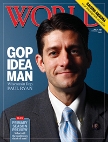
MUST-READ: WORLD magazine puts Paul Ryan on the front cover

Rep. Paul Ryan

This is the best evangelical news magazine out there. The same one that profiled Michele Bachmann a while back.

Here’s the cover story. (H/T Muddling Toward Maturity)

Excerpt:

While a student at Miami University in Ohio, Ryan thought he’d become an economist. He read the likes of Milton Friedman and Ayn Rand and envisioned a life of theories. But he eventually learned that public policy is the arena where ideas really live or die. “That is what built this country—good ideas,” he says.Post-graduation stints as a speechwriter for Jack Kemp, at a conservative think tank, and as legislative director for Sen. Sam Brownback of Kansas led to Ryan’s successful run for an open House seat in 1998. He was just 28.

After almost a decade of near anonymity in Congress, Ryan’s 2007 ascension as the ranking Republican on the House Budget Committee gave him the staff resources and the clout to let out his inner economist. He now also is senior member of the tax-writing House Ways and Means Committee. From those perches he has crafted a roadmap to privatize Medicare and Medicaid, provide vouchers for many federal programs, replace employee-sponsored health insurance plans with individual tax credits, and impose tough controls on federal spending.

The Congressional Budget Office, the nonpartisan number crunchers, determined that Ryan’s roadmap delivered on its promises of balanced budgets and smaller deficits (unlike its projections for Obamacare). Under current policies, the CBO concludes that the nation in 2080 will devote 34 percent of its gross domestic product (GDP) to government spending; under Ryan’s plan, the CBO predicts that federal spending in 2080 would fall to less than 14 percent of the GDP while the government would enjoy a 5 percent annual surplus. And all without raising taxes. In fact, Ryan proposes a flat tax of two rates: 10 percent and 25 percent.

Better read it quick, before it goes behind the pay firewall.

Lately, I have been busy working my way through the Indivisible e-book that the Heritage Foundation published. The e-book is about 85 pages long, and features leading fiscal and social conservatives, writing from the point of view that they do not normally adopt! In the e-book, Paul Ryan, a huge fiscal conservative, writes about the right to life. Check it out. I just ordered 5 more copies of Indivisible from the Heritage Foundation along with some of their new booklet on Regulations.

How bad is the situation in Greece?

From the UK Daily Mail. (H/T Verum Serum)

After months of dithering over how to rein in its vast deficit, the Greek government has been forced to plead for a £93billion international bail-out package and implement hugely unpopular austerity measures, to be voted on today.

Amid the rioting, the euro plunged, stock markets crashed and German Chancellor Angela Merkel admitted the very ‘future of Europe’ was at stake.

[…]In the most horrific incident, 20 terrified staff were trapped in the burning Marfin bank after it was firebombed by protesters. The mob blocked firefighters from getting to the blaze.

Two women and a man suffocated in the smoke as they tried to escape the flames. Bank officials told reporters one woman had been pregnant.

A fire department official said their lives could have been saved had ‘ crucial minutes’ not been lost getting through the rioters’ blockades.

The death toll is now up to four.

The socialists have owned Greece for most of the last 30 years

What happened in Greece? Marketwatch wrote about their recent elections in 2009.

Excerpt:

The political drama is about socialist George Papandreou’s electoral victory over the conservatives and his rise to the same position, prime minister of Greece, which his father and grandfather had held before him.

The tragedy will come if he is tempted to follow in his father’s populist footsteps, as his campaign rhetoric suggests he will. Such a choice might prove disastrous not only for Greece but for the rest of the European Union as well.

Greece’s turn left is unique, even in the wake of the economic perplexity that has gripped the world since summer 2008.

[…]Promises to raise public-sector salaries are problematic enough, but to raise wages beyond the amount eroded by inflation, as Pasok said it would, is altogether derelict. So is the thought that such spending, along with 3 billion euros in aid to small businesses, can be financed by further taxing the rich and cracking down on tax evasion.

In 1981, the Greek socialist party formed the first socialist government in Greece’s history, and subsequently governed the country for most of the 1980s, 1990s and early 2000s. They were the main opposition party between 2004 and 2009.

And here’s what happened:

Year Debt (Million € equivalent) Number of civil servants
1960 33 185,000
1970 226 280,000
1980 1,062 400,000
1985 4,828 600,000
1990 22,304 815,000
2007 234,776 1,050,000

That’s right, they had the equivalent of Barack Obama in charge, for a long, long time. Tax and spend, hope and change.

The crisis of debt in Europe

And check out this alarming analysis from RealClearMarkets: (H/T Belmont Club via ECM)

Virtually every country in the EU spends more than it takes in and has made long-term fiscal promises to an aging work force that it can’t keep. A little over a year ago, economist Jagadeesh Gokhale, writing for the National Center for Policy Analysis, produced a pithy – and scary – summation of the fiscal challenges faced by Europe. Don’t read it if you have trouble sleeping.

“The average EU country,” he concluded, “would need to have more than four times (434%) its current annual gross domestic product in the bank today, earning interest at the government’s borrowing rate, in order to fund current policies indefinitely.”

In other words, Europe would have to have the equivalent of roughly $60 trillion in the bank today to fund its very general welfare benefits in the future. Of course, it doesn’t.

Things haven’t changed much since that study was done. So suppose they don’t put aside all that money. What then? By 2035, Gokhale reckons, the EU will need an average tax rate of 57% to pay for its lavish welfare state.

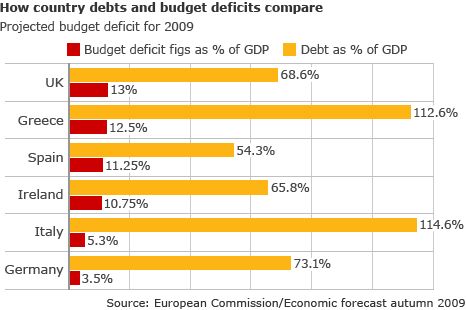
Today, Greece is only the tip of a very large iceberg. Portugal, Spain, Italy and Ireland together owe $3.9 trillion in short- and medium-term debts, an amount larger than their combined GDP, estimated last year at $3.3 trillion.

Picture:

Don’t let socialists run your country. They spend too much!