When Democrats held Congress, the Obama agenda was audacious. Today, faced with global unrest and an economic reckoning, the president is filling out basketball brackets and scolding school bullies.
‘There is only one president,” Senate Budget Committee Chairman Kent Conrad, D-N.D., told Politico this week, when asked if President Obama should be exercising leadership toward reforming America’s out-of-control entitlement spending programs, such as Medicare and Social Security.
The soothsayer famously told Julius Caesar to “beware the ides of March.” One of the priority items for Obama on Tuesday, March 15, was taping his picks for the NCAA basketball tournament.
Last week, the president and the first lady were holding a “White House Conference on Bullying Prevention,” at which he recalled being taunted because of “big ears and the name that I have.” He lamented recent youthful suicides, such as those of Ty Field and Carl Walker-Hoover.
We can’t just accept that “kids will be kids,” Obama insisted, citing data showing that many American students have been “pushed, shoved, tripped, even spit on.”
Then, of course, there is the partying. Late last month, the president and first lady treated themselves to an East Room concert by Smokey Robinson, Sheryl Crow, comedian Jamie Foxx and others. At previous soirees, the Obama White House has hosted Stevie Wonder, Paul Simon, Tony Bennett, Bob Dylan, Joan Baez, and even a cavalcade of stars from Broadway shows.
And let’s not forget former Beatle Paul McCartney being flown in from England to sing “Michelle” to the first lady and attack President George W. Bush from the East Room stage.
He has no idea what the average American family is facing right now.
Federal government expenditures are set to fall next fiscal year by $16.5-billion, or 6.2%, with big cuts to regional development and environment programs, according to documents tabled Tuesday.
That would leave total expenditures for the 2011-12 year at $250-billion, with the bulk taken up by transfer payments to individuals and governments, and operating costs. Just over $30-billion of that expense is attributed to refinancing Canada’s debt.
The figures, contained in spending estimates provided by the Treasury Board, sees budget increases for departments entrusted with security and law enforcement – such as a 21% boost to jails — but cuts of roughly 20% to Environment Canada, Natural Resources Canada and Agriculture and Agri-Food Canada.
Government is supposed to be concerned with security and law enforcement, not with environmentalist wastefulness.
Here’s Paul Ryan. He would like to cut our budget by 6.2% – and maybe even more.
If Canada is cutting their government waste, then why can’t we?
The federal government could save billions in taxpayer dollars annually by consolidating duplicative government programs, according to a new report.
The newly-released report from the Government Accountability Office “makes us all look like jackasses,” Sen. Tom Coburn (R-Okla.) told reporters Monday night.
The conservative senator said the report — which identifies redundancies in more than 546 individual programs — reveals why the United States is $14 trillion in debt.
“Anybody who says we don’t look like fools up here hasn’t read the report,” he said.
[…]The GAO reviewed 34 areas (among them agriculture, defense and social services) where agencies, offices or initiatives have similar or overlapping objectives. The report also looked at 47 additional cost-saving opportunities related to more general government efficiency. For instance, the report said, “Improved corrosion prevention and control practices could help [the Defense Department] avoid billions in unnecessary costs over time.”
Addressing duplicative efforts on even a single issue could save billions, the report found. For instance, the GAO says the government could save up to $5.7 billion annually by addressing potentially duplicative policies designed to boost domestic ethanol production. Additionally, the Defense Department could save $460 million annually by making broader changes to the governance of its military health care system.
The report finds that there are 15 agencies involved in food safety, 80 programs involved in economic development and more than 100 involved in surface transportation. There are 10 agencies and 82 programs involved in teacher quality, and more than 20 agencies and about 56 programs involved in financial literacy efforts. There are about 2,300 investments across the Defense Department to modernize its business operations.
House Majority Leader Eric Cantor (R-Va.) said today that in order to foster long term economic growth, “we’re going to deal with the pressing issues of regulatory waste in our agencies, as well as long term issues facing our country with entitlement programs.”
This is why we have to stop giving private sector money to government. They don’t earn any money by making things or helping people – they don’t sell anything useful. They just steal money from the productive workers and businesses and then they waste it and run up trillion dollar deficits. This kind of corruption, fraud and waste would not survive in small businesses, and probably not even in big businesses. Business have to be efficient or they go bankrupt. They have to perform or their competitors will have them for lunch. The consumer is king in the private sector.
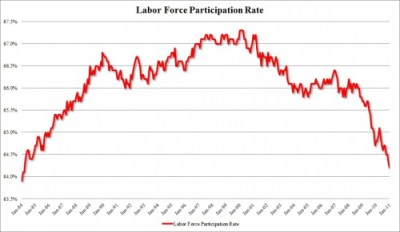
By now, everyone has heard that Marxist Obama has failed to create jobs again, so that the underemployment rate is at 19.2%. (Underemployment is even higher than employment because it takes into account people working part-time who want to work full-time but can’t). That means that 20% of the population either cannot find work, or cannot find full-time work. The labor force participation under Obama’s socialist regime is now at a 26-year low.
Excerpt:
At 64.2%, the labor force participation rate (as a percentage of the total civilian noninstitutional population) is now at a fresh 26 year low, the lowest since March 1984, and is the only reason why the unemployment rate dropped to 9% (labor force declined from 153,690 to 153,186). Those not in the Labor Force has increased from 83.9 million to 86.2 million, or 2.2 million in one year! As for the numerator in the fraction, the number of unemployed, it has plunged from 15 million to 13.9 million in two months! The only reason for this is due to the increasing disenchantment of those who completely fall off the BLS rolls and no longer even try to look for a job. Lastly, we won’t even show what the labor force is as a percentage of total population. It is a vertical plunge.
Canada’s job creation in January was more than four times the median forecast, pushing the Canadian dollar to its strongest level since May 2008 and adding to evidence the country’s economic recovery may be accelerating.
Employment rose by 69,200 and the labor force increased by 106,400, Statistics Canada said today in Ottawa. The jobless rate rose to 7.8 percent from December’s 7.6 percent, as more people sought work. Economists forecast 7.6 percent unemployment and job growth of 15,000, according to the median estimates of 25 and 26 economists surveyed by Bloomberg News.
“This adds confidence to the notion we are headed for a better year for growth and growth in the job market,” said Mark Chandler, head of Canadian currency and rates strategy at Royal Bank of Canada’s RBC Capital Markets unit in Toronto. “There isn’t a lot of slack in the labor market in Canada, certainly on a relative basis to other countries.”
Canadian policy makers have been dealing with the impact of a strong currency and a slowdown in growth of household and government spending that crimped the economic recovery in the second half of last year. Bank of Canada Governor Mark Carney stopped raising interest rates after September and Finance Minister Jim Flaherty scaled back plans to exit stimulus.
“It’s one of these reports that’s strong through and through – it’s hard to find any weakness,” said David Tulk, chief Canada macro strategist at Toronto-Dominion Bank’s TD Securities unit.
“The Bank of Canada would likely just see this as a step towards a stronger recovery, but not a point where they would need to respond,” he said. He predicts a July rate increase.
[…]The report restores Canada’s status as having regained all the jobs lost in the recession, after a Jan. 28 revision based on updated census data reduced Statistics Canada’s estimate of total employment.
The Canadian dollar gained 0.4 percent to 98.75 cents per U.S. dollar at 4:30 p.m. in New York from 99.11 cents yesterday, after earlier touching 98.32 cents, the strongest level since May 2008. The benchmark 10-year Canadian government bond yield increased four basis points to 3.46 percent, the highest since May.
[…]“Too many Canadians are still looking for work, the economic recovery is fragile,” Flaherty said today in response to a question in the House of Commons. “We need to continue with our job-creating, low-tax plan.”
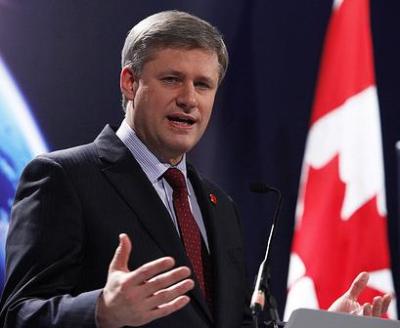
Prime Minister Stephen Harper has said reductions in corporate taxes are the best way to boost employment.
[…]Wal-Mart Stores Inc., the world’s largest retailer, said Jan. 26 it will open 40 “supercenters” in Canada by the end of January 2012, creating 9,200 construction and store jobs.
Basically, the Canadians listened to Obama’s speeches, and then decided to do the EXACT OPPOSITE of what he said. They are drilling for more oil, lowering corporate taxes below 20%, (ours is 36%), cutting spending and raising interest rates to encourage people to spend less and invest more, which supports job creation. This is what Hayek would recommend. In order to create jobs, you need to cut corporate taxes to provide businesses with a profit motive. And you need to make sure that there is capital to borrow for risk-taking, which happens when interest rates are higher because people save more money by giving it to banks to lend to businesses. When a business sees that it can keep profits that it makes then that’s what they’ll do. That’s when they start expanding their businesses and taking risks – when there is money to be made. If you keep banning drilling, imposing health care costs and demonizing businesses in speeches, like Obama does, then they WON’T hire anyone.
I hope that all the young people who voted for the first MTV President are happy with their 18% youth unemployment rate. Ideas have consequences.
But the differences between Canada are even more pronounced. Recall that Canada is ONE TENTH the size of the United States, with one-tenth the population, one-tenth the GDP, and one-twentieth the national debt. A 700,000 increase in the number of jobs is really like a 700,000 increase when projected proportionally to the United States. Canada didn’t spend massive amounts of money on “stimulus” spending, because the prime minister is NOT a Keynesian. He’s a Hayekian, like me. He’s not following the socialist, academic playbook – he’s following the capitalist, real-world playbook. He doesn’t believe that lowering interest rates and wasting money of government public works projects is a way out of a recession. And he’s right.

 WINTERY KNIGHT