Tag Archives: Earth

New study: Saturn’s orbit keeps Earth in the circumstellar habitable zone

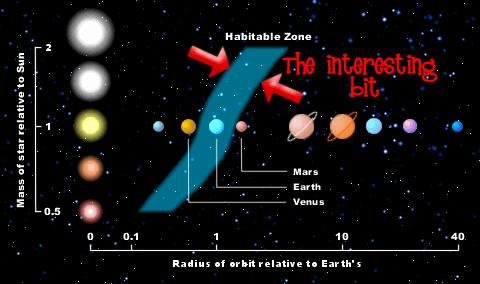
Circumstellar Habitable Zone

What do you need in order to have a planet that supports complex life? First, you need liquid water at the surface of the planet. But there is only a narrow range of temperatures that can support liquid water. It turns out that the size of the star that your planet orbits around has a lot to do with whether you get liquid water or not.

A heavy, metal-rich star allows you to have a habitable planet far enough from the star so  the planet can support liquid water on the planet’s surface while still being able to spin on its axis. The zone where a planet can have liquid water at the surface is called the circumstellar habitable zone (CHZ). A metal-rich star like our Sun is very massive, which moves the habitable zone out further away from the star.

If our star were smaller, we would have to orbit much closer to the star in order to have liquid water at the surface. Unfortunately, if you go too close to the star, then your planet becomes tidally locked, like the moon is tidally locked to Earth. Tidally locked planets are inhospitable to life. So we need a star massive enough to give us a nice wide habitable zone far away from the Sun itself.

But even with the right size star, which we have in our solar sytem, we still have CHZ problems. Just because a planet starts off in the circumstellar habitable zone, it doesn’t mean that it will stay there.

Jay Richards tweeted about this new article from the New Scientist, which talks about that very problem.

Excerpt: (links removed)

Earth’s comfortable temperatures may be thanks to Saturn’s good behaviour. If the ringed giant’s orbit had been slightly different, Earth’s orbit could have been wildly elongated, like that of a long-period comet.

Our solar system is a tidy sort of place: planetary orbits here tend to be circular and lie in the same plane, unlike the highly eccentric orbits of many exoplanets. Elke Pilat-Lohinger of the University of Vienna, Austria, was interested in the idea that the combined influence of Jupiter and Saturn – the solar system’s heavyweights – could have shaped other planets’ orbits. She used computer models to study how changing the orbits of these two giant planets might affect the Earth.

Earth’s orbit is so nearly circular that its distance from the sun only varies between 147 and 152 million kilometres, or around 2 per cent about the average. Moving Saturn’s orbit just 10 percent closer in would disrupt that by creating a resonance – essentially a periodic tug – that would stretch out the Earth’s orbit by tens of millions of kilometres. That would result in the Earth spending part of each year outside the habitable zone, the ring around the sun where temperatures are right for liquid water.

Tilting Saturn’s orbit would also stretch out Earth’s orbit. According to a simple model that did not include other inner planets, the greater the tilt, the more the elongation increased. Adding Venus and Mars to the model stabilised the orbits of all three planets, but the elongation nonetheless rose as Saturn’s orbit got more tilted. Pilat-Lohinger says a 20-degree tilt would bring the innermost part of Earth’s orbit closer to the sun than Venus.

So the evidence for a our solar system being fine-tuned for life keeps piling up. It’s just another factor that has to be just right so that complex, embodied life could exist here. All of these factors need to be just right, not just the orbits of any other massive planets. And you need at least one massive planet to attract comets and other such unwelcome intruders away from the life-permitting planets.

Here’s a good clip explaining the circumstellar habitable zone:

The factor I blogged about today is just one of the things you need in order to get a planet that supports life.

Here are a few of the more well-known ones:

  • a solar system with a single massive Sun than can serve as a long-lived, stable source of energy
  • a terrestrial planet (non-gaseous)
  • the planet must be the right distance from the sun in order to preserve liquid water at the surface – if it’s too close, the water is burnt off in a runaway greenhouse effect, if it’s too far, the water is permanently frozen in a runaway glaciation
  • the solar system must be placed at the right place in the galaxy – not too near dangerous radiation, but close enough to other stars to be able to absorb heavy elements after neighboring stars die
  • a moon of sufficient mass to stabilize the tilt of the planet’s rotation
  • plate tectonics
  • an oxygen-rich atmosphere
  • a sweeper planet to deflect comets, etc.
  • planetary neighbors must have non-eccentric orbits

Here is a study that I wrote about recently about galactic habitable zones.
Is Kepler-452b an Earth-like planet? Does it support life?

Apologetics and the progress of science

Previously, I blogged about a few of the minimum requirements that a planet must satisfy in order to support complex life.

Here they are:

  • a solar system with a single massive Sun than can serve as a long-lived, stable source of energy
  • a terrestrial planet (non-gaseous)
  • the planet must be the right distance from the sun in order to preserve liquid water at the surface – if it’s too close, the water is burnt off in a runaway greenhouse effect, if it’s too far, the water is permanently frozen in a runaway glaciation
  • the planet has to be far enough from the star to avoid tidal locking and solar flares
  • the solar system must be placed at the right place in the galaxy – not too near dangerous radiation, but close enough to other stars to be able to absorb heavy elements after neighboring stars die
  • a moon of sufficient mass to stabilize the tilt of the planet’s rotation
  • plate tectonics
  • an oxygen-rich atmosphere
  • a sweeper planet to deflect comets, etc.
  • planetary neighbors must have non-eccentric orbits
  • planet mass must be enough to retain an atmosphere, but not so massive to cause a greenhouse effect

Now what happens if we disregard all of those characteristics, and just classify an Earth-like planet as one which is the same size and receives the same amount of radiation from its star? Well, then you end up labeling a whole bunch of planets as “Earth-like” that really don’t permit life.

Here’s an article from The Conversation which talks about a recent case of science fiction trumping science facts. (H/T JoeCoder)

Excerpt:

NASA’s announcement of the discovery of a new extrasolar planet has been met with a lot of excitement. But the truth is that it is impossible to judge whether it is similar to Earth with the few parameters we have – it might just as well resemble Venus, or something entirely different.

The planet, Kepler-452b, was detected by the Kepler telescope, which looks for small dips in a star’s brightness as planets pass across its surface. It is a method that measures the planet’s size, but not its mass. Conditions on Kepler-452b are therefore entirely estimated from just two data points: the planet’s size and the radiation it receives from its star.

Size and radiation from its star? That’s all?

More:

Kepler-452b was found to be 60% larger than the Earth. It orbits a sun-like star once every 384.84 days. As a result, the planet receives a similar amount of radiation as we do from the sun; just 10% higher. This puts the Kepler-452b in the so-called “habitable zone”; a term that sounds excitingly promising for life, but is actually misleading.

The habitable zone is the region around a star where liquid water could exist on a suitable planet’s surface. The key word is “suitable”. A gas-planet like Neptune in the habitable zone would clearly not host oceans since it has no surface. The habitable zone is best considered as a way of narrowing down candidates for investigation in future missions.

What about plate tectonics – does it have that?

Kepler-452b’s radius puts it on the brink of the divide between a rocky planet and a small Neptune. In the research paper that announced the discovery, the authors put the probability of the planet having a rocky surface about 50%-60%, so it is by no means sure.

Rocky planets like the Earth are made from iron, silicon, magnesium and carbon. While these ingredients are expected to be similar in other planetary systems, their relative quantities may be quite different. Variations would produce alternative planet interiors with a completely different geology.

For example, a planet made mostly out of carbon could have mantles made of diamond, meaning they would not move easily. This would bring plate tectonics to a screeching halt. Similarly, magnesium-rich planets may have thick crusts that are resilient to fractures. Both results would limit volcano activity that is thought to be essential for sustaining a long lasting atmosphere.

What about retaining the right kind of atmosphere, which depends on the mass of the planet. Does it have that?

If Kepler-452b nevertheless has a similar composition to Earth, we run into another problem: gravity. Based on an Earth-like density, Kepler-452b would be five times more massive than our planet.

This would correspond to a stronger gravitational pull, capable of drawing in a thick atmosphere to create a potential runaway greenhouse effect, which means that the planet’s temperature continues to climb. This could be especially problematic as the increasing energy from its ageing sun is likely to be heating up the surface. Any water present on the planet’s surface would then boil away, leaving a super-Venus, rather than a super-Earth.

You might remember that “retain atmosphere” requirement from the lecture by Walter Bradley that I posted with a summary a few days ago.

What about having a Jupiter-sized sweeper planet – does it have that?

Another problem is that Kepler-452b is alone. As far as we know, there are no other planets in the same system. This is an issue because it was most likely our giant gas planets that helped direct water to Earth.

At our position from the sun, the dust grains that came together to form the Earth were too warm to contain ice. Instead, they produced a dry planet that later had its water most likely delivered by icy meteorites. These frozen seas formed in the colder outer solar system and were kicked towards Earth by Jupiter’s huge gravitational tug. No Jupiter analogue for Kepler-452b might mean no water and therefore, no recognisable life.

What about having a magnetic field – does it have that?

All these possibilities mean that even a planet exactly the same size as Earth, orbiting a star identical to our sun on an orbit that takes exactly one year might still be an utterly alien world. Conditions on a planet’s surface are dictated by a myriad of factors – including atmosphere, magnetic fields and planet interactions, which we currently have no way of measuring.

You know, after the whole global warming hoax, you would think that NASA would have learned their lesson about sensationalizing wild-assed guesses in order to scare up more research money from gullible taxpayers who watch too much Star Trek and Star Wars.

The best answer to this is for parents to make sure that their kids are learning the facts about astrobiology from books like “The Privileged Planet” and “Rare Earth”, where the full list of requirements for a life-supporting planet will be found. Pity that we can’t rely on taxpayer-funded public schools to do that for us, because they are too busy pushing Planned Parenthood’s sex education curriculum and global warming fears, instead of real science and engineering.

Guillermo Gonzalez lectures on the corelation between habitability and discoverability

There are 5 video clips that make up the full lecture, which took place in 2007 at the University of California, Davis.

The playlist for all 5 clips is here.

About the speaker

Guillermo Gonzalez is an Associate Professor of Physics at Grove City College. He received his Ph.D. in Astronomy in 1993 from the University of Washington. He has done post-doctoral work at the University of Texas, Austin and at the University of Washington and has received fellowships, grants and awards from such institutions as NASA, the University of Washington, the Templeton Foundation, Sigma Xi (scientific research society) and the National Science Foundation.

Click here to learn more about the speaker.

The lecture

Here’s part 1 of 5:

And the rest are here:

Topics:

  • What is the Copernican Principle?
  • Is the Earth’s suitability for hosting life rare in the universe?
  • Does the Earth have to be the center of the universe to be special?
  • How similar to the Earth does a planet have to be to support life?
  • What is the definition of life?
  • What are the three minimal requirements for life of any kind?
  • Requirement 1: A molecule that can store information (carbon)
  • Requirement 2: A medium in which chemicals can interact (liquid water)
  • Requirement 3: A diverse set of chemical elements
  • What is the best environment for life to exist?
  • Our place in the solar system: the circumstellar habitable zone
  • Our place in the galaxy: the galactic habitable zones
  • Our time in the universe’s history: the cosmic habitable age
  • Other habitability requirements (e.g. – metal-rich star, massive moon, etc.)
  • The orchestration needed to create a habitable planet
  • How different factors depend on one another through time
  • How tweaking one factor can adversely affect other factors
  • How many possible places are there in the universe where life could emerge?
  • Given these probabilistic resources, should we expect that there is life elsewhere?
  • How to calculate probabilities using the “Product Rule”
  • Can we infer that there is a Designer just because life is rare? Or do we need more?

The corelation between habitability and measurability.

  • Are the habitable places in the universe also the best places to do science?
  • Do the factors that make Earth habitable also make it good for doing science?
  • Some places and times in the history of the universe are more habitable than others
  • Those exact places and times also allow us to make scientific discoveries
  • Observing solar eclipses and structure of our star, the Sun
  • Observing stars and galaxies
  • Observing the cosmic microwave background radiation
  • Observing the acceleration of the universe caused by dark matter and energy
  • Observing the abundances of light elements like helium of hydrogen
  • These observations support the big bang and fine-tuning arguments for God’s existence
  • It is exactly like placing observatories on the tops of mountains
  • There are observers existing in the best places to observe things
  • This is EXACTLY how the universe has been designed for making scientific discoveries

This argument from the “discoverability” of the universe has now been picked up by famous Christian philosopher Robin Collins, so we should expect to hear more about it in the future.