
Tag Archives: Divorce

47-year-old divorced woman with kids sues dating agency for failing to find her a rich husband

Do young women understand how to get to a stable marriage?

Today, many women put off marriage while they’re in their 20s, when they are most attractive to marriage-minded men. Some marry, but they marry based on spontaneity and feelings, and it turns into divorce. What happens next? Here’s an example from the UK Daily Mail. (H/T Dina)

Excerpt:

A divorced mother-of-three who sued an ‘exclusive’ dating agency after it failed to find her a rich boyfriend has been handed her money back by a top judge.

Tereza Burki paid £12,600 to Seventy Thirty to hunt for ‘possibly the man of my dreams, the father of my child’, she told the High Court in London.

The 47-year-old said the agency assured her it only dealt in ‘creme de la creme’ matches and could introduce her to ‘bachelors you dream of meeting’.

But Judge Richard Parkes QC today ordered the agency to repay her fee, ruling that she had been ‘deceived’ by Seventy Thirty’s then-managing director.

And, as well as giving her her money back, the judge awarded her £500 for the ‘disappointment and sadness’ she suffered. Her total award was £13,100.

Burki is 47 years old today, so in 2014, I assume that she was around 43 years old. 43, as you know, is well past the normal age for having children. Women’s fertility declines sharply at age 27, then takes a nose-dive at age 35. By 40, it’s nearly impossible to get pregnant, which is why women who want children ought to focus on finding a good man in their early-to-mid-20s.

More:

When she signed up with the agency in 2014, Mrs Burki’s requirements for the men she wanted to meet were ‘not modest’, the judge added.

She wanted a wealthy man with ‘a lifestyle similar or more affluent than her own’ and, ideally, ‘multiple residences’.

But the most important factor for Mrs Burki, who lives on an upmarket street in Chelsea, West London, was that her soulmate would be prepared to have more children, as she wanted four.

[…]Giving evidence during the case, Mrs Burki told the judge: ‘You shouldn’t promise people who are in a fragile state of mind, in their mid-40s, the man of their dreams.

I’m sure that the reason Dina sent me this article is to warn me about how irresponsible some women can be. After all, this woman HAD a decade in her 20s to get serious about finding a man who would commit to her, and give her children. We don’t know what happened in her 20s. But judging from the enormous gap between her demands and her own attractiveness (43 and divorced with 3 children from another man), she was probably being selfish. She’s very clear about what she wants from a man, but she hasn’t prepared for what a man might want from her.

So let’s review that.

Marriage-minded men are interested in a wife during a certain time window when the support of a woman really makes a difference. That time period is the stressful period of a man’s life, when he first graduates from college or trade school and has to start his career. The first years of a career are the most stressful. And that’s when having the physical, emotional, and practical support of a young, attractive, chaste woman really makes a difference. Married men do better at things like earning, saving, health, etc. than single men. Naturally, the best time to GET THIS SUPPORT is the time when the man is doing things that determine his earning, saving, health, etc.

It’s not that older women have no value. It’s that the woman has to be present during the critical time when a man is trying to do hard things, and he doesn’t have the safety net of savings, a resume, etc. Many men move for their first jobs, which just adds another level of difficulty to those early years. When I moved for my first job, everything was difficult: eating, sleeping, cleaning, being content with chastity, etc. I had no family nearby, and I left behind all my friends. It would have been nice to have had the support of a young, and beautiful marriage-minded woman at the critical time when I needed it.

But now, after the degrees have been earned, the gapless resume filled out, the retirement accounts filled, and the house paid for, it’s hardly the time for a woman over 40 to show up and demand her share, when she never invested anything into the enterprise.

And yet, many women apparently DO think like this. Many seem to have no concept of what a man wants out of marriage, and that’s why they waste their 20s doing what feels good to them, and just expecting marriage to happen without any self-denial or self-sacrifice or self-control. If they really cared about marriage, then they would prioritize understanding what marriage-minded men want and need. They would be developing marriage skills and marriage character – things like cooking, caring for others, being good with money, child care, being sober, being faithful, etc. If a woman wants a husband, then she ought to be concerned with helping him to do the things that she expects him to do as a husband.

There used to be some awareness in young women that premarital sex with hot bad boys was bad for her future husband. That focusing on partying and travel was bad for her future husband. That doing easy degrees, getting easy jobs, while going into debt was bad for future husband. Now it seems that women are making all their decisions based on what feels good for them in the moment, in total ignorance of how that ruins their ability to invest in the man who wants to marry them later. They just can’t (or won’t) understand how being selfish today has consequences to marriage and family tomorrow.

Do women not look at marriage-minded men doing what we are doing and think “I don’t want him to have to do that alone. I want to help him, so that it’s not so difficult. And if I have to learn how to do things that help him, then I will put my own needs and feelings second, and learn to do what helps him”. Is there any woman out there who looks at a good, marriage-ready man, and thinks about what he needs? And about what she can do to help him? If not, then is it any wonder that men have lost interest in marriage?

I noticed that Dalrock also posted on this, and some of the comments are interesting.
If we seriously want men to marry and become fathers, let’s repeal no-fault divorce

I saw a very good article at the Heritage Foundation web site about the importance of fathers for children. The author Virginia Allen listed out some of the benefits that fathers provide to children:

Studies have found that children raised without a father are:

  • At a higher risk of having behavioral problems.
  • Four times more likely to live in poverty.
  • More likely to be incarcerated in their lifetime.
  • Twice as likely to never graduate high school.
  • At a seven times higher risk of teen pregnancy.
  • More vulnerable to abuse and neglect.
  • More likely to abuse drugs and alcohol.
  • Twice as likely to be obese.

From education to personal health to career success, children who lack a father find themselves at a disadvantage to their peers raised in a two-parent household.

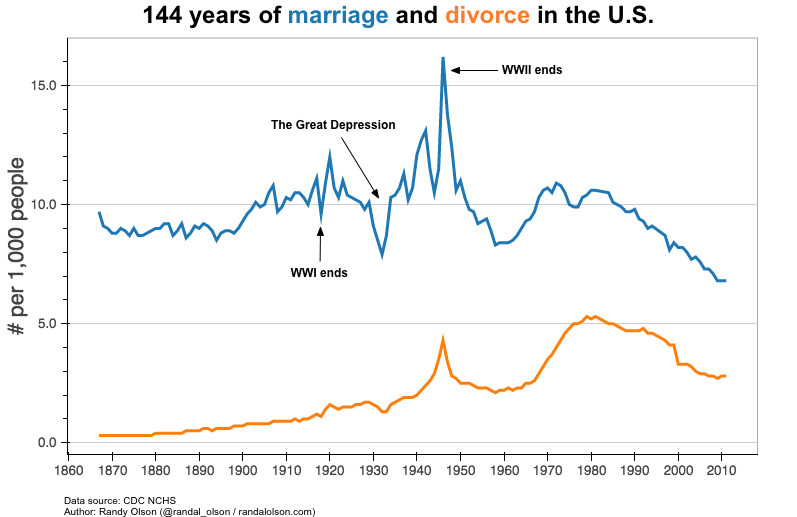
I was looking for a good analysis of why there’s been a decline of marriage and fatherhood, and I found an article by Joe Carter on The Gospel Coalition, of all places. By looking at marriage rates and historical events that changed the marriage rate, he was able to identify the cause of the decline of marriage – and fatherhood.

Marriage and divorce rates per capita

I’ll spare you the statistical analysis, which is excellent, and give you the conclusion – although you can guess it from the graph above:

Now that we’ve explored the data, what year should we use as the marker for the beginning of the decline of marriage in the United States? I would argue for 1985, the last year that the marriage rate topped 10 percent.

[…]What changed in 1985 that could have led to the decline in marriage? There are likely numerous factors—which we’ll examine in future articles—but one stands out in particular: By 1985, all states (except for New York) had enacted no-fault divorce legislation.

The most helpful book I know of about no-fault divorce is “Taken Into Custody”, by Dr. Stephen Baskerville. He wrote a column  for Crisis magazine that summarizes some of his ideas.

Excerpt:

Feminists were drafting no-fault divorce laws in the 1940s, which the National Association of Women Lawyers now describes as “the greatest project NAWL has ever undertaken.”

The result effectively abolished marriage as a legal contract. Today it is not possible to form a binding agreement to create a family.

The new laws did not stop at removing the requirement of citing grounds for a divorce, to allow divorce by mutual consent, as deceptively advertised at the time. Instead they created unilateral and involuntary divorce, so that one spouse may dissolve a marriage without any agreement or fault by the other.

Here’s what divorce does to the spouse who is the victim of the unilateral “no-fault” divorce:

Though marriage is a civil matter, the logic quickly extended into the criminal, including a presumption of guilt against the involuntarily divorced spouse (“defendant”). Yet formal due process protections of criminal proceedings did not apply, so forcibly divorced spouses became quasi-criminals not for recognized criminal acts but for failing or refusing to cooperate with the divorce by continuing to claim the protections and prerogatives of family life: living in the common home, possessing the common property, or—most vexing of all—parenting the common children.

Following from this are the horrendous civil liberties violations and flagrant invasions of family and individual privacy that are now routine in family courts. A personalized criminal code is legislated by the judge around the forcibly divorced spouse, controlling their association with their children, movements, and finances. Unauthorized contact with their children can be punished with arrest. Involuntarily divorced parents are arrested for running into their children in public, making unauthorized telephone calls, and sending unauthorized birthday cards.

In my conversations with men, no-fault divorce laws, and anti-male divorce courts are the main reasons given for why they do not pursue marriage and fatherhood. Men do not want to be coerced in a marriage with the threat of divorce by an unhappy wife. Men do not want to be subject to the government in so many areas of their lives if the wife does carry out the threat. They especially don’t want to be separated from their children. One my secular male friends told me that he would not marry unless the woman had evidence in her past of hating radical feminism and no-fault divorce. This was the main criteria. He actually was able to find a woman who was a men’s rights activist who hated divorce. But that was the only way he would marry.

Statistically speaking, the wife is more likely to initiate divorce than the husband. Women initiate 70% of divorces, the majority of those just because she is “unhappy”. I think this is because women get into marriage based on their feelings, and they think that it is the husband’s job to make them feel good. They see their happiness as the primary goal of the marriage, and see a marriage that does not make them happy as a marriage that needs to be ended. Their view of commitment really means “I’ll commit so long as it makes me feel good”. None of this is particularly appealing to men, who take marriage vows to mean what they say, and think that the commitment isn’t conditional on being happy. (Note: if your husband doesn’t have this view of marriage, then why did you choose him out of all the other men in the world?)

Are we going to repeal no-fault divorce, then?

My experiences speaking with divorced Christian women is that they married primarily based on first impressions and emotional responses. No-fault divorce was seen as a boon to women who had married the wrong men by following their hearts. It’s an interesting question to ask whether women really would want no-fault repealed. It would mean that they would have to get serious about who they marry. They would have to think about what a man does in a marriage. They would have to think about what men want out of a marriage. And they would have to say no to their feelings, both in choosing a man, and in keeping the man after the wedding.

I’ve been told by women that the rapid giving of sex is a way to get attention from a man without having to be respectful of him. Are women willing to stop using sex as a tool to attract the wrong men, and start developing their skills as wives and mothers in order to attract the right men? Are women willing to stop seeing relationships as “fun and thrills”, and get serious about pursuing men who have marriage and children as the goal? Are wives willing to give a man what he needs in the marriage: sex, respect and obedience? Are they willing to give up the threat of divorce in the home and learn to argue rationally and compromise?

If women aren’t willing to demand the repeal of no-fault divorce laws and get serious about men and marriage, then what’s the point of complaining that men don’t want to marry and become fathers? If you’re not willing to fix the root cause of the problem, then don’t complain about the problem.

New study: men and women have different goals and expectations when cohabitating

Men who cohabitate are not certain that the relationship is permanent
Cohabitating men don’t see cohabitation as permanent, but married men do see marriage as permanent

Consider this fascinating article from the radically-leftist The Atlantic, authored by marriage researcher W. Bradford Wilcox. The article discusses the different beliefs of cohabitating men and women regarding goals and expectations for relationships.

Excerpt:

According to a new paper from RAND by sociologists Michael Pollard and Kathleen Mullan Harris, cohabiting young adults have significantly lower levels of commitment than their married peers. This aversion to commitment is particularly prevalent among young men who live with their partners.

Pollard and Harris found that the majority of cohabiting young men do not endorse the maximum indicator of relationship permanence: 52 percent of cohabiting men between ages 18 and 26 are not “almost certain” that their relationship is permanent. Moreover, a large minority (41 percent) of men report that they are not “completely committed” to their live-in girlfriends. By contrast, only 39 percent of cohabiting women in the same age group are not “almost certain” their relationship will go the distance, and only 26 percent say they are not “completely committed”. Not surprisingly, the figures above and below also indicate that married women and men are much less likely to exhibit the low levels of commitment characteristic of many cohabiting relationships today.

[…]The only thing worse than being in a relationship for years with an uncommitted person, it would seem, is marrying one. Research by psychologists Scott Stanley and Galena Rhoades, spotlighted in a New York Times op-ed last year, suggests that cohabiting couples are in for trouble when they “slide” into cohabitation and then marriage rather than “decide” to take the same steps. Their work indicates that many couples begin living together without clear expectations, common values, or a shared commitment to one another. And after a time, some of these couples get married, in part because friends, family, and they themselves think it’s the logical next step. But without common values and a shared sense of commitment, the couples who slide into cohabitation and marriage, instead of purposely deciding to deepen their commitment to one another, are more likely to divorce.

Stanley and Rhoades illustrate this point by pointing to the research on cohabitation, engagement, and divorce. Women who cohabit prior to engagement are about 40 percent more likely to divorce, compared to those who do not cohabit. By contrast, couples who cohabit after an engagement do not face a higher divorce risk. Those who cohabit only after engagement or marriage also report higher marital quality, not just lower odds of divorce. Stanley and Rhoades think that “sliders” are more likely than “deciders” to cohabit prior to an engagement, and to have trouble in their marriage if they go on to tie the knot. On the other hand, couples who deliberately choose to move in together after a public engagement or wedding are more likely to enjoy the shared commitment that will enable their relationship to last.

So, given the low levels of commitment and the gender mismatch in expectations often found among today’s cohabiting couples, young men and especially women who aspire to a strong and stable marriage should take caution when considering moving in together.

You can click through the article to see the graphs he is talking about in the excerpt. Highly recommended. Just be aware Wilcox that accepts feminism (i.e. – promiscuity, no-fault-divorce, career-focus, day care, etc.) as non-negotiable improvements that should not be rolled back. His view is that men should just man up and continue to marry feminists like they used to marry non-feminists, even though marriage isn’t as good of a deal for men as it used to be before feminism.

It turns out that women cannot just pick a good-looking guy and drift into a commitment by stringing together good days and good experiences. A man who is looking for recreational premarital sex with a woman before marriage is not looking for marriage, but recreation. Marriage is a commitment to work hard, be disciplined, be self-sacrificial and to compromise with another person – all in close quarters. When choosing a mate, you need to look for someone who is good at commitments. Not someone who is good at fun.

The ability to have fun with a man is not a good predictor of marital success because fun is unrelated to the things that a man really does in a marriage: protect, provide, and lead on moral and spiritual issues. Similarly, the ability to impress your friends with a man’s appearance or entertainment value does not make a commitment work. What makes a commitment work… is a man who demonstrates that he is good at making plans and achieving goals through discipline and hard work. Marriage requires making plans and achieving goals more than it requires having fun. Recreational premarital sex is about having fun – not making plans and achieving goals. Instead of talking about the next good time with a man, maybe women need to learn to talk about the mechanics of marriage with a man. And talk about the man’s roles in a marriage with a man. And then they need to learn to avoid men who don’t have plans and who aren’t ready to perform those roles. There are plenty of men who are not “bad boys” who do have plans and who are ready to perform traditional male roles. Young women: don’t waste your youth and beauty on men who are not ready to commit.

A final point. I have noticed today that women tend to avoid men who have strong, exclusive views on moral questions and spiritual questions. The minute a man expresses a moral point of view or a theological argument, women tend to want to avoid him. Sometimes they fear rejection from men with definite convictions. Sometimes they resent male leadership. And there are other reasons to avoid strong men. The problem is that a man who has definite moral views is exactly the kind of man who is likely to be trustworthy and predictable in the marriage. And a man who has definite spiritual views is exactly the kind of man who is going to have some sort of overarching plan for the marriage (AND PARENTING) beyond mere pleasure. You wouldn’t choose someone who was guided by hedonism to be your stock broker or your medical doctor, because doing a hard job requires self-sacrifice and discipline. The same rule applies to choosing husbands. Husbands have duties that are typically best performed by moral, spiritual men.