
Tag Archives: Design

New study: tiny songbirds fly over the Atlantic ocean and back each year

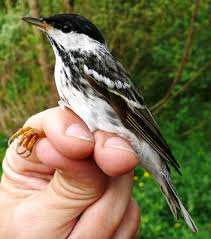
Blackpoll Warbler- so tiny and so cute!
Blackpoll Warbler- so cute!

I love birds! I really, really do! A lot!

So here is the latest study, reported in Science Daily about our amazing feathered friends.

They write:

For more than 50 years, scientists had tantalizing clues suggesting that a tiny, boreal forest songbird known as the blackpoll warbler departs each fall from New England and eastern Canada to migrate nonstop in a direct line over the Atlantic Ocean toward South America, but proof was hard to come by.

Now, for the first time an international team of biologists report “irrefutable evidence” that the birds complete a nonstop flight ranging from about 1,410 to 1,721 miles (2,270 to 2,770 km) in just two to three days, making landfall somewhere in Puerto Rico, Cuba and the islands known as the Greater Antilles, from there going on to northern Venezuela and Columbia. Details of their study, which used light-level, or solar, geolocators, appear in the current issue of Biology Letters.

First author Bill DeLuca, an environmental conservation research fellow at the University of Massachusetts Amherst, with colleagues at the University of Guelph, Ontario, the Vermont Center for Ecostudies and other institutions, says, “For small songbirds, we are only just now beginning to understand the migratory routes that connect temperate breeding grounds to tropical wintering areas. We’re really excited to report that this is one of the longest nonstop overwater flights ever recorded for a songbird, and finally confirms what has long been believed to be one of the most extraordinary migratory feats on the planet.”

While other birds, such as albatrosses, sandpipers and gulls are known for trans-oceanic flights, the blackpoll warbler is a forest dweller that migrates boldly where few of its relatives dare to travel. Most migratory songbirds that winter in South America take a less risky, continental route south through Mexico and Central America, the authors note. A water landing would be fatal to a warbler.

[…]For this work the scientists fitted geolocator packs on 20 birds in Vermont and 20 more in Nova Scotia. They were able to recapture three birds from the Vermont group and two from the Nova Scotia group for analyses.

So-called light-level geolocators use solar geolocation, a method used for centuries by mariners and explorers. It is based on the fact that day length varies with latitude while time of solar noon varies with longitude. So all the instrument needs to do is record the date and length of daylight, from which daily locations can then be inferred once the geolocator is recaptured. “When we accessed the locators, we saw the blackpolls’ journey was indeed directly over the Atlantic. The distances travelled ranged from 2,270 to 2,770 kilometers,” DeLuca says.

Evolution News has more on the discovery.

They write:

More record-breaking discoveries may be in store. Oskin says that some of the blackpoll warblers spend their summers in Alaska and Canada instead of New England. If they fly east before joining the southern route to Colombia and Venezuela, it would add three thousand more miles to their annual migration.

[…]But that’s not all. Lest we forget, there are the Monarch butterflies, much smaller and lighter than birds, that travel three thousand miles from Canada to Mexico each year, as detailed in Illustra’s film Metamorphosis. Even though butterflies don’t fly non-stop, that’s — well, we need an adjective beyond “extraordinary.” And more recently, British scientists found that another butterfly, the painted lady, flies triple that distance — nine thousand miles — in its annual migration from the UK to Africa.

Think of all the integrated systems that have to be in place to make these migrations possible. The birds or butterflies need elegant flight systems, with all the attendant muscles, nerves, and structural supports required. They require digestive systems to sustain them, circulatory systems, thermal systems, sensory systems, and protection from the elements. Most astonishing are the navigational systems, including sensing the stars or the earth’s magnetic field, to take them unerringly to their destination and back over routes of thousands of miles. To pack all that in a tiny animal is a masterpiece of miniaturization. Oh — and then there’s a reproductive system, and a battery of instincts to operate all the systems.

It seems fair to say these engineering marvels are beyond the reach of unguided Darwinian evolution. The birds don’t have to fly that far. Warblers could stay inland along the coast, and feed on the way, or learn to get by through the winter like other birds do. Butterflies, too, could stay with other species that don’t migrate. Natural selection would take the easy road, get rid of the wings, and let them grovel in the dirt to eke out a living. These migratory abilities are gratuitous and superfluous to the requirements of mere survival. Such over-design, right on the “brink of impossibility,” speaks of design so beyond our comprehension, we can only stand in awe.

Butterflies are OK, but birds are much better – you can actually make friends with birds. Anyway, if you like birds as much as I do… well, no one likes them as much as I do… but if you like birds a lot, then you should get Illustra’s documentary Flight: The Genius of Birds and watch it. And share it with your friends.
The many meanings of the word “evolution”

This is from an essay by Stephen C. Meyer and Mike Keas. (H/T Justin Taylor)

Meyer and Keas caution people about answering questions about evolution until the term is clearly defined.

Here are their 6 meanings of the word:

  1. Evolution as Change Over Time
  2. Evolution as Gene Frequency Change
  3. Evolution as Limited Common Descent
  4. Evolution as a Mechanism that Produces Limited Change or Descent with Modification
  5. Evolution as Universal Common Descent
  6. Evolution as the “Blind Watchmaker” Thesis

Here is one that everyone accepts:

2. Evolution as Gene Frequency Change

Population geneticists study changes in the frequencies of alleles in gene pools. This very specific sense of evolution, though not without theoretical significance, is closely tied to a large collection of precise observations. The melanism studies of peppered moths, though currently contested, are among the most celebrated examples of such studies in microevolution. For the geneticist, gene frequency change is “evolution in action.”

And one that is controversial:

6. Evolution as the “Blind Watchmaker” Thesis

The “blind watchmaker” thesis, to appropriate Richard Dawkins’s clever term, stands for the Darwinian idea that all new living forms arose as the product of unguided, purposeless, material mechanisms, chiefly natural selection acting on random variation or mutation. Evolution in this sense implies that the Darwinian mechanism of natural selection acting on random variations (and other equally naturalistic processes) completely suffices to explain the origin of novel biological forms and the appearance of design in complex organisms. Although Darwinists and neo-Darwinists admit that living organisms appear designed for a purpose, they insist that such “design” is only apparent, not real, precisely because they also affirm the complete sufficiency of unintelligent natural mechanisms (that can mimic the activity of a designing intelligence) of morphogenesis. In Darwinism, the variation/selection mechanism functions as a kind of “designer substitute.” As Dawkins summarizes the blind watchmaker thesis: “Natural selection, the blind, unconscious, automatic process which Darwin discovered and which we now know is the explanation for the existence and apparently purposeful form of all life, has no purpose in mind. It has no mind and no mind’s eye.”

For discussion purposes, I accept 1-4, which I think are consistent with the evidence. I deny 5 and 6 because they are inconsistent with the evidence.

It’s a good article to read to prepare yourself to discuss this with someone who is antagonistic to design. They may offer evidence for one definition of evolution that everyone accepts, then take it to be proof of a much more controversial definition of evolution. You have to get the definition clear first.

One last piece of advice. If you ever get asked this “do you believe in evolution” question – say, by a secular leftist anxious to label you as a moron – then you might consider going on the offensive, using this list of alternate science-related questions that actually affect public policy from David Harsanyi. Put your questioner on the defensive.

New study: bird origins poses a convergence challenge to common ancestry

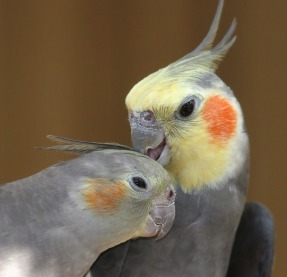
Male normal gray cockatiel preens his wife's crest
Male cockatiel preens his wife’s crest

We have to start this post with the definition of convergence in biology.

In evolutionary biology, convergent evolution is the process whereby organisms not closely related (not monophyletic), independently evolve similar traits as a result of having to adapt to similar environments or ecological niches.

It is the opposite of divergent evolution, where related species evolve different traits.

On a molecular level, this can happen due to random mutation unrelated to adaptive changes; see long branch attraction. In cultural evolution, convergent evolution is the development of similar cultural adaptations to similar environmental conditions by different peoples with different ancestral cultures. An example of convergent evolution is the similar nature of the flight/wings of insects, birds, pterosaurs, and bats.

All four serve the same function and are similar in structure, but each evolved independently.

And now, this new article on convergence in birds and humans, from Evolution News.

They write:

Everyone is familiar with the striking ability of certain birds (such as parrots) to vocalize speech, much as humans do. Well, according to the new papers published in Science that I wrote about earlier, confirming that birds arose explosively, those vocalization abilities are the result of “convergent evolution” at both the morphological and genetic levels.

Nature News reports, “The authors also conclude that vocal learning may have evolved independently in the ancestors of parrots, hummingbirds and songbirds.” But this is about more than just birds. According to a Science Daily article about the technical papers, the genetic “convergent evolution” extends to birds and humans:

“We’ve known for many years that the singing behavior of birds is similar to speech in humans — not identical, but similar — and that the brain circuitry is similar, too,” said Jarvis, an associate professor of neurobiology at the Duke University Medical School and an investigator at the Howard Hughes Medical Institute. “But we didn’t know whether or not those features were the same because the genes were also the same.”Now scientists do know, and the answer is yes — birds and humans use essentially the same genes to speak.

After a massive international effort to sequence and compare the entire genomes of 48 species of birds representing every major order of the bird family tree, Jarvis and his colleagues found that vocal learning evolved twice or maybe three times among songbirds, parrots and hummingbirds.

Even more striking is that the set of genes involved in each of those song innovations is remarkably similar to the genes involved in human speaking ability.

If you’re already thinking “This isn’t ‘convergent evolution,’ it’s common design,” you haven’t seen the best part yet. Science Daily goes on:

One of the Dec. 12 papers in Science found there is a consistent set of just over 50 genes that show higher or lower activity in the brains of vocal learning birds and humans. These changes were not found in the brains of birds that do not have vocal learning and of non-human primates that do not speak, according to this Duke team, which was led by Jarvis; Andreas Pfenning, a graduate of the PhD program in computational biology and bioinformatics (CBB); and Alexander Hartemink, professor of computer science, statistical science and biology.”This means that vocal learning birds and humans are more similar to each other for these genes in song and speech brain areas than other birds and primates are to them,” Jarvis said.

These genes are involved in forming new connections between neurons of the motor cortex and neurons that control the muscles that produce sound.

The Science paper puts it this way:

More than 50 genes contributed to their convergent specialization and were enriched in motor control and neural connectivity functions. These patterns were not found in vocal nonlearners, but songbird RA was similar to layer 5 of primate motor cortex for another set of genes, supporting previous hypotheses about the similarity of these cell types between bird and mammal brains.(Pfenning et al., “Convergent transcriptional specializations in the brains of humans and song-learning birds,” Science, Vol. 346: 1256846-1 – 1256846-13 (December 12, 2014). )

So certain birds and humans use the same genes for vocalization — but those genetic abilities are absent in non-human primates and birds without vocal learning? If not derived from a common ancestor, as they clearly were not, how did the genes get there? This kind of extreme convergent genetic evolution points strongly to intelligent design.

The rest of the article talks about the conclusions of the study authors – they think it’s a huge problem – and it is.

I hope you’re all beginning to see why I love birds so much. I just adore them. In fact, I am excited about them right now, and will probably appear silly by gushing about how great they are. Fortunately, my editorette is not hear to stop me!

Birds are not just a living disproof of naturalistic evolution. They are also loveable and adorable. (Especially parrots, of course) If you guys are considering a pet, go out and get yourself a cockatiel, if it’s your first bird, or a green-cheek conure, if you’ve had birds before. Just remember that they live 20-25 years, so you have to be ready to face responsibilities, expectations and obligations if you make a commitment like that. And you know what? That is totally awesome, to have someone to care about. It’s good stewardship to care for animals. And if you can’t commit to a parrot of your own over the long haul, then put out an additional bird feeder this winter, and vote against wind power. Wind power kills birds, and I hate it.

Also, that bird in the Evolution News post is an Indian ringneck parrot. And they are awesome!!!!

More posts on convergence