Tag Archives: Denmark

Sweden turning to capitalism as money for government spending runs out

I hear a lot of people in my office predicting doom and gloom for the United States. Rubbish. The worst that’s going to happen is that we have the kind of slow economy that France has, and that will only last until we run out of money to borrow.

Yahoo News explains what happens when socialists run out of money.

Excerpt:

The Nordic model, known for high taxes and its cradle-to-grave welfare system, is getting a radical makeover as nations find themselves cash-strapped.

[…]In the wake of a banking crisis in the early nineties, Stockholm scrapped housing subsidies, reformed the pension system and slashed the healthcare budget.

A voucher-based system that allows for-profit schools to compete with state schools was introduced, and has drawn attention from right-wing politicians elsewhere, including Britain’s Conservative Party.

In 2006, conservative Prime Minister Fredrik Reinfeldt’s government accelerated the pace of reform, tightening the criteria for unemployment benefits and sick pay while lowering taxes.

Income tax in Sweden is now lower than in France, Belgium and Denmark, and public spending as a share of GDP has declined from a record 71.0 percent in 1993 to 53.3 percent last year.

Just so you know, his numbers might be out of date.

The latest Heritage Foundation Index of Economic Freedom says this:

The top individual income tax rate is 57 percent, and the top corporate tax rate has been cut to 22 percent. Other taxes include a value-added tax (VAT) and a capital gains tax. The overall tax burden is 44.5 percent of GDP. Public expenditures make up about half of GDP, and public debt is below 40 percent of GDP. The government is attempting to expand investment in infrastructure and research while reining in welfare spending.

The United States had this:

The top individual income tax rate has risen to 39.6 percent, and the top corporate tax rate remains at 35 percent. Other taxes include a capital gains tax and excise taxes. The payroll tax holiday expired at the beginning of 2013. The overall tax burden amounts to 25.1 percent of gross domestic income. General government expenditures are slightly over 40 percent of GDP. Total public debt equals over 100 percent of the size of the economy.

So we are actually worse than Sweden now, in terms of government spending as a percent of GDP.

Denmark, too

More from the Yahoo News article:

If Sweden is the Nordic country to have gone the furthest in shrinking its welfare state, Denmark has moved the fastest.

When her Social Democratic government took power in 2011, there was little to suggest Prime Minister Helle Thorning-Schmidt would make any dramatic changes to the country’s cherished welfare state — funded by the world’s highest tax burden.

After a centre-right government had raised the retirement age and reduced the unemployment benefits period from four to two years, “Gucci Helle” — as she is known among her detractors — went on to cut corporate taxes to 22 percent from 25 percent.

Other reforms have included requiring young people on benefits to undertake training, and withdrawing student aid to those taking too long to finish their studies.

Denmark has been spurred into action by a persistently sluggish economy since a housing bubble imploded in 2007, leading to anaemic household spending.

But among Danes there is also a sense that the welfare state was ballooning out of control.

In 2011, a TV report aiming to show what life was like for the poor in Denmark visited the home of a single mother on benefits, whose disposable income turned out to be 15,728 kroner (2,107 euros, $2,860) per month.

“Poor Carina”, as she was later nicknamed, sparked a national debate on the level of unemployment benefits, with one pollster crediting her with fuelling a rise in the number of people who felt benefits were too high.

It would be nice if we had journalists who could do a story like that.

A different article from a Swedish newspaper called The Local has more on the new Sweden.

Excerpt:

One in ten Swedes now has private health insurance, often through their employers, with some recipients stating it makes business sense to be seen quickly rather than languish in national health care queues.

More than half a million Swedes now have private health insurance, showed a new review from industry organization Swedish Insurance (Svensk Försäkring). In eight out of ten cases, the person’s employer had offered them the private insurance deal.

“It’s quicker to get a colleague back to work if you have an operation in two weeks’ time rather than having to wait for a year,” privately insured Anna Norlander told Sveriges Radio on Friday. “It’s terrible that I, as a young person, don’t feel I can trust the health care system to take care of me.”

The insurance plan guarantees that she can see a specialist within four working days, and get a time for surgery, if needed, within 15.

I used to make fun of Sweden for being so socialist, but then I started to read more about them on Reason.com and from the Cato Institute (two libertarian sites) and my mind changed. These new articles confirm for me  that Sweden is improving their economy by embracing the free market system and rejecting socialism. Obviously, there is more to do, but the trend is good, and the results cannot be questioned. What could the United States do if we acted more like Sweden? It seems like just as they are moving away from government control of health care, we are moving towards it! We are embracing old ideas, and we need something new.

I am still worried about the European countries because of the breakdown of the family, the disrespect of marraige and the low fertility rates. But still, this is a good sign for those of us who are worrying that we need to cheer up. This is how socialism ends. We’ll get there.
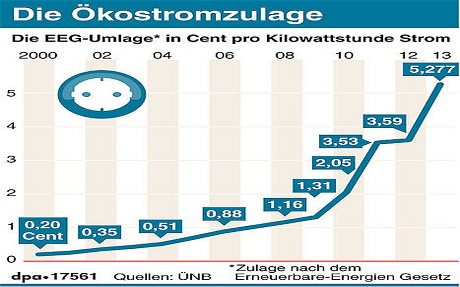
How well is government promotion wind and solar power working out in Germany?

Surcharge paid by German households and SMEs

First, let’s hear from the ultra-leftist New York Times. (H/T Dennis Prager)

Excerpt:

It is an audacious undertaking with wide and deep support in Germany: shut down the nation’s nuclear power plants, wean the country from coal and promote a wholesale shift to renewable energy sources.

But the plan, backed by Chancellor Angela Merkel and opposition parties alike, is running into problems in execution that are forcing Germans to come face to face with the costs and complexities of sticking to their principles.

German families are being hit by rapidly increasing electricity rates, to the point where growing numbers of them can no longer afford to pay the bill. Businesses are more and more worried that their energy costs will put them at a disadvantage to competitors in nations with lower energy costs, and some energy-intensive industries have begun to shun the country because they fear steeper costs ahead.

Newly constructed offshore wind farms churn unconnected to an energy grid still in need of expansion. And despite all the costs, carbon emissions actually rose last year as reserve coal-burning plants were fired up to close gaps in energy supplies.

A new phrase, “energy poverty,” has entered the lexicon.

“Often, I don’t go into my living room in order to save electricity,” said Olaf Taeuber, 55, who manages a fleet of vehicles for a social services provider in Berlin. “You feel the pain in your pocketbook.”

Mr. Taeuber relies on just a single five-watt bulb that gives off what he calls a “cozy” glow to light his kitchen when he comes home at night. If in real need, he switches on a neon tube, which uses all of 25 watts.

Even so, with his bill growing rapidly, he found himself seeking help last week to fend off a threat from Berlin’s main power company to cut off his electricity. He is one of a growing number of Germans confronting the realities of trying to carry out Ms. Merkel’s most ambitious domestic project and one of the most sweeping energy transformation efforts undertaken by an industrialized country.

[…]The cost of the plan is expected to be about $735 billion, according to government estimates, and may eventually surpass even that of the euro zone bailouts that have received far more attention during Ms. Merkel’s tenure. Yet as the transition’s unknowns have grown, so have costs for the state, major companies and consumers.

[…]With consumers having to pay about $270 each in surcharges this year to subsidize new operators of renewable power, the hardest hit are low-wage earners, retirees and people on welfare, Mr. Gärtner said. Government subsidies for the plan amounted to $22.7 billion in 2012 and could reach $40.5 billion by 2020, according to John Musk, a power analyst at RBC Capital Markets.

[…]Part of the reason consumer prices have risen so sharply is that, for now, the government has shielded about 700 companies from increased energy costs, to protect their competitive position in the global economy.

Industrial users still pay substantially more for electricity here than do their counterparts in Britain or France, and almost three times as much as those in the United States, according to a study by the German industrial giant Siemens. The Cologne Institute for Economic Research said there had been a marked decline in the willingness of industrial companies to invest in Germany since 2000.

Note that German industry has been EXEMPT from paying the green energy surcharge. Households and small-to-medium-size enterprises are paying it.

The key part of the article, I think, is this:

One of the first obstacles encountered involves the vagaries of electrical power generation that is dependent on sources as inconsistent and unpredictable as the wind and the sun.

And no one has invented a means of storing that energy for very long, which means overwhelming gluts on some days and crippling shortages on others that require firing up old oil- and coal-burning power plants. That, in turn, undercuts the goal of reducing fossil-fuel emissions that have been linked to climate change.

Last year, wind, solar and other nonfossil-fuel sources provided 22 percent of the power for Germany, but the country increased its carbon emissions over 2011 as oil- and coal-burning power plants had to close gaps in the evolving system, according to the German electricity association BDEW.

Didn’t anyone think of that problem before starting out this crazy plan? No. Because they important thing was feelings – politicians had to feel good about solving a made-up crisis.

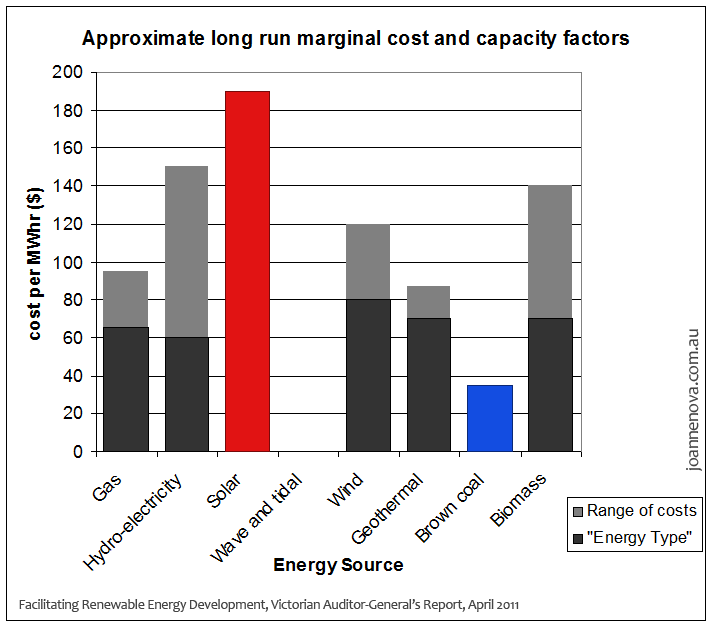
Cost of renewable wind and solar energy

Why can’t leftists learn from the failed experiments of others?

Government-subsidized green energy scams have been tried before in Spain and Denmark. Did they work?

Well, we know that in Spain, the green jobs programs failed. (H/T ECM)

Excerpt:

Subsidizing renewable energy in the U.S. may destroy two jobs for every one created if Spain’s experience with windmills and solar farms is any guide.

For every new position that depends on energy price supports, at least 2.2 jobs in other industries will disappear, according to a study from King Juan Carlos University in Madrid.

U.S. President Barack Obama’s 2010 budget proposal contains about $20 billion in tax incentives for clean-energy programs. In Spain, where wind turbines provided 11 percent of power demand last year, generators earn rates as much as 11 times more for renewable energy compared with burning fossil fuels.

The premiums paid for solar, biomass, wave and wind power – – which are charged to consumers in their bills — translated into a $774,000 cost for each Spanish “green job” created since 2000, said Gabriel Calzada, an economics professor at the university and author of the report.

“The loss of jobs could be greater if you account for the amount of lost industry that moves out of the country due to higher energy prices,” he said in an interview.

The Heritage Foundation cites a study from Denmark, which shows that wind power has also failed.

Excerpt:

But according to a new study from the Danish Centre for Political Studies (CEPOS), commissioned by the Institute for Energy Research, the road to increased wind power is less traveled for a reason. The study refutes the claim that Denmark generates 20 percent of its power from wind stating that its high intermittency not only leads to new challenges to balance the supply and demand of electricity, but also provides less electricity consumption than assumed. The new study says, “wind power has recently (2006) met as little as 5% of Denmark’s annual electricity consumption with an average over the last five years of 9.7%.” Furthermore, the wind energy Denmark exports to its northern neighbors, Sweden and Norway, does little to reduce carbon dioxide emissions because the energy it replaces is carbon neutral.

The study goes on to say that the only reason wind power exists in Denmark is “through substantial subsidies supporting the wind turbine owners. Exactly how the subsidies have been shared between land, wind turbine owners, labor, capital and its shareholders is opaque, but it is fair to assess that no Danish wind industry to speak of would exist if it had to compete on market terms.”

But there’s a cost involved. When government spends more money, it necessarily diverts labor, capital and materials from the private sector. Just like promises are made in the United States about green jobs creation, the heavily subsidized Danish program created 28,400 jobs. But “this does not, however, constitute the net employment effect of the wind mill subsidy. In the long run, creating additional employment in one sector through subsidies will detract labor from other sectors, resulting in no increase in net employment but only in a shift from the non-subsidized sectors to the subsidized sector.”

And because these resources are being diverted away from more productive uses (in terms of value added, the energy technology underperforms compared to industrial average), “Danish GDP is approximately $270 million lower than it would have been if the wind sector work force was employed elsewhere.”

Why do people keep voting in leaders who don’t know what they are doing? Why are people surprised when emotional craziness and moral preening doesn’t work out financially?

Previously, I blogged about how Obama was causing our electricity prices to skyrocket by effectively banning coal power. Not to mention blocking the Keystone XL pipeline. Keep that in mind when you are lighting your house with 5 Watt light bulbs. This doesn’t happen by accident – you need politicians to wage war on the free market system in order for this to happen. And that’s what we’ve been voting for in the last two elections.

Related Posts

Marriage was weakened in countries that legalized same-sex marriage

A sociologist summarizes what can be known about the effects of gay marriage on society by appealing to evidence from other countries. (H/T Dina)

Excerpt:

Gay marriage will further destabilise marriage and family life in Britain, a leading sociologist has warned Parliament.

Dr Patricia Morgan told the House of Commons that same-sex marriage reinforced the idea that marriage is irrelevant to parenthood.

This was the principle factor, she said, that has caused the collapse in marriage rates between heterosexuals in countries where gay marriage had been introduced – as well as a sharp rise in cohabitation and the numbers of children born out of wedlock.

She said there was no evidence whatsoever to prove the Coalition Government’s assertions that gay marriage would bolster the institution.

She made her claims in a 22-page paper submitted at the Committee Stage of the Marriage (Same Sex Couples) Bill.

It contained a detailed analysis of marriage trends in Sweden, Norway, Denmark, Spain, Belgium, Canada and some U.S. states were gay marriage has been legalised.

[…]Spain in particular, she said, saw a “precipitous” downward acceleration in the numbers of all marriages by a 15,000 a year in first three years that followed the legalisation of same-sex marriage by the Socialist government in 2005.

The rate of decline later more than doubled to 34,000 fewer marriages a year in between 2008 and 2010.

Dr Morgan also produced evidence to show that heterosexual marriages were less stable in those countries where same-sex marriage had been introduced because they were expected to conform to the values of gay couples whose unions were often open, rather than exclusive, and far more likely to break down.

Cohabiting gay couples were 12 times more likely to separate that married heterosexual couples, she said.

Dr Morgan also predicted the widespread victimisation of individuals and institutions who dared to resist the redefinition of marriage.

“Some clearly hope that compulsion to perform same sex weddings will sever Church and state and further push Christianity out of the public arena and, therefore, consciousness,” she said.

“Undermined and stigmatised for their unreasonableness and prejudice, the moral authority of religious institutions will further retreat in favour of a narrow secular ideology, particularly as sexual behaviour at odds with traditional norms is further encouraged and advanced.”

Why can’t we stop talking about abstract concepts like “tolerance” and “homophobia” and just look at the results of legalizing same-sex marriage? We want to strengthen marriage, because marriage is better for children emotionally and financially. If we look at the results of legalizing same-sex marriage in other countries, we can know for certain whether it strengthened marriage, and therefore helped children. Rhetoric and insults doesn’t tell us anything. We need to look at the data that we have from other countries.