Tag Archives: Deficit

Liberal Party has made Ontario’s economy a disastrous failure

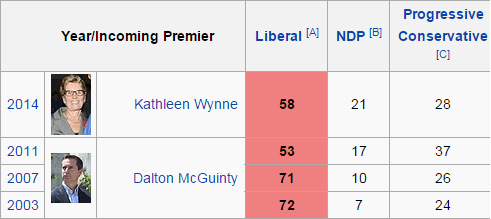
Liberal Party has dominated Ontario since 2003

I like to follow the economic situations in the most liberal Canadian provinces to see how bad things can get when liberals are in charge. This article is by Joe Oliver, who I have mentioned before on this blog.

Here’s the article from the Financial Post:

The numbers tell the story. Ontario is the largest sub-national debtor in the entire world, just one alarming distinction. Its debt is more than twice that of California, a state with three times the population and one that has its own severe fiscal problems. Its debt is $294 billion, or over $21,000 per capita. Net debt to GDP is up 48 per cent in the past 10 years to almost 40 per cent, second only to Quebec. Last year’s interest obligations totalled $11.4 billion, about the same as the cost of community and social services. I doubt many Ontarians realize how much they are paying just in interest on the provincial debt. It averages $840 per person every year and rising. Not surprisingly, Standard and Poor’s downgraded Ontario’s bond credit from AA- to A+, citing a very high debt burden and very weak budgetary performance

The energy sector is nationalized in Ontario – there is no free market competition, it’s all government-run. Consumers have one choice when they want to purchase electricity – the provincial government. How well has nationalizing the energy sector (“Ontario Hydro”) worked out?

Some of its biggest problems are self-inflicted. Recently, we received a stunning revelation from Bonnie Lysyk, the province’s Auditor-General. In the past eight years, electricity cost $37 billion above market price. Even more staggering, it will pay a further $132 billion above market by 2032. The by-now infamous Green Energy Act guaranteed the price for wind and solar, so that they cost double and 3.5 times the U.S. market price respectively. As a result, energy costs have skyrocketed by 70 per cent, a regressive tax that hurts lower income earners disproportionately and depresses personal consumption. Higher energy costs also render businesses less competitive, which discourages job-creating capital investment.

Surprise! Green energy doesn’t lower electricity bills. But that hasn’t stopped the Liberal government from jumping into it with both feet.

There is no respect for the taxpayer in Ontario… every dollar earned there is seen by the ruling elite as more fuel for her vote-buying schemes. They want to spend their way to prosperity, as if spending money in the right way will cause economic growth. Well, here’s the truth: the government can never cause the people who start businesses and create value to produce more by taking more from them. The more the government takes from job creators, the more job creators scale back their productivity.

We should learn from the failure of socialism in other countries so that we don’t repeat their mistakes here.

Related posts

Who’s better at managing money – Republicans or Democrats?

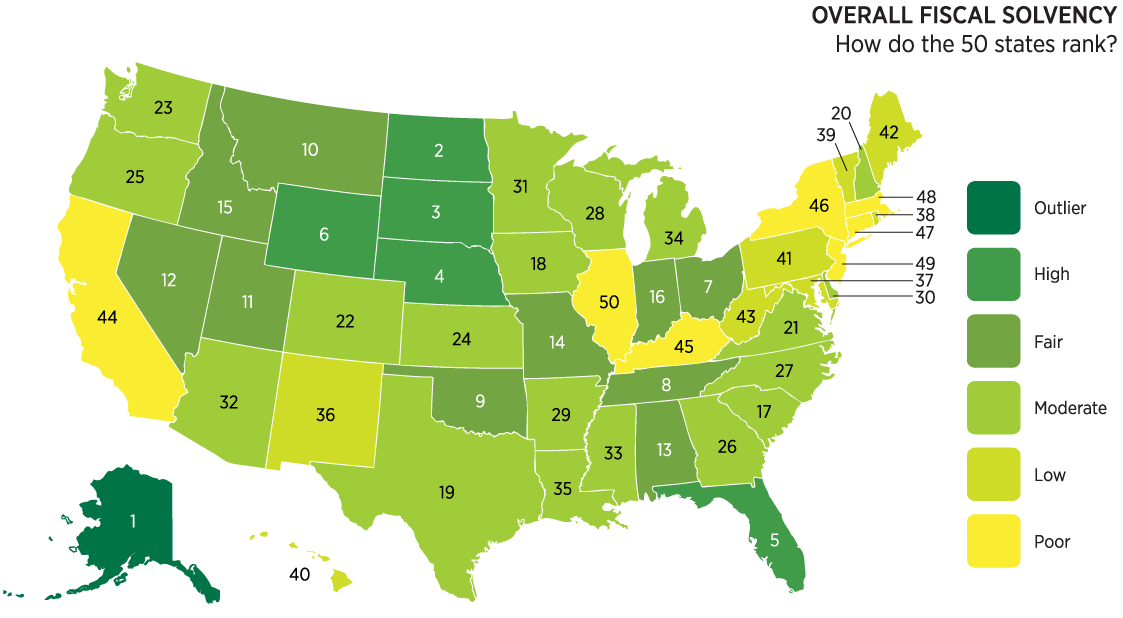
One of the best jobs for managing money is being governor of a state. So, let’s take a look at the 50 states and see which ones have the best governors for managing money.

Here’s a new report from George Mason University, and it’s written up in Investors Business Daily.

IBD says:

A new report from George Mason University’s Mercatus Center ranks all 50 states based on 14 measures designed to determine whether states can pay their short-term bills and meet their long-term obligations — debt, pension liabilities and such. The data go through 2013.

The best-run states have enough cash to pay its current bills, enough revenue coming in to meet its fiscal year needs, a cushion for economic shocks, and management long-term liabilities.

The worst states, in contrast, have “tens, if not hundreds, of billions of dollars in unfunded liabilities — constituting a significant risk to taxpayers in both the short and the long term.”

[…]There’s only one factor these fiscal winners and losers share in common. And that’s their political leanings. Of the top 10 states in the Mercatus ranking, just two — Florida and Ohio — voted for the Democratic presidential candidate in the past four elections, and just one — Montana — has a Democratic governor. Even if you look at the 25 best-performing states, only three could be considered reliably liberal.

At the other end of the list, just two of the 10 lowest-ranked states — Kentucky and West Virginia — have voted for the Republican in the past four presidential elections. And while four of them have Republican governors, they all are in solid blue states and all were elected to clean up messes left by their Democratic predecessors.

It’s also worth noting that these same states consistently show up at the top and bottom of other lists that measure business friendliness, tax burden and economic freedom.

In fact, six of the 10 worst-performing states in the Mercatus ranking — California, New York, Illinois, New Jersey, Massachusetts, and Connecticut — are also states with the heaviest tax burdens and rated the least business friendly, according to rankings from the Tax Foundation and Chief Executive magazine.

It would appear, then, that abiding by a philosophy of limited government, lower taxes and fewer regulations leads to growth, prosperity and fiscal soundness.

Here’s the full map from the George Mason University study:

George Mason University study on fiscal solvency

At the state-level, everyone understands that Republican governors know what they are doing, because they understand economics. So then why do we forget that and elect a community organizer when it comes to the Presidency? Do we just not care about the debts we are piling onto our children when we elect wastrels and profligates?

Puerto Rico debt crisis will impact U.S. investors

Which financial companies hold Puerto Rica debt?
Which financial companies hold Puerto Rico debt?

Pay attention to this article from Investors Business Daily if you have investments.

It says:

With the financial world transfixed by Greece’s debt-driven meltdown, Puerto Rico announces it can’t pay its $73 billion in debt. Once again, we’re learning that welfare statism is no replacement for fiscal responsibility.

Compared to Greece’s $353 billion in debt, Puerto Rico’s $73 billion doesn’t sound so big. On a per capita basis, it’s about a third less.

But appearances deceive. Puerto Rico is in deep, owing actually much more than that amount.

We learned this after a report on Monday, co-authored by former International Monetary Fund No. 2 Anne Krueger, revealed the island’s finances are a shambles.

The devastating analysis noted that some 150 agencies ran up deficits that couldn’t even be accurately counted, so the true indebtedness might be even higher — as much as $100 billion by some estimates.

Now Republicans favor privatizing state-owned organizations because the private sector is more efficient. Democrats want to nationalize private sector services so that they can control access to it and use their monopoly to buy votes.

What does Puerto Rico do?

The government has funneled public money to state-owned enterprises that are supposed to be financially independent. Worse, the report said, many workers no longer even look for jobs, since welfare benefits pay more than actual work.

Now guess whether a Republican or a Democrat is to blame for this. Which party likes to borrow money from future generations in order to buy votes with spending right now?

In short, the government has been horrendously mismanaged.

[…]The problem is, Puerto Rico’s dysfunctional economy means the debts only piled higher, with no way to pay them. Deficits grew, too, since spending was never really cut.

Now, as a commonwealth, it can’t declare bankruptcy. It can default, however. That would be messy, creating a financial crisis in the territory, causing businesses to close and sending thousands fleeing to the U.S. mainland. Yet the Democrat-led government has said that, while it hopes to avoid default, it won’t cut either pensions or spending. So disaster looms.

Wow, just like Greece – they refused to cut pensions, raise retirement ages and cut spending, too. There is some good news – we probably won’t have to bail them out:

A bailout? Even President Obama rules that out. If the White House couldn’t bail out union-run Detroit, it sure couldn’t do it for Puerto Rico.

And, despite Padilla’s denials, politics is very much a part of the equation. Just like Greece and dozens of other financial basket cases, Puerto Rico has become a welfare state run by leftist bureaucrats and politicians that overspends on public pensions without having the money to pay for it all.

It’s a story repeated over and over around the world.

If Puerto Rico defaults, it won’t suffer alone, however. As the New York Times notes, “much of Puerto Rico’s debt is widely held by individual investors on the United States mainland, in mutual funds or other investment accounts, and they may not be aware of it.”

So better check your 401(k). Or your hedge fund. Because virtually all of that $73 billion is held by the U.S.

This is not to time for you to quit your job and go on vacations or focus on fun in any way. There is a world-wide financial crisis brewing. It’s nothing to panic over, but this is serious enough for us all to focus on our careers and savings, and cut our own spending. It’s not just Greece or Puerto Rico either, there are other warning signs from other countries, e.g. – China, Japan, etc.

Look:

Meanwhile, across the globe, we’re headed toward a reckoning on excessive debt, and it won’t be pretty. The welfare state model with big pensions for all and lavish unemployment benefits is dead. We’re watching its death throes now. Only the politicians don’t get it.

Even here, many states have severe debt problems with underfunded public sector obligations, as well as other problems. There’s just this problem with people wanting to depend on government. There are too many people wanting a free ride, and too few people willing to work and raise the next generation of workers.