
Tag Archives: Debt

FL senator Marco Rubio: “We need more taxpayers, not more taxes”

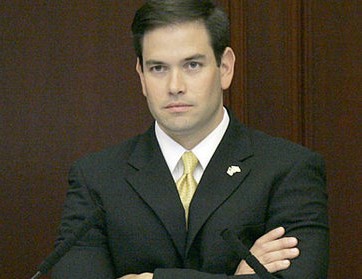
Florida Senator Marco Rubio

If there is anyone I like almost as much as Michele Bachmann, it’s Marco Rubio. And boy, can this guy do an interview.

On the Sean Hannity show: (7 minutes)

And on the Rush Limbaugh radio show: (11 minutes)

He’s William Lane Craig-esque. He just talks about the issues without one hem or haw. Not an uh or an ah to be heard. It’s uncanny. Hmmn. Look at that picture up there. He looks very intense. Do you think he might be some sort of conservative super-android designed by the U.S. Military in a secret base under a mountain in Colorado? I’m not sure.

I actually heard him interviewed on the Hugh Hewitt show on Tuesday night. Hugh played the interview back-to-back in two consecutive hours, and then his producer Duane Patterson posted the full transcript. This one was the best interview of all. Hugh does a great interview, and he was blown away by Marco Rubio.

Excerpt:

HH: Now the President is betting, obviously, that he can turn a conservative message into a toxic one for 2012. Your old colleague from the Florida House, Adam Hasner, is running for Senate down there, a lot like Josh Mandel in Ohio, and Ted Cruz in Texas, they’re running as real conservatives with very much a Rubio-like message from 2010. Will that work in this environment of demagoguery from the White House?

MR: Yeah, it will work, because the common sense of the American people is powerful, and I think that too many people here in Washington walk around thinking well, we can spin it this way, or we can use our allies in the media to confuse people and make them not believe their own eyes. But the truth is that we’re way past that today. The ability of people to get information from multiple sources in real time, the ability of us to communicate directly to our constituents, to go on programs such as yours and talk about the reality of what we’re facing, is something that wasn’t around not that long ago, and it’s incumbent upon us who feel passionate about this to go out there and make clear to the people what our choices are. And this is not a complicated issue. It’s very, very simple. The United States spends more money than it takes in, and it’s not generating enough revenue for its government to pay down the debt. So we have to figure out how do we stop spending more money than we take in? We need a balanced budget amendment. We need a spending cap. And we need real reductions in spending starting right now. And what do we do to get more revenue in the hands of government so it can pay down its debt and not grow its government? Well, you’re not going to do that through tax increases. You’re going to do that through new taxpayers, that is getting people back to work, getting people hired and working, so these people will pay taxes, and then we can use that revenue to pay down the debt. That’s what we need. And you’re not going to create new taxpayers, you’re not going to create economic growth and jobs in America if you’re running around threatening to raise taxes.

HH: Do you think the President understands the underlying economics, Senator Rubio, and is just demagoguing it? Or is he fundamentally misinformed about how capitalism works?

MR: I think there are three things going on here. Number one, I think he’s a prisoner to extremist elements in his own base who not only, they don’t care that the taxes don’t solve any problems. They want their pound of flesh. They want to punish somebody, they want class warfare. That’s what they believe in. And this is their chance to do it, and they’re putting pressure on him to do that. So I think that’s his first problem. His second problem is that I think he’s surrounded by a bunch of people who philosophically do not believe fully in the free enterprise system, and in fact, they’d like to see government play a greater role. And they see this downturn in the economy, and crisis such as this, as an opportunity to exert more government involvement in our economy. And that’s the second problem. And his third problem is a level of incompetence. I think the President, quite frankly, is not up to the job. And if you look at every measure of quality of life in America today, unemployment is higher. The debt is higher. The only thing lower is the value of your home. If you look at every measurable economic thing in America today, they are all worse than they were the day he took over. Two and a half years into his presidency, things continue to get worse, not better, and it’s because the President is incompetent in his job as president. He is not, he doesn’t know what he’s doing.

I think he’s going to be President one day. And I agree with him on Obama’s competence. The man is not qualified in any way, shape or form to run a lemonade stand, much less to be the President of the most powerful country on the planet. I would like to see a Marco Rubio/Allen West ticket in 2020, after the two Michele Bachmann terms are done.


Taxing the rich at 100% doesn’t cover Obama’s 1.6 trillion dollar deficit

An amazing, must-read article from Arthur C. Brooks, president of the American Enterprise Institute. He writes about the national debt problem.

Excerpt:

The practical answer to this problem involves common sense. What do most of America’s families do when they find they are overspending? They don’t send the kids out to get part-time jobs in order to increase family revenues–they cut back on their spending. Why? Because that’s what works to solve the problem.

The government can learn from families. In fact, the data show that when countries are trying to find their way out of a debt crisis, the more they rely on tax increases as opposed to spending cuts, the more likely they are to fail. My colleagues Kevin Hassett, Andrew Biggs, and Matt Jensen studied 21 developed countries that have attempted fiscal consolidation over the last 37 years. Some succeeded and returned to economic health; -others failed.

On average, failed attempts to close budget gaps relied 53 percent on tax increases and 47 percent on spending cuts. Successful consolidations averaged 85 percent spending cuts and 15 percent tax increases. Some of the most successful financial comebacks–like Finland’s in the late 1990s–involved more than 100 percent spending cuts, so that taxes could be lowered. The spending cuts by the successful countries centered on entitlements and government personnel.

Now let’s look at the moral argument against raising taxes. Why does the president want to increase America’s tax burden? You may think it’s just a way to increase revenues and reduce the deficit. But even the president knows he can’t solve the fiscal crisis by helping himself to bigger and bigger chunks of the income of America’s most successful people. Even if individuals earning more than $200,000 were taxed at a 100 percent marginal rate–and we confiscated their passports so they could not flee–the take would come to $1.27 trillion, or just 77 percent of this year’s deficit.

For the administration, it’s not about the money–as we have heard again and again, it’s about “fairness.” The president believes that we will be a better nation if we redistribute more money from those who have more to those who have less. How much more do we need to redistribute until our system is fair?

As you ponder this question, remember the facts: The wealthiest 5 percent of Americans already account for 59 percent of federal income taxes. Nearly half of our citizens pay no federal income taxes at all–yet two-thirds of us believe that everybody should at least pay something, even if just to remind ourselves that government isn’t free. The Tax Foundation reports that the percentage of Americans who are net takers from the tax system is nearing 70 percent.

Arthur C. Brooks is an expert in making moral arguments for the free market. He is a Christian, and has debated against Jim Wallis on Christianity and economics. I think we have to take his advice (elsewhere in the article) where

Are the Bush tax cuts to blame for Obama’s 1.6 trillion dollar deficits?

Obama Budget Deficit 2011

From the Wall Street Journal, the raw numbers on the Bush tax cuts and the deficit. (H/T Paul Ryan)

Excerpt:

But what about the liberal claim, repeated constantly, that the Bush tax cuts of 2001 and 2003 caused today’s deficits? CBO has shown this to be demonstrably false. On May 12, the budget arm of Congress examined the changes in its baseline projections from 2001 through 2011. In 2001, it had predicted a surplus in 2011 of $889 billion. Instead, it expects a deficit of $1.4 trillion.

What explains that $2.29 trillion budget reversal? Well, the direct revenue loss from the combination of the 2001 and 2003 Bush tax cuts contributed roughly $216 billion, or only about 9.5% of the $2.29 trillion. And keep in mind that even this low figure is based on a static revenue model that assumes almost no gains from faster economic growth.

After the Bush investment tax cuts of 2003, tax revenues were $786 billion higher in 2007 ($2.568 trillion) than they were in 2003 ($1.782 trillion), the biggest four-year increase in U.S. history. So as flawed as it is, the current tax code with a top personal income tax rate of 35% is clearly capable of generating big revenue gains.

CBO’s data show that by far the biggest change in its deficit forecast is the spending bonanza, with outlays in 2011 that are $1.135 trillion higher than the budget office estimated a decade ago. One-third of that is higher interest payments on the national debt, notwithstanding record low interest rates. But $523 billion is due to domestic spending increases, including defense, education, Medicaid and the Obama stimulus. Mr. Bush’s Medicare drug plan accounts for $53 billion of this unanticipated spending in 2011.

The last GOP budget was in 2007, and the deficit was $160 billion, ONE TENTH of Obama’s budget deficit. And that was WITH the tax cuts. The cause of the current trillion dollar deficits is Barack Obama’s spending.

Remember what the unemployment rate was under Bush:

Comparison of unemployment rates - Bush vs Obama

I think that looking at the budget deficit numbers and the unemployment numbers is a good way to judge how capable a President is. It gets away from the media spin, the gaffes, the jokes on those liberal Comedy Channel shows. Just look at the numbers, because we all have to care about jobs and spending. Politics is about our freedom, prosperity and security. Not about making us laugh or feel superior to others.