At the end of 2011, the last year for which data are available, some 108.6 million people received one or more means-tested government benefit programs — bureaucratese for welfare.
Meanwhile, there were just 101.7 million people with full-time jobs, the Census data show, including both the private and government sectors.
This is a real danger for the U.S. — the danger of dependency. Anytime more people are being paid not to work than to work, it imperils our democracy. No one votes to cut his own welfare benefits. So welfare grows.
[…]According to official data from the government, 46.5 million people live in poverty in the U.S. Doing the quick math, that means just 43% of all those on welfare are officially considered poor.
When you add in other government programs with a check attached — Social Security, Medicare, veterans benefits, unemployment and other non-means-tested benefits — you find a whopping 151 million Americans get a check from the government other than an income-tax refund.
[…]A Cato Institute study in August found that welfare now pays more than minimum-wage work in 35 states. Indeed, the federal government has 126 separate programs to help low-income earners.
“The current welfare system provides such a high level of benefits that it acts as a disincentive for work,” the study said. “Welfare currently pays more than a minimum-wage job in 35 states, even after accounting for the Earned Income Tax Credit, and in 13 states it pays more than $15 per hour.”
Given all the disincentives, it seems as if the government doesn’t even want people to work. But why would that be?
Perhaps it’s in the interest of those on the so-called progressive left — those most responsible for the uncontrolled growth of the welfare state — to keep Americans out of work and dependent on government.
Sure looks that way. After all, for Democrats, dependent voters are reliable voters.
Where did the money come from? Well, all this subsidized dependency has been going on, we have been adding 6.5 trillion to the national debt. Our national debt is now up to $17 trillion – more than our entire Gross Domestic Product! The national debt will have to be paid back by future generations of Americans. So what we are really doing here is transferring money from children who can’t vote to adults who can vote. That’s what the Democrat Party is doing with all of this spending.
This program of inter-generational theft amounts to enslaving the next generation. You could even view the public schools as complicit in it, since they are teaching young people to value giving the public schools more money. It’s like brainwashing a victim of abuse to believe that the abuse is normal. By the time the young people wake up and realize that they are eating grass while their “educators” dine on caviar, it will be too late. This is not surprising since the Democrats are the part of slavery, historically speaking. Maybe we need to start using rhetoric like that so that people understand what is really going on.
Jay Richards, Ph.D., is a Senior Fellow of the Discovery Institute where he directs the Center on Wealth, Poverty and Morality, and is a Visiting Scholar at the Institute for Faith, Work & Economics. Most recently he is the co-author with James Robison of the best-selling Indivisible: Restoring Faith, Family, and Freedom Before It’s Too Late”.
In addition to writing many academic articles, books, and popular essays on a wide variety of subjects, he recently edited the new award winning anthology, God & Evolution: Protestants, Catholics and Jews Explore Darwin’s Challenge to Faith . His previous book was Money, Greed, and God: Why Capitalism Is the Solution and Not the Problem (HarperOne, May 2009), for which he received a Templeton Enterprise Award in 2010.
[…]In recent years, he has been a Contributing Editor of The American at the American Enterprise Institute, a Visiting Fellow at the Heritage Foundation, and a Research Fellow and Director of Acton Media at the Acton Institute. Richards has a B.A. with majors in Political Science and Religion, an M.Div. (Master of Divinity) and a Th.M. (Master of Theology), and a Ph.D. (with honors) in philosophy and theology from Princeton Theological Seminary.
Jim Wallis:
Jim Wallis (born June 4, 1948) is a Christian writer and political activist. He is best known as the founder and editor of Sojourners magazine and as the founder of the Washington, D.C.-based Christian community of the same name. Wallis is well known for his advocacy on issues of peace and social justice. Although Wallis actively eschews political labels, he describes himself as an evangelical and is often associated with the evangelical left and the wider Christian left. He works as a spiritual advisor to President Barack Obama. He is married to the Rev. Joy Carroll, who was one of the first female priests in the Church of England. He is also a leader in the Red-Letter Christian movement.
[…]In 2010, Wallis admitted to accepting money for Sojourners from philanthropist George Soros after initially denying having done so. When conservative writer Marvin Olasky pointed this out, and that Soros also financed groups supporting abortion, atheism, and same-sex marriage, in a WORLD magazine column, Wallis said Olasky “lies for a living”; he subsequently apologized to Olasky for the comments. In 2011, Wallis acknowledged that Sojourners had received another $150,000.00 from Soros’ Open Society Foundation.
[…]In regard to the 2011 United States budget proposal, Wallis described Congressman Paul Ryan and his congressional allies as “bullies” and “hypocrites.”
Wallis just came out this month in favor of gay marriage. He is also a strong supporter of Barack Obama, who is radically pro-abortion. Some pro-lifers have argued that Barack Obama has the same views on abortion as Kermit Gosnell.
The format of the debate
20 minute opening speeches
10 minute rebuttals
10 minutes of discussion
Q&A for the remainder
SUMMARY
I use italics below to denote my own observations.
Jim Wallis’ opening speech:
My goal is to spark a national conversation on the “common good”.
A story about my son who plays baseball.
The central goal of Christianity is to promote the “common good”.
Quotes “Catholic social teaching” which values “human flourishing”.
The “common good” is “human flourishing”.
Is the purpose of Christianity is to make sure that everyone has enough material stuff or to preach the gospel?
When Christians go on mission trips, it’s good that they focus on things like human trafficking.
Democrat John Lewis is the “conscience of the U.S. Congress”.
John Lewis gets a 0% rating from the American Conservative Union in 2012.
John Lewis gets a 8% rating from the American Conservative Union in 2011.
John Lewis gets a 2.29% lifetime rating from the American Conservative Union.
Nothing is going well in Washington right now except comprehensive immigration reform.
Does he think that Christianity means giving 12-20 million illegal immigrants a path to citizenship, while skilled engineers cannot even get green cards, even though there is a shortage of them? Does he think that the other people in society who earn more than they receive from the government ought to be taxed more in order to provide more services and benefits to those who earn less than they take from the government?
Jay Richards’ opening speech:
Two topics: 1) what is the common good? 2) what should Christians do to promote the common good?
Catholicism defines the “common good” as “Indeed, the common good embraces the sum of those conditions of the social life whereby men, families and associations more adequately and readily may attain their own perfection.”
We have natural ends that we are supposed to be achieving and some places, like South Korea, are better for allowing that to happen.
The common good is broader and prior to any sort of political specification.
It’s not the political good or what the state is supposed to do.
It’s not about the communal good, as in Soviet Russia, where the communal good was above individual and familial good.
The common good is the social conditions that promote the things that we humans have in common as individuals and members of family.
The common good takes account of who we are as individuals and in associations with other individuals, e.g. – families.
Christians don’t have to be doing the same things to promote the common good, e.g. – pastors, entrepreneurs, etc.
The church, as the church, has as its primary goal making disciples of all nations.
But even in that capacity, the church should be interested in more than just conversions and saving souls.
We also have to care about God’s created reality including things like physics, education, etc.
How should Christians promote the common good in politics?
Question: when is coercion warranted?
In Romans 13, Paul says that the state does have power to coerce to achieve certain ends, like justice.
Most Christians think that there are some things where the state can use coercion, for example, to prevent/punish murder.
It is OK for the police to use coercive force to maintain public order and the rule of law.
But we need to ask whether other things are legitimate areas for the state to use coercive force.
We should only give the state power to coerce when there is no other way to achieve a goal.
We need to leverage the science of economics in order to know how to achieve the common good.
Jay Richards’ main point in the debate
Henry Hazlitt: “The art of economics consists in looking not merely at the immediate but at the longer effects of any act or policy; it consists in tracing the consequences of that policy not merely for one group but for all groups.”
For example, what happens if we raise the federal minimum wage to $50. What happens next for all groups? That’s what we need to ask in order to know which policies achieve the common good.
When it comes to economics a lot of things have been tried in other places and times.
We can know what works and doesn’t work by studying what was tried before and in other places.
Many things are counter-intuitive – things that sound good don’t work, things that sound bad do work.
Principle: “We are our brother’s keeper”. Christians have an obligation to care for their neighbors.
We all agree on the goal. But how do we do things that will achieve that goal?
We have to distinguish aspirations from principles and prudential judgment.
Principle: We should provide for the material needs of the poor.
Prudence: Seeing the world as it is, and acting accordingly.
Example policies: which minimum wage is best? None? $10? $20?
We decide based on seeing how different economic policies achieve the goal of helping the poor.
Jim Wallis’ first rebuttal:
Jesus commanded us to “care for the poor and help to end poverty”.
Actually, Jesus thought that acknowledging him and giving him sacrificial worship was more important than giving money to the poor, see Matthew 26:6-13:
6 While Jesus was in Bethany in the home of Simon the Leper,
7 a woman came to him with an alabaster jar of very expensive perfume, which she poured on his head as he was reclining at the table.
8 When the disciples saw this, they were indignant. “Why this waste?” they asked.
9 “This perfume could have been sold at a high price and the money given to the poor.”
10 Aware of this, Jesus said to them, “Why are you bothering this woman? She has done a beautiful thing to me.
11 The poor you will always have with you, but you will not always have me.
12 When she poured this perfume on my body, she did it to prepare me for burial.
13 Truly I tell you, wherever this gospel is preached throughout the world, what she has done will also be told, in memory of her.”
It’s not clear to me whether Jim Wallis thinks that preaching is more important than redistributing wealth to address material inequality.
I like what Jesus said in a TV series, even though it’s not in the Bible when an actor playing Jesus said to “change the world”.
Jesus never said to “change the world” in the Bible. Should we be concerned that he is quoting a TV actor playing Jesus instead of Jesus.
Here is a terrific story about Bill Bright.
I love Catholic social teaching.
Quote: “All are responsible for all”.
I go to the World Economic Forum at Davos, Switzerland every year. I spoke once at 7 AM on the 4th floor.
It’s a funny place for a Christian to be if they care about the poor – rubbing shoulders with leftist elites. He must have named a dozen high-profile people that he spoke with during the debate, as if he could win the debate by some sort of argument from name-dropping. He mentioned the Davos thing several times!
The greatest beneficiary of government actions to deal with the economic crisis was Wall Street banks.
I’m going to tell you a story about what a Washington lawyer says to Jesus.
I’ve had conversations with business leaders where I tell them to integrate moral truths.
I talk about the Good Samaritan parable.
Quote: “Do you love your undocumented neighbor?”
Quote: “Do you love your Muslim neighbor?”
Jay Richards’ first rebuttal:
Who is responsible for your own children? Who knows the most about them?
Parents should have more discretion over their children because they have more knowledge about their child and what’s best for them.
The Good Samaritan doesn’t show that government should confiscate wealth through taxation and redistribute it.
The Good Samaritan emphasizes voluntarily charity to help people who are not necessarily your immediate neighbor.
Some of the things we do should be for the good of other people in other countries.
But then we are back to leveraging economics to know what policies are good for those other people in other countries.
The principle of subsidiarity: if a problem can be addressed by a lower level of society (family) then we shouldn’t make higher levels (government) address it.
The best place to take care of children is within the family.
Only if the family fails should wider and wider spheres get involved.
Although we want to think of the common good in a global sense, we don’t want to lose sight of the fact
The financial crisis: we need to integrate moral truths, but also economic truths.
We don’t want to assume policies based on intuitions, we want to check our intuitions using economic principles.
Why did we have a financial crisis in mortgages, but not in commodities futures or technology, etc.?
Greed is a contributing factor in all areas of business.
Something more was going on in the mortgage markets than just greed.
There were specific policies that caused the mortgage lending crisis.
The root cause of the problem were “affordable housing policies” that lowered lending restrictions on low income people.
The policy ended up degrading the underwriting standards on loans.
Government intruded into the market and undermined the normal ways of
People were getting massive loans with no income, no jobs, no assets and no down payment.
The federal government created a market for risk loans by guaranteeing
There was a government imposed quota on mortgage lenders such that 50% of their loans had to be given to high-risk borrowers.
That is what led to the financial crisis. Not the free market, but intrusions into the free market.
These policies were well-meaning and implemented by people from both parties. But they had bad effects.
STEPHANOPOULOS: How is this going to end? You’re clearly not budging right now, even though you are taking — even though polls show that most Americans blame Republicans for the shutdown right now. How long is it going to go on? Is the government going to stay shut down until we reach the debt limit deadline of October 17th?
BOEHNER: Listen, the debt limit is right around the corner. The president is saying, I won’t negotiate. I won’t have a conversation. Even though, President Reagan negotiated with Democrats who controlled the Congress back then. Even though President George Herbert Walker Bush had a conversation about raising the debt limit. During the Clinton administration, there were three fights over the debt limit. You and I participated in several of those. And even President Obama himself in 2011, went through a negotiation.
Now, he’s saying no. I’m not going to do this.
I’m going to tell you what, George. The nation’s credit is at risk because of the administration’s refusal to sit down and have a conversation.
STEPHANOPOULOS: They’re saying it’s at risk because of your refusal to pass a clean debt limit. There have been some reports–
BOEHNER: We’re not going to pass a clean debt limit increase.
STEPHANOPOULOS: Under no circumstances?
BOEHNER: I told the president, there’s no way we’re going to pass one. The votes are not in the House to pass a clean debt limit. And the president is risking default by not having a conversation with us.
STEPHANOPOULOS: So under no circumstances will you pass a clean debt limit?
BOEHNER: We’re not going down that path. It is time to deal with America’s problems. How can you raise the debt limit and do nothing about the underlying problem?
George, we’ve spent more than what we’ve brought in for 55 of the last 60 years. This year, the federal government will have more revenue than any year in the history of our country, and yet we’re still going to have a nearly $700 billion budget deficit. We’re squandering the future for our kids and our grandkids, by not dealing with this problem.
STEPHANOPOULOS: The deficit, as you know, has been coming down this year, but I want to press you on this issue of the risks of not passing a clean debt limit. The Treasury Department put out a report just the other day, where they said it would be unprecedented and catastrophic, that would be the impact of failing to pass a debt limit. They’re going to say, credit markets could freeze. The value of the dollar could plummet. U.S. interest rates could skyrocket. The negative spillovers could reverberate around the world, and there might be a financial crisis and recession that could echo the events of 2008 or worse.
Do you agree with that assessment?
BOEHNER: I do. And the president is putting the nation at risk by his refusal to sit down and have a conversation.
STEPHANOPOULOS: As — we’re going to go back on this. He says you’re putting it at risk by refusing to pass a clean debt limit, so just let me — let me press that, because there have been some reports that you have told your own members that you would be willing to put a debt limit on the floor that would pass with Democratic votes, even if it didn’t get a majority of the Republican caucus. Is that no longer true?
BOEHNER: My goal here is not to have the United States default on their debt. My goal here is to have a serious conversation about those things that are driving the deficit and driving the debt up. And the president’s refusal to sit down and have a conversation about this is putting our nation at risk of default.
STEPHANOPOULOS: So are you saying that if he continues to refuse to negotiate, the country is going to default?
BOEHNER: That’s the path we’re on. The president canceled his trip to Asia. I assumed — well, maybe he wants to have a conversation. I decided to stay here in Washington this weekend. He knows what my phone number is. All he has to do is call.
STEPHANOPOULOS: So it’s October 17th, 8:00 p.m. The clock is ticking towards midnight. The country is scheduled to run out of money, won’t be able to pay its bills anymore. What do you do in that moment?
BOEHNER: No family in America can spend more than what it brings in for 55 of the last 60 years. No family or business in America can survive a $700 billion budget deficit in one year. It is time for us to deal with our underlying spending problems.
I’m willing to sit down and have a conversation with the president. But his refusal to negotiate is putting our country at risk.
STEPHANOPOULOS: So the clock is ticking on October 17th. You’re not going to put that bill on the floor?
BOEHNER: I want to deal with our underlying problem.
STEPHANOPOULOS: Yes or no, would you put that bill on the floor?
BOEHNER: I don’t want the United States to default on its debt. But I’m not going to raise the debt limit without a serious conversation about dealing with problems that are driving the debt up. It would be irresponsible of me to do this.
STEPHANOPOULOS: It’s also been reported that you’re going to guarantee that we do not default. It sounds like you’re not prepared to offer that guarantee, you’re not prepared to promise you would actually put the bill on the floor.
BOEHNER: I’ve been willing to sit down with the president and have this conversation. His refusal to negotiate is what’s putting the government at risk of default.
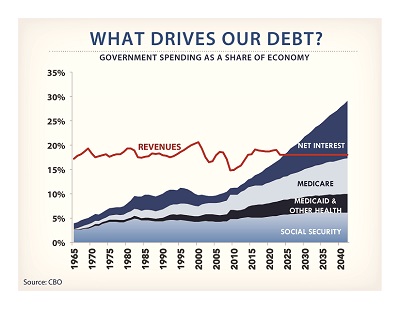
What is Boehner talking about having a conversation about debt?
This:
What Drives Our Debt
That’s what Boehner is talking about. He doesn’t want to keep raising the debt ceiling over and over when it looks like the entitlement programs are going to be consuming a greater share of government revenues, leaving no money left over for other programs. It looks like the Republicans in the House are serious about trying to stop our runaway spending problem. The Democrats? They just want a blank check to keep spending on Solyndra, and then they’ll send your kids (and grandkids) the bill.

 WINTERY KNIGHT