Tag Archives: Debt

Two Blue Cross plans out of Obamacare, Obama wants taxpayer bailout for insurers

Investors Business Daily reports on the latest big health insurer to drop out of Obamacare.:

Two Blue Cross plans made the stunning announcement in the past week that they were dropping out of ObamaCare markets. If even the Blues — the backbone of the individual insurance market for decades — can’t make it, ObamaCare is truly on the road to ruin.

[…]Despite getting approval on an eye-popping rate hike of nearly 60% for 2017, Blue Cross Blue Shield of Tennessee announced that it was quitting three of the largest ObamaCare markets in the state, which will leave 100,000 enrollees to scramble for an alternative coverage next year.

The state’s Blue Cross had lost half a billion dollars in ObamaCare’s first three years, and the company’s spokesman said “there are too many uncertainties to continue participating on a statewide level as we have before.”

That decision came shortly after Blue Cross Blue Shield of Nebraska’s announcement that it was pulling out of ObamaCare entirely in that state — stranding some 20,000 ObamaCare enrollees — after losing $140 million. “We can’t take another hit,” said CEO Steve Martin last Friday. The decision came after the company had won approval for a 42% premium increase.

These dropouts are on top of the June announcement that Minnesota’s Blue Cross was abandoning the states individual market entirely in the wake of $500 million in losses, which means more than 100,000 people in the state will be looking for a new insurer for next year.

That same month, Arizona’s Blue Cross announced that it was dropping out of two counties — Maricopa and Pinal. It later decided to get back into Pinal County after Aetna fled the state, which would have left Pinal with zero insurers in the ObamaCare exchange.

In North Carolina, Blue Cross was contemplating an exit until other insurers dropped out, leaving it the sole carrier in much of the state.

[…]Even before the latest pullbacks, 974 counties in the U.S. — which represent 31% of all counties — were down to one ObamaCare insurer after Aetna, UnitedHealth, Humana and others pulled out of various states, and after most of the ObamaCare-created insurance co-ops failed, according to the Kaiser Family Foundation. Another 31% of counties will be stuck with just two insurers.

Fewer choices means less competition means higher prices for consumers.

Bloomberg News explains:

Minnesota will let the health insurers in its Obamacare market raise rates by at least 50 percent next year, after the individual market there came to the brink of collapse, the state’s commerce commissioner said Friday.

The increases range from 50 percent to 67 percent, Commissioner Mike Rothman’s office said in a statement. Rothman, who regulates the state’s insurers, is an appointee under Governor Mark Dayton, a Democrat. The rate hike follows increases for this year of 14 percent to 49 percent.

[…]On average, rates in the state will rise by about 60 percent, said Shane Delaney, a spokesman for MNSure, the state’s marketplace for Obamacare plans.

Wow, this is a lot different than what Obama promised in his campaign speeches, isn’t it?

A lot of young people believed Obama’s promises in 2008 and again in 2012:

And you can keep your doctor! And you can keep your health plan! Because Obama! Everything will be fine, don’t ask for evidence that he has ever achieved anything in his life. He’s handsome! He has a nice voice! He’s confident!
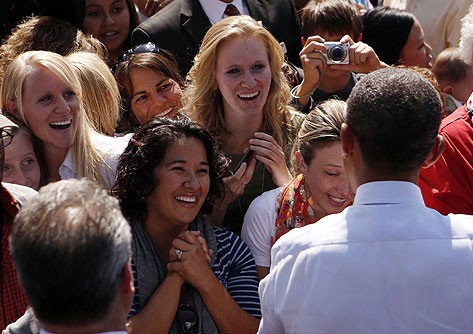
Should we pick a candidate based on our emotional response to his confidence?
Should we pick a candidate based on our emotional response to his confident words?

Yes, OK. But what about this problem of health insurance companies taking huge losses and pulling out of Obamacare? I don’t think that the program works as well, if all the health insurance providers stop selling health insurance.

Well, don’t worry! Because Obama has a plan to give all his insurance company friends a big bailout from his private stash of taxpayer dollars.

The Weekly Standard explains:

Obamacare’s “risk corridor” program was designed to redistribute money in the Obamacare exchanges from health insurers who made money to those who lost money. Profitable insurers would pay in; unprofitable insurers would get paid out. With so many insurers losing money under Obamacare, however, the program was positioned to become a bailout, as there was no guarantee in Obamacare’s text that the money paid out wouldn’t exceed the money paid in.

[…][I]n late 2014, congressional Republican leadership took action. Congress put an end to Obamacare’s insurer bailout, as it added language to the CRomnibus spending package stipulating that the risk corridors must be budget-neutral: No more could be paid out to insurers than was paid in by insurers. Taxpayers would no longer be on the hook for bailing out insurance companies. In December of 2014, Obama signed that legislation into law.

Congress had acted just in time. Whereas the Obama administration and the CBO both claimed the risk-corridor program would pay for itself, insurers paid $362 million into the program in 2014 and—if not for Congress’s having stopped the bailout—would have been paid out a cool $2.87 billion. For every $1 that was paid in, about $8 would have been paid out. Instead, insurers received only $362 million, and Congress saved taxpayers $2.5 billion.

Obama now seems determined to change that. He is reportedly planning another end-run around Congress—and the Constitution—by bailout out insurers with taxpayer money that Congress hasn’t appropriated. The Post reports, “Justice Department officials have privately told several health plans suing over the unpaid money that they are eager to negotiate a broad settlement, which could end up offering payments to about 175 health plans.” […]In other words, the administration is “eager” to settle with insurers and provide them the bailout that Congress, with Obama’s signature, expressly denied.

Oh, that’s fine then. Obama is going to give the big insurance companies the bailout they deserve. He is such a generous man!

Obama already doubled the national debt from $10 trillion to $20 trillion in 8 years. We have another $1 trillion in student loan debt, thanks to his nationalization of the student loan administration. And another housing bubble of unknown value on the horizon. When will voters understand that they need to vote for competent people?

Every immigrant without a high school degree will cost taxpayers $640,000

Major welfare programs as of 2012

I am very much in favor of expanding and streamlining immigration processes for skilled immigrants, especially for areas where there is more demand than supply. But I am not in favor of letting in refugees or other unskilled immigrants, especially if they will be eligible to collect benefits paid for by other working taxpayers.

The Daily Signal explains what the cost is:

On Thursday, the National Academies of Sciences, Engineering, and Medicine will release its report on “The Economic and Fiscal Consequences of Immigration.” According to the report, first generation immigrants as a group increase the nation’s fiscal deficit. In other words, the government benefits they receive exceed the taxes paid.

The National Academies’ report provides 75-year fiscal projections for new immigrants and their descendants. The fiscal impact varies greatly according to the education level of the immigrant. Low-skill immigrants are shown to impose substantial fiscal costs that extend far into the future. The future government benefits they will receive greatly exceed the taxes they will pay.

On average, a nonelderly adult immigrant without a high school diploma entering the U.S. will create a net fiscal cost (benefits received will exceed taxes paid) in both the current generation and second generation. The average net present value of the fiscal cost of such an immigrant is estimated at $231,000, a cost that must be paid by U.S. taxpayers.

The concept of “net present value” is complex: it places a much lower value on future expenditures than on current expenditures.

One way to grasp net present value is that it represents the total amount of money that government would have to raise today and put in a bank account earning interest at 3 percent above the inflation rate in order to cover future costs.

Thus, as each adult immigrant without a high school diploma enters the country, the government would need to immediately put aside and invest $231,000 to cover the future net fiscal cost (total benefits minus total taxes) of that immigrant.

Converting a net present value figure into future outlays requires information on the exact distribution of costs over time. That data is not provided by the National Academies.

However, a rough estimate of the future net outlays to be paid by taxpayers (in constant 2012 dollars) for immigrants without a high school diploma appears to be around $640,000 per immigrant over 75 years. The average fiscal loss is around $7,551 per year (in constant 2012 dollars).

Slightly more than 4 million adult immigrants without a high school diploma have entered the U.S. since 2000 and continue to reside here. According to the estimates in the National Academies report, the net present value of the future fiscal costs of those immigrants is $920 billion.

If you want to take in refugees or unskilled immigrants or sponsor elderly family members, then they should not be allowed to collect benefits paid by other taxpayers. The family that is here already must provide for them, and be held accountable should anything go wrong. Unfortunately, that’s not how the system works now, and it’s not what the Democrats want. They want to import more people who will depend on big government, and then give them the right to vote.

Now, you might think that young American students who expect to find jobs will also expect to keep most of what they earn. It’s very surprising then that they keep voting for a party (the Democrats) that seeks to enslave them with the obligation to pay for other people. I know that the next generation will be paying more in taxes than I ever did during my lifetime.

How exposed is your state to the problem of underfunded pensions?

I am thinking about moving to a new state in the future, and one of the factors I am considering is underfunded pension liabilities. This basically refers to the ability of a state to pay out pensions to retiring public sector employees going forward. I’m going to tell you everything you need to know to solve this problem in this post.

First, Investors Business Daily explains the problem:

A new report by Hoover Institution Senior Fellow Joshua Rauh shows that, unless action is taken soon, many local governments could face bankruptcy because they can’t meet their pension obligations.

[…]The problem is surprisingly simple: States and cities overestimate returns on their pension fund investments, while systematically underfunding them. The result is a growing deficit that will require massive tax hikes or dramatic and painful cuts in government services and promised pensions to public workers.

Rauh’s study looked at 564 state and local pension systems, representing $4.8 trillion in pension liabilities and $3.6 trillion in assets — for an apparent current deficit of just $1.19 trillion.

So far, so good. But Rauh notes the average expected return on pension assets is about 7.6% — which means a doubling every 9.5 years. He calls that assumption “wildly optimistic,” and says a more realistic assumption would be the Treasury bond rate of 3% or lower — less than half the expected return.

Unless pension managers, politicians and voters do something now, the unfunded liabilities of the national system will continue to grow out of control, reaching $3.4 trillion in just 10 years. States and cities across the country would have to raise taxes massively to keep from becoming insolvent.

Right now, state and local governments set aside about 7.3% of revenues for public pensions. To keep the funding gap from exploding and taking down governments across the nation, pension spending would have to rise to  17.5% of revenues on average — roughly equal to a 240% tax increase.

How did things get so bad? Generations of feckless politicians have refused to face down public employee unions, which have negotiated massively expensive pensions for their members while concealing their true cost. Politicians have gone along with it because, heck, it’s not their money and anyway, the problems will take place long after they’re out of office. That’s where we are now.

States and cities will come under intense pressure to raise taxes on local citizens to pay for this travesty. Instead, they should get rid of the public employee unions that have plundered the public for too long and have made local government inefficient, expensive and dysfunctional. If not, they can expect to face the same economy-crippling effects as Detroit, San Bernardino and a number of other cities have — financial insolvency.

Now, obviously states with kick-ass governors like Scott Walker of Wisconsin are not going to have the same exposure to such problems as incompetent governors like Maggie Hassan of New Hampshire. Scott Walker know how to rein in public sector unions.

Let’s get the numbers to confirm this hypothesis.

Bloomberg has the numbers:

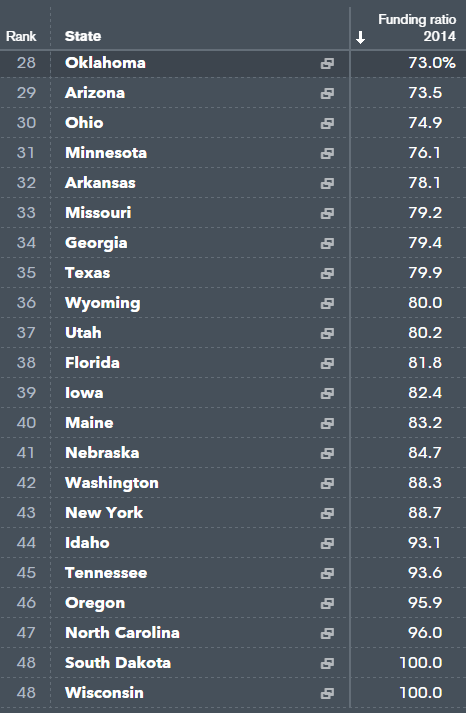
Bloomberg ranked 49 U.S. states based on their pension funding ratios in 2014 under GASB 25. (Delaware is not included because of insufficient data for GASB 25.)

Here are the best states… Wisconsin is 100% funded:

States with the best-funded pension liiabilities

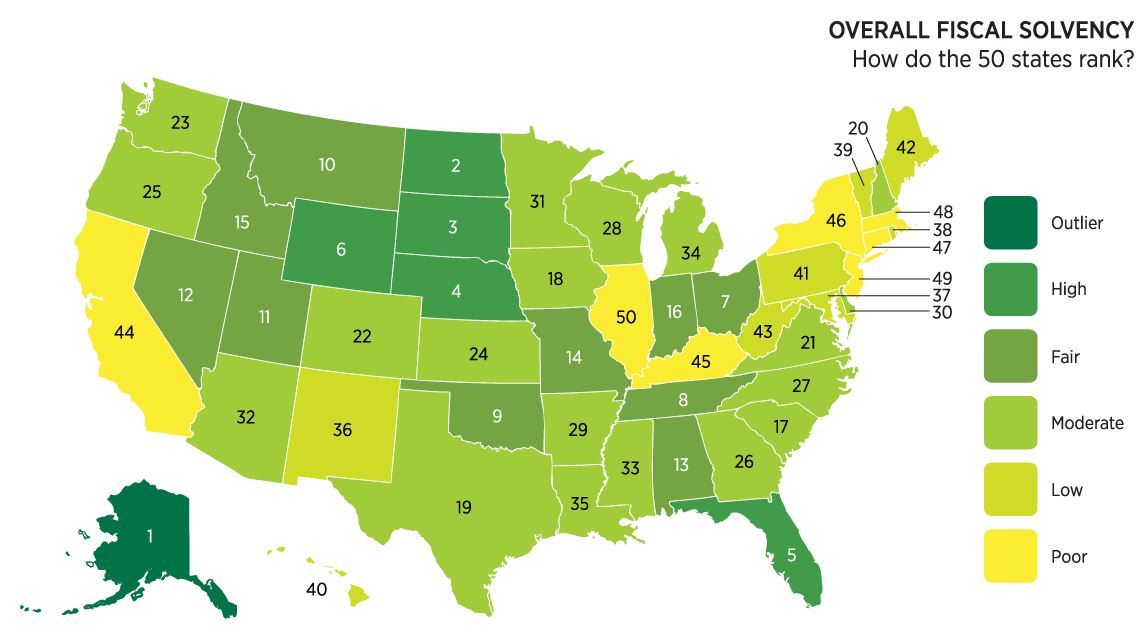
And actually there is a comprehensive analysis of the fiscal solvency of all the states right here from George Mason University.

Here’s the map:

Overall fiscal solvency by state

I notice that the deep blue states like California, Massachusetts, Illinois, Connecticut, New Jersey, etc. are just horrible states. No wonder everyone is fleeing them in droves. Socialism doesn’t work. Eventually, the money runs out.

So, if you’re thinking of moving to a new state, look at that. And if you don’t want to move, then vote for governors like Scott Walker who will take on public sector unions – otherwise, you’re headed for a big tax hike in the future, to pay for the big spending liberals of the past.