Understand the debt crisis with this article from the Wall Street Journal.
Excerpt:
The Bush Presidency and previous GOP Congresses contributed to the current problem by not insisting on domestic cuts to finance the cost of war, and by adding the prescription drug benefit without reforming Medicare. But as recently as 2008 spending was still only 20.7%, and debt held by the public was only 40.3%, of GDP.
In the name of saving the economy from panic, the White House and the Pelosi Congress then blew out the American government balance sheet. They compounded the problem of excessive private debt by adding unsustainable public debt.
They boosted federal spending to 25% of GDP in 2009, 23.8% in 2010 (as TARP repayments provided a temporary reduction in overall spending), and back nearly to 25% this fiscal year. Meanwhile, debt to GDP climbed to 53.5% in 2009, 62.2% in 2010, and is estimated to hit 72% this year—and to keep rising. These are all figures from Mr. Obama’s own budget office.
Rather than change direction this year, Mr. Obama’s main political focus has been to preserve those spending levels by raising taxes. His initial budget in February for fiscal 2012 proposed higher spending. He then resisted the modest spending cuts that the GOP proposed for the rest of fiscal 2011.
He responded to Paul Ryan’s proposal to reform Medicare and Medicaid by calling it un-American and unworthy of debate. In the most recent budget talks, he would only consider small entitlement reforms (cuts in payments to providers) if Republicans agreed to raise taxes. He has refused even to discuss ObamaCare or serious reforms in Medicare and Social Security. Meanwhile, federal payments to individuals continue to grow as a share of all spending, as the nearby chart shows.
This is how you become the Downgrade President.
Barack Obama owns this credit downgrade. It was his party that increased spending starting in 2007.
The second and even more crucial issue is whether Congress will take necessary action beyond the next year to bring our debt under control over the medium and long-term. This is where the rating agencies really voice their strong concern. Again, Standard & Poor’s:
Congress and the Administration might also settle for a smaller increase in the debt ceiling, or they might agree to a plan that, while avoiding a near-term default, might not, in our view, materially improve our base case expectation for the future path of the net general government debt-to-GDP ratio.”
Moody’s response is similar:
The outlook assigned at that time to the government bond rating would very likely be changed to negative at the conclusion of the review unless substantial and credible agreement is achieved on a budget that includes long-term deficit reduction. To retain a stable outlook, such an agreement should include a deficit trajectory that leads to stabilization and then decline in the ratios of federal government debt to GDP and debt to revenue beginning within the next few years.
What the rating agencies are saying is that Congress and the President must pass legislation that immediately begins to rein in deficits and bring our debt down to more acceptable levels, and either keeps it there or continues to drive it down further.
Right now, there are two plans on the table, because the Senate rejected Boehner’s “Cut, Cap and Balance” plan. Do either of these plans address the concerns of the two credit agencies?
The Boehner proposal would cut $1.2 trillion in discretionary spending. There is no assurance that these cuts will occur, but let’s assume they do. Let’s even be generous and assume that they are – in the words of S&P– “enacted and maintained throughout the decade.” This would cut debt held by the public from its projected $24.9 trillion in 2021 to $23.7 trillion, and when measured against the economy from 104% to 99.4%. Certainly, this is an improvement, but it is hardly declining from today’s levels, nor would these cuts fundamentally restructure entitlements – the real driver of our deficits in the future.
Step two in the Boehner proposal would reduce deficits by an additional $1.8 trillion over ten years. Even assuming these cuts all happen, and even assuming they were all spending cuts – a broad assumption given the President’s rhetoric surrounding tax hikes on the wealthy – this would bring publicly held debt down to 92% of GDP. Better, but not that much. Even throwing in interest savings from deficit reduction would bring this down to 88%. Again, not much improvement and far worse than today’s debt ratio.
The Reid proposal doesn’t move the ball forward enough either. At best it falls somewhat short of Boehner’s $3 trillion by $800 billion ($1.2 trillion in discretionary and some confusing savings to be had from winding down operations in Iraq and Afghanistan of $1.0 trillion.)
Neither of this week’s dueling debt ceiling proposals would pass the test from Moody’s or Standard and Poor’s for a credible, firm and actionable plan that would turn the tide of our deficits to put our debt on a manageable track. And if that holds true, then a downgrade by the rating agencies could occur smack in the very election year the President is trying to scoot through.
[…]The fact is, the only plan that could likely pass muster with Moody’s and Standard and Poor’s is House passed, Cut, Cap and Balance. Why? They tackle spending with firm caps that are enforceable, and before the end of the decade bring spending down to 19.9% of GDP and keep it there.
My guess right now is that Obama is going to sign the Boehner plan into law. He has no choice, Boehner pwnd him in the deal negotiations. Obama is going to have to yield, or all the blame for the default will go on HIS shoulders. As much as I like the new Boehner plan, it doesn’t look like it’s going to stop our debt rating from being downgraded. We needed to pass the Cut, Cap and Balance plan, but the Democrats rejected it. Think of that when interest rates shoot up. A debt downgrade is going to cause WIDE-RANGING repercussions in the lives of ordinary working families.
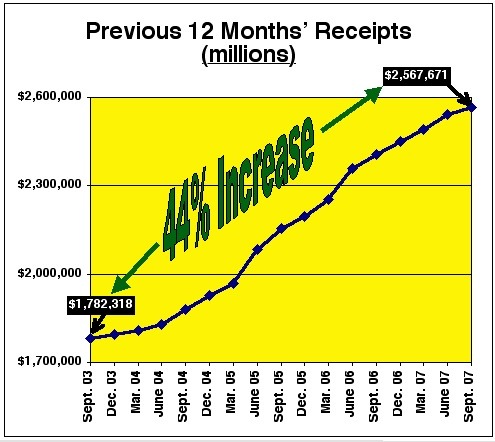
From Newsbusters. It turns out that Bush’s tax cuts in 2001 and 2003 were not responsible for adding to the deficit. They actually increased the amount of tax money being collected, as the economy grew, and more jobs were created. People pay more in taxes when they have jobs.
Excerpt:
The graph doesn’t show collections tanking, does it? Instead, the graph shows that collections increased by 44%, or almost $800 billion, in four years. Adding up the individual increments in each of the four years compared to 2003 (2004 – $98B; 2005 – $371B; 2006 – $624B; 2007 – $785B; 2008, not shown, treating IRS stimulus payments as outlays instead of negative receipts – $835B), what really happened is that in the five full fiscal years after George W. Bush got the across-the-board and investment-related tax cuts he had been pushing for since taking office in 2001, the cumulative increase in tax collections was over $2.7 trillion.
Doubtless, the static analysis crowd will claim that collections would have been even higher (I guess by a cumulative $1.6 trillion, given the AP’s Democratic Party talking point above) if the Bush cuts hadn’t been enacted. Two words, guys: Prove it. Two follow-up words: You can’t.
We can argue all day long about the how much of the increase in collections was due to the incentive effects of the tax cuts and how of the improvement might have occurred anyway, but no one can credibly act as if it’s an established fact that the Bush cuts somehow caused collections to go $1.6 trillion in the opposite direction. There is absolutely no proof for this contention, and plenty of evidence that the Bush cuts jump-started an economy and federal collections, both of which had been flat or declining during the two years leading up to mid-2003. The more reasonable conclusion to reach is that the country would already be dead in the water if the Bush tax cuts hadn’t passed in 2003. Instead, the wire service hopes that its “Bush tax cuts cost us” meme will be gullibly recited during the next several days at its subscribing newspaper, TV, and radio outlets. “Disgraceful” doesn’t even begin to describe this pathetic promotion of self-evident falsehood.
The fact is that the federal budget was one good year away from balancing after the $162 deficit reported in fiscal 2007. Unfortunately, that was the last budget passed by a Republican-controlled Congress, and it was the only year which showed a modest increase in overall spending. Beginning in 2007 with effects beginning in fiscal 2008, the House and Senate controlled by Nancy Pelosi and Harry Reid began increasing spending at rates far beyond what profligate Republicans spent earlier in the decade, and, unfortunately, Bush 43 made no real effort to stop them…
In 1980, the last year before the tax cuts, tax revenues were $956 billion (in constant 1996 dollars).
Revenues exceeded that 1980 level in eight of the next 10 years. Annual revenues over the next decade averaged $102 billion above their 1980 level (in constant 1996 dollars).
When you get people to start engaging in the economy, you can collect more taxes from them. They engage when they think that they will be able to keep more of what they make from their labor.


 WINTERY KNIGHT