Tag Archives: Debates

What are the historical arguments for the empty tomb story?

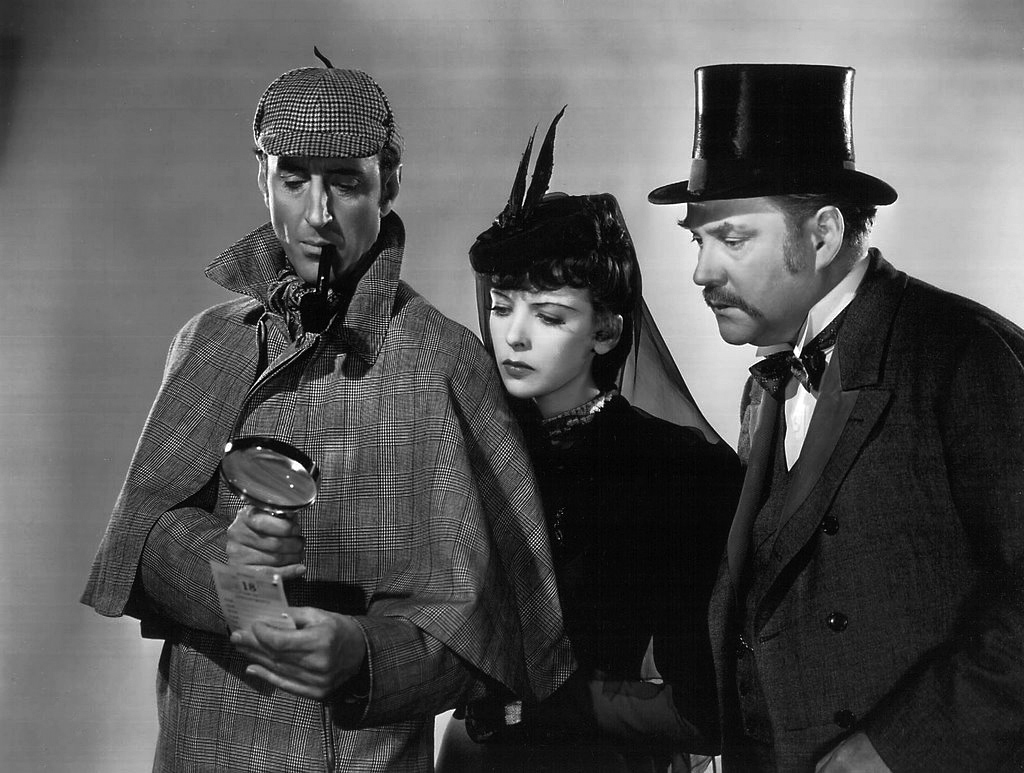
Sherlock Holmes and John Watson are going to take a look at the data

I wanted to go over this article by William Lane Craig which includes a discussion of the empty tomb, along with the other minimal facts that support the resurrection.

The word resurrection means bodily resurrection

The concept of resurrection in use among the first converts to Christianity was a Jewish concept of resurrection. And that concept of resurrection is unequivocally in favor of a bodily resurrection. The body (soma) that went into the grave is the body (soma) that came out.

Craig explains what this means with respect to the fast start of Christian belief:

For a first century Jew the idea that a man might be raised from the dead while his body remained in the tomb was simply a contradiction in terms. In the words of E. E. Ellis, “It is very unlikely that the earliest Palestinian Christians could conceive of any distinction between resurrection and physical, ‘grave emptying’ resurrection. To them an anastasis without an empty grave would have been about as meaningful as a square circle.”

And:

Even if the disciples had believed in the resurrection of Jesus, it is doubtful they would have generated any following. So long as the body was interred in the tomb, a Christian movement founded on belief in the resurrection of the dead man would have been an impossible folly.

It’s significant that the belief in the resurrection started off in the city where the tomb was located. Anyone, such as the Romans or Jewish high priests, who wanted to nip the movement in the bud could easily have produced the body to end it all. They did not do so, because they could not do so, although they had every reason to do so.

There are multiple early, eyewitness sources for the empty tomb

Paul’s early creed from 1 Corinthians 15:3-7, dated to within 5 years of the crucifixion, implies the empty tomb.

Craig writes:

In the formula cited by Paul the expression “he was raised” following the phrase “he was buried” implies the empty tomb. A first century Jew could not think otherwise. As E. L. Bode observes, the notion of the occurrence of a spiritual resurrection while the body remained in the tomb is a peculiarity of modern theology. For the Jews it was the remains of the man in the tomb which were raised; hence, they carefully preserved the bones of the dead in ossuaries until the eschatological resurrection. There can be no doubt that both Paul and the early Christian formula he cites pre-suppose the existence of the empty tomb.

The dating of the resurrection as having occurred “on the third day” implies the empty tomb. The date specified for the resurrection would have been the date that the tomb was discovered to be empty.

The phrase “on the third day” probably points to the discovery of the empty tomb. Very briefly summarized, the point is that since no one actually witnessed the resurrection of Jesus, how did Christians come to date it “on the third day?” The most probable answer is that they did so because this was the day of the discovery of the empty tomb by Jesus’ women followers. Hence, the resurrection itself came to be dated on that day. Thus, in the old Christian formula quoted by Paul we have extremely early evidence for the existence of Jesus’ empty tomb.

A few quotes from atheist historians not from Dr. Craig’s article: (thanks to Eric of Ratio Christi OSU)

Michael Goulder (Atheist NT Prof. at Birmingham) “…it goes back at least to what Paul was taught when he was converted, a couple of years after the crucifixion.” [“The Baseless Fabric of a Vision,” in Gavin D’Costa, editor, Resurrection Reconsidered (Oxford, 1996), 48.]

Gerd Lüdemann (Atheist Prof of NT at Göttingen): “…the elements in the tradition are to be dated to the first two years after the crucifixion of Jesus…not later than three years… the formation of the appearance traditions mentioned in I Cor.15.3-8 falls into the time between 30 and 33 CE.” [The Resurrection of Jesus, trans. by Bowden (Fortress, 1994), 171-72.]

Robert Funk (Non-Christian scholar, founder of the Jesus Seminar): “…The conviction that Jesus had risen from the dead had already taken root by the time Paul was converted about 33 C.E. On the assumption that Jesus died about 30 C.E., the time for development was thus two or three years at most.” [Roy W. Hoover, and the Jesus Seminar, The Acts of Jesus, 466.]

The early pre-Markan burial narrative mentions the empty tomb. This source pre-dates Mark, the earliest gospel. The source has been dated by some scholars to the 40s. For example, the atheist scholar James Crossley dates Mark some time in the 40s. (See the debate below)

The empty tomb story is part of the pre-Markan passion story and is therefore very old. The empty tomb story was probably the end of Mark’s passion source. As Mark is the earliest of our gospels, this source is therefore itself quite old. In fact the commentator R. Pesch contends that it is an incredibly early source. He produces two lines of evidence for this conclusion:

(a) Paul’s account of the Last Supper in 1 Cor. 11:23-5 presupposes the Markan account. Since Paul’s own traditions are themselves very old, the Markan source must be yet older.

(b) The pre-Markan passion story never refers to the high priest by name. It is as when I say “The President is hosting a dinner at the White House” and everyone knows whom I am speaking of because it is the man currently in office. Similarly the pre-Markan passion story refers to the “high priest” as if he were still in power. Since Caiaphas held office from AD 18-37, this means at the latest the pre-Markan source must come from within seven years after Jesus’ death. This source thus goes back to within the first few years of the Jerusalem fellowship and is therefore an ancient and reliable source of historical information.

So we are dealing with very early sources for the empty tomb.

Lack of legendary embellishments

The empty tomb narrative in the gospels lacks legendary embellishments, unlike later 2nd century forgeries that originated outside of Jerusalem.

The eyewitness testimony of the women

This is the evidence that has been the most convincing to skeptics, and to me as well.

The tomb was probably discovered empty by women. To understand this point one has to recall two facts about the role of women in Jewish society.

(a) Woman occupied a low rung on the Jewish social ladder. This is evident in such rabbinic expressions as “Sooner let the words of the law be burnt than delivered to women” and “Happy is he whose children are male, but woe to him whose children are female.”

(b) The testimony of women was regarded as so worthless that they were not even permitted to serve as legal witnesses in a court of law. In light of these facts, how remarkable must it seem that it is women who are the discoverers of Jesus’ empty tomb. Any later legend would certainly have made the male disciples to discover the empty tomb. The fact that women, whose testimony was worthless, rather than men, are the chief witnesses to the empty tomb is most plausibly accounted for by the fact that, like it or not, they were the discoverers of the empty tomb and the gospels accurately record this.

The earliest response from the Jewish high priests assumes the empty tomb

This report from Matthew 28 fulfills the criteria of enemy attestation, although Matthew is not the earliest source we have. Oh, well.

In Matthew 28, we find the Christian attempt to refute the earliest Jewish polemic against the resurrection. That polemic asserted that the disciples stole away the body. The Christians responded to this by reciting the story of the guard at the tomb, and the polemic in turn charged that the guard fell asleep. Now the noteworthy feature of this whole dispute is not the historicity of the guards but rather the presupposition of both parties that the body was missing. The earliest Jewish response to the proclamation of the resurrection was an attempt to explain away the empty tomb. Thus, the evidence of the adversaries of the disciples provides evidence in support of the empty tomb.

Note how careful Craig is not to imply that the guard tradition is historical, because we can’t prove the guard as a “minimal fact”, since it doesn’t pass the standard historical criteria.

See it used in a debate

You can see the arguments made and defended from criticism in this debate with the atheist scholar James Crossley.

This my favorite resurrection debate.

William Lane Craig and atheist Daniel Dennett discuss cosmology and fine-tuning

British Spitfire and German Messerschmitt Me 109 locked in a dogfight
British Spitfire and German Messerschmitt Bf 109 locked in a dogfight

Here is audio of a very interesting exchange between William Lane Craig and leading atheist Daniel Dennett.

This audio records a part of the Greer-Heard debate in 2007, between prominent atheist Daniel Dennett and lame theistic evolutionist Alister McGrath. Craig was one of the respondents, and this was the best part of the event. It is a little bit advanced, but I have found that if you listen to things like this over and over with your friends and family, and then try to explain it to non-Christians, you’ll get it.

By the way, this is mostly original material from Craig, dated 2007, and he delivers the speech perfectly, so it’s entertaining to listen to.

Craig presents three arguments for a Creator and Designer of the universe:

  • the contingency argument
  • the kalam cosmological argument
  • the teleological argument

He also discusses Dennett’s published responses to these arguments, and that’s what I want to focus on, since most of you are already familiar with Craig’s philosophical arguments for the existence of God.

Dennett’s response to Craig’s paper

Here is my snarky paraphrase of Dennett’s reponse: (this is very snarky, because Dennett was just awful)

  • Craig’s three arguments are bulletproof, the premises are plausible, and grounded by the best cutting edge science we know today.
  • I cannot find anything wrong with his arguments right now, but maybe later when I go home it will come to me what’s wrong with them.
  • But atheism is true even if all the evidence is against it today. I know it’s true by my blind faith.
  • The world is so mysterious, and all the science of today will be overturned tomorrow so that atheism will be rational again. I have blind faith that this new evidence will be discovered any minute.
  • Just because the cause of the beginning of time is eternal and the cause of the beginning of space is non-physical, the cause doesn’t have to be God.
  • “Maybe the cause of the universe is the idea of an apple, or the square root of 7”. (HE LITERALLY SAID THAT!)
  • The principle of triangulation might have brought the entire physical universe into being out of nothing.
  • I don’t understand anything about non-physical causation, even though I cannot even speak meaningful sentences unless I have a non-physical mind that is causing my body to emit the meaningful sentences in a non-determined manner.
  • Alexander Vilenkin is much smarter than Craig and if he were here he would beat him up good with phantom arguments.
  • Alan Guth is much smarter than Craig and if he were here he would beat him up good with phantom arguments.
  • This science stuff is so complicated to me – so Craig can’t be right about it even though he’s published about it and debated it all with the best atheists on the planet.
  • If God is outside of time, then this is just deism, not theism. (This part is correct, but Craig believes that God enters into time at the moment of creation – so that it is not a deistic God)
  • If deism is true, then I can still be an atheist, because a Creator and Designer of the universe is compatible with atheism.
  • I’m pretty sure that Craig doesn’t have any good arguments that can argue for Christianity – certainly not an historical argument for the resurrection of Jesus based on minimal facts, that he’s defended against the most prominent historians on the planet in public debates and in prestigous books and research journals.

This is a very careful treatment of the arguments that Dr. Craig goes over briefly during his debates. Recommended.

Positive arguments for Christian theism

Sean Carroll debates William Lane Craig on cosmology and God’s existence

Here’s the video of the debate:

Carroll was as good of a speaker as Craig in terms of style. Very easy to listen to, very quick on his feet, very civil. There was no clear winner on style.

It was difficult to assess the truth value of scientific points being made, especially for the layperson. I explained a few of them in my posts earlier this week, but I think laypeople might struggle with them if they are hearing about these things for the first time.

A couple of Craig’s slides: (click for larger images)

Slide 1 of 2:

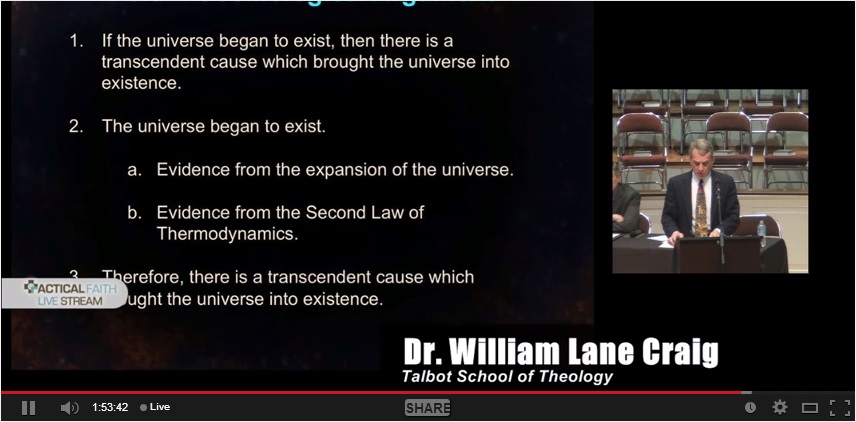
Dr. Craig slide #1 of 2

Slide 2 of 2:

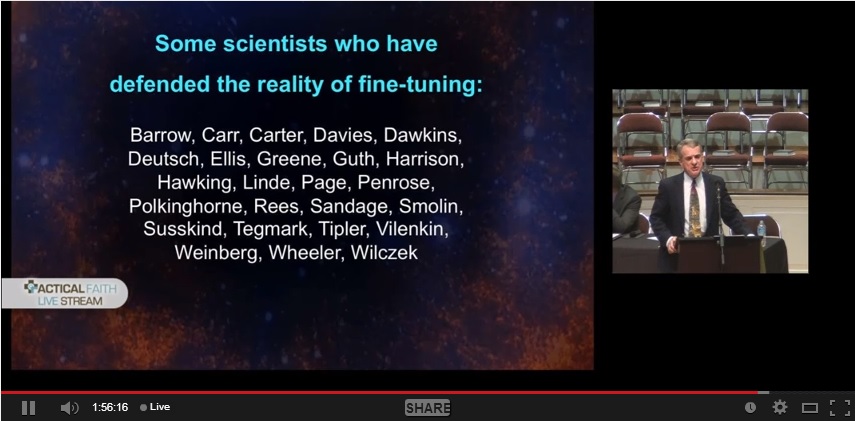
Dr. Craig slide #2 of 2

Quick summary: (this is not complete, because I couldn’t get everything they were saying noted)

Dr. Craig defended two arguments: 1) the kalam cosmological argument and the fine-tuning argument.

Dr. Craig supported the origin of the universe with 1) the expansion of the universe and 2) the second law of thermodynamics.

Dr. Craig said that the BGV theorem supports a beginning for the universe.

Dr. Craig said that the consensus of scientists did not accept Carroll’s naturalistic cosmology, quoting Stephen Hawking in support.

Dr. Craig said that multiverse models fall victim to the Boltzmann brain problem, where we should observe Boltzmann brains coming into existence and then phasing out again far more probably than embodied minds. But we observe embodied minds, and no Boltzmann brains.

Dr. Carroll said that science cannot study metaphysical questions.

Dr. Carroll said that science is about making models that may or may not be consistent with the experimental data.

Dr. Carroll said that the BGV theorem does not support a beginning for the universe.

Dr. Carroll proposed 17 alternative cosmologies, but did not provide a shred of scientific evidence for any of them, the way that Craig did for the standard model.

Dr. Carroll refuted Dr. Craig’s citation of Stephen Hawking, and Craig yielded the point.

Dr. Carroll speculated that science might progress to the point where the fine-tuning can be explained without an intelligent cause, and he gave an example of where that happened (inflation).

Dr. Craig argued that all 17 of the models suggested by Carroll either conflicted with evidence, had serious problems or did require a beginning.

Dr. Craig argued that Carroll’s own model required a beginning.

Dr. Craig argued that Carroll’s own model fell victim to the Boltzmann brain problem.

Dr. Craig argued that Carroll’s own model violated the second law of thermodynamics.

Dr. Craig re-stated his point that the baby universe spawning in Carroll’s model was speculative and incomplete, and cited Christopher Weaver’s work.

Dr. Carroll denied that things that pop into being out of nothing require a transcendent cause.

Dr. Carroll reiterated that science can only make naturalistic models, and that he did not have to answer questions about ultimate causes.

Dr. Carroll showed a photo of Alan Guth expressing his opinion that the universe is “probably” eternal. No evidence was given for this assertion.

Dr. Carroll said that the fine-tuning was not done in an optimal way, because one fine-tuned value was lower than it needed to be, and it should be exactly what it needed to be if God did it.

Dr. Carroll said that a finely-tuned universe is more probably in naturalism than in theism, because God can do anything he wants and doesn’t need a fine-tuned universe.

Dr. Carroll said he would stop defending his model now, and would instead defend Aguirre-Gratton.

Dr. Craig gave three reasons why the universe popping into being out of nothing requires a transcendent cause.

First, he said that nothing cannot cause anything to happen, because nothing is nothing.

Second, he said that if things pop into being out of nothing, then why don’t we see it happening all the time with other things.

Third, he said that we have no reason to dismiss the causal principle, especially when it is the basis of scientific inquiry and has been so fruitful in the progress of science.

Dr. Craig reiterated that baby universes in Carroll’s model would be dominated by Boltzmann brains, and we don’t observe that.

Dr. Craig said that even on the quantum gravity models that Carroll mentioned, there would still be a beginning.

Dr. Carroll said that Craig mustn’t say “popped into being” but instead that “there was a first moment of time”.

Dr. Carroll said that his model does indeed violate the second law of thermodynamics “YES!”.

At this point Carroll stopped talking about the topic of the debate and started expressing personal opinions about religion. It’s funny how often atheists do this in debates.

Dr. Carroll said that most theists don’t believe in God because of cosmology, but because of community and feelings.

Dr. Carroll said that science had learned a lot in the last 2000 years, so theism was false.

Dr. Carroll said that most philosophers don’t think that God exists, so theism was false.

Dr. Carroll said microscopes and telescopes were absent 2000 years ago, so theism was false.

Dr. Carroll said that religion should be about community and feelings, not about what is true.

Conclusion:

My conclusion was that Carroll lost because he is just satisfied to throw theories out and not to argue that they are true by citing evidence. Carroll never seemed to be interested in finding out what is true, but instead he just wanted to tell a story that didn’t include God, and assert that by Occam’s Razor, his story was a better explanation. I am not impressed with theoretical speculations, although the layperson might be. I kept waiting for him to respond to Craig’s points about how his model was falsified by experimental evidence and observations, e.g. – the Boltzmann brains or the baby universe generation, and he never cited the evidence I wanted him to cite. Craig did have some evidence for his views, but he could have been stronger in making his case. He could have shown the e-mail from Vilenkin that stated that he had understood the BGV theorem, and was using it correctly, for example.

For me the winning side comes down to evidence. The standard model is the standard model because of scientific evidence. Until that evidence is overturned, then speculative models are of no interest to anyone who is evidence-driven. Speculations are not science. A philosophical presupposition of metaphysical naturalism is not science.

If you want to see a good lecture on scientific evidence related to cosmology, then there is the particle physicist Michael Strauss lecture on cosmology and fine-tuning at Stanford University and his more recent lecture at the University of Texas. Note that Strauss is an experimental physicist, not a theoretical physicist like Carroll.

Here’s another review of the debate by Randy Everist of Possible Worlds blog. He explains the back-and-forth over Boltzmann brains and the BGV theorem in more detail.