Tag Archives: Debate

Ted Cruz wins Fox Business #GOPDebate, Fiorina and Rubio outperform

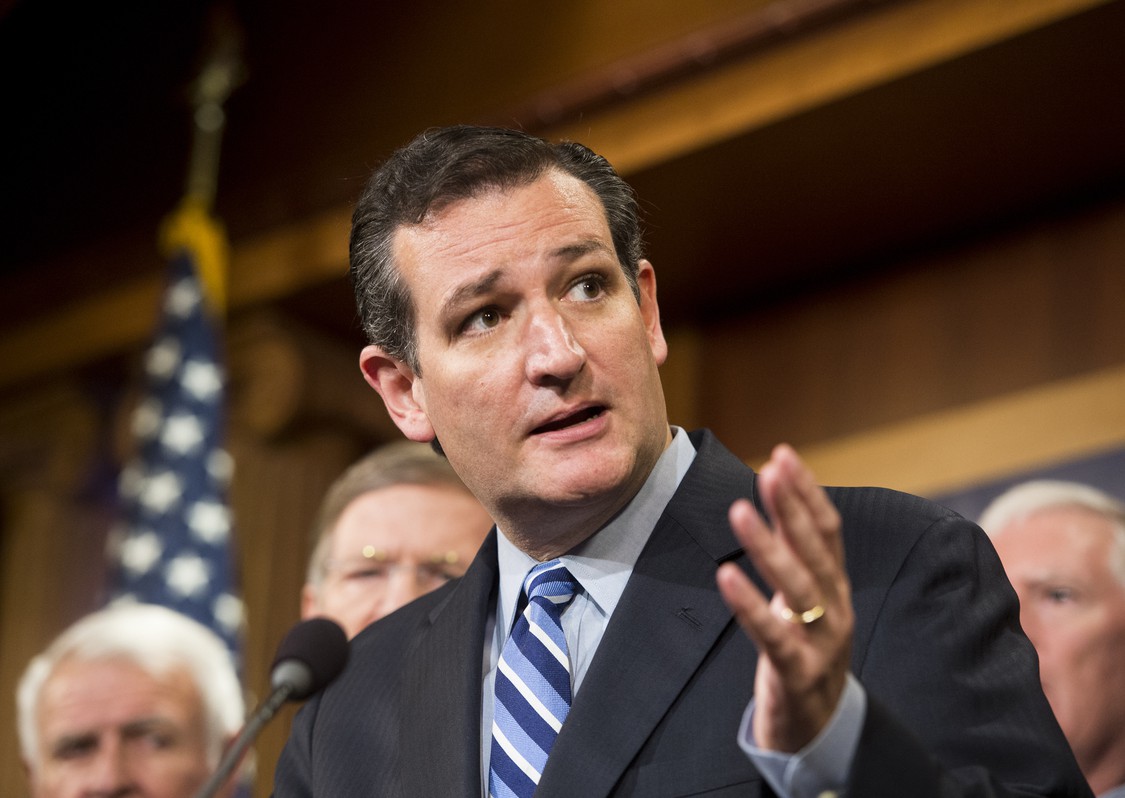
Texas Senator Ted Cruz

I think Cruz did the best, Rubio did well enough to take second place, and Fiorina was much improved, especially on foreign policy, where she gave a clear explanation of the doctrine of peace through strength. She did third best, but had the strongest moment of the debate when she schooled everyone on foreign policy. She really knows foreign policy cold.

Red State does a good job of providing unbiased opinion, here is their assessment:

The Winners

1. Sen. Ted Cruz (R-TX) – While Cruz hit his talking points and made some great statements, like Jeb, he did not stand out. This isn’t as big a problem for him as it is the others, because he has a natural base of conservative voters that will turn out for him no matter what. Bush doesn’t have that, and that’s why he’s free-falling at his point. Cruz coming out swinging against the agriculture lobby could very well be his testing the water for corn subsidy talk in Iowa.

2. Carly Fiorina – Carly showed why she should not be counted out yet. She speaks like a caring grandmother, and she has to be the calmest neoconservative I’ve ever seen on a stage speaking about the Middle East. She spoke calmly and coolly on every issue that came her way, and some issues that didn’t. She cannot yet be counted out.

3. Sen. Marco Rubio (R-FL)  – Rubio did not hurt himself tonight by any stretch of the imagination. He let Sen. Rand Paul (R-KY) ruffle his feathers a little bit, but I think he overall hit his notes correctly. He is clearly courting the warhawks of the Republican Party right now. He hit on his family background only once, focusing instead on global affairs and fighting back against Paul.

They thought Carson and Trump did OK, and Kasich, Paul and Bush “lost”. I think that Carson and Paul did OK, but Trump and Bush underperformed, and Kasich did the worst of all. Trump just has no ability in foreign policy, Bush is too liberal on immigration. Kasich is a big government liberal across the board.

Over at the more establishment Weekly Standard, Jonathan Last – who is a bit wild – said this:

Ted Cruz: If you were forced to pick a winner, it would probably be Cruz. He picked the right fights—with Kasich and Paul. He gave a dynamite explanation of how illegal immigration impacts wage growth and was generally impressive. With each passing debate he looks more like a finalist.

Marco Rubio: This performance wasn’t as strong as his last. Rubio started out talking vocational training and the nexus of family stability, virtue, and economic growth—basically the Santorum 2012 playbook.

Carly Fiorina: She probably had the single strongest moment of the night in her blistering, detailed, canny riff on how she would approach Putin. If she’s going to get a third-look from voters, tonight might prompt it.

Ted Cruz attacks Hillary Clinton’s failed policies:

Ted Cruz says no to bank bailouts, yes to FDIC reimbursing depositors:

Jeb Bush vs Ted Cruz on illegal immigration and LEGAL immigration:

Marco Rubio on the importance of strong families:

Marco Rubio vs Rand Paul on tax credits for families and defense spending:

Carly Fiorina on Putin and foreign policy:

Carly Fiorina on American entrepreneurship:

Ben Carson on the minimum wage:

Finally, there is the latest episode of the Weekly Standard podcast, which is my favorite political podcast, the one you should subscribe to if you subscribe to any. Bill Kristol, the editor of the Weekly Standard, thought that it was a good night for Ted Cruz. I agree.

I also love the Ben Shapiro podcast from the Daily Wire, and I am updating the post now to point to a new episode – episode 24. Shapiro agrees with me: Christie AND Jindal won the undercard debate, and Cruz did the best in the main event.

I spend the night reading and re-tweeting on Twitter – sorry to everyone for the huge number of tweets. What was striking to me was the juvenile nature of the Democrat tweets. Many of them came from professional comedians or Hollywood celebrities… but others came from liberal politicians, and even people from liberal think tanks. Yet not ONE tweet from the left was anything of substance. It was all just dismissive mocking. Literally. Not one serious tweet. It’s not surprising that they are so supportive of a clueless clown who added $10 trillion dollars to the national debt, and point that achievement as a great success. Oh well, that’s why we have elections. I would be happy with any of Jindal, Cruz or Rubio right now. I would even take Fiorina in a pinch.

One final thing. Fox Business put on the fairest and most engaging debate yet. They set the standard for everyone else, and made CNBC look like incompetent college students. Every debate should run this smoothly – the moderators just disappeared, and they let the candidates talk to America, and talk to each other. I learned a lot about the candidate’s views, and nothing at all about the moderator’s views.

On the issues: assessing the 2016 Republican presidential candidates

Latest Republican presidential primary polls
Latest Republican presidential primary polls (click for larger image)

The PDF is here. (50 pages, but you only have to read about the candidates you might consider voting for)

Unfortunately, radically leftist Politico is the only one with a write-up on it, so here goes:

The hard-line conservative arm of the Heritage Foundation has tough criticism for much of the 2016 field, but high praise for the Texas senator.

The political arm of The Heritage Foundation has released a detailed assessment of the 2016 Republican presidential field — and it offers harsh words for many candidates. But not for Sen. Ted Cruz.

Cruz receives almost exclusively praise for his stances in the 50-page 2016 presidential policy scorecard, the first of its kind produced by Heritage Action. The report grades the candidates across six categories: growth, opportunity, civil society, limited government, favoritism and national security.

Many of the lines in the scorecard appear destined for future attack ads.

Jeb Bush, for instance, is accused of having “kowtowed to the state’s environmental lobby” in Florida. Chris Christie “has shown favoritism toward well-connected real estate developers.” Rand Paul’s “views at times veer outside the conservative mainstream.” And Donald Trump backs “massive tariffs that would damage the American economy.”

Cruz, by contrast, manages to emerge with barely a blemish, receiving only softly worded critiques of his adopting “sound policies advanced by others” rather than crafting his own.

[…]“Cruz has been willing to pay a political price for taking on government favoritism,” the report reads.

The group even forgives Cruz for one of the few trespasses he has made against its positions, voting for a bill that served “as a bargaining chip for [Export-Import Bank] allies to secure reauthorization.” The report credits him for later switching his vote and then publicly attacking Republican Senate Majority Leader Mitch McConnell for allegedly lying about his plans.

Bobby Jindal, who is running hard to the right in Iowa, receives among the more glowing reviews. So does Marco Rubio, who angered the right with his pursuit of a comprehensive immigration plan after first being elected with tea party support.

The two current front-runners in the polls, Ben Carson and Trump, were dinged for their lack of a record on conservative causes and a lack of specifics in their visions. “His unconventional foreign policy prescriptions raise more questions of significant consequence than they answer,” Heritage writes of Trump.

Bush was singled out for some of the most biting critiques. “Has shown favoritism toward Florida special interests and supports amnesty” for undocumented immigrants, reads one bullet point.

In its 2016 assessment, Heritage dings Bush for not supporting recent efforts to defund Planned Parenthood this fall because he said he opposed precipitating a government shutdown. The report accuses him of “playing to President [Barack] Obama’s talking points rather than reinforcing conservatives.”

No, everyone knows that my list of candidates favors governors who have a history of putting in place actual policies that actually affected real people in the real world and got real conservative results. So on that score, Cruz and Rubio way down the list because they have achieved very little:

  1. Scott Walker
  2. Bobby Jindal
  3. Rick Perry
  4. Ted Cruz
  5. Marco Rubio

Ted Cruz’s Twitter feed and his overall feel to me is that all he does is talk, talk, talk. He just doesn’t have the record of Bobby Jindal at putting policies into place. For example, as governor, Jindal actually cut spending. He actually put in place pro-life measures that actually saved lives. He actually put in place a school choice program that helped low-income students get out of failing schools. He actually cut off funding for Planned Parenthood. He actually defended religious liberty. Cruz is just a senator, so he hasn’t got that proven record. I believe he would be conservative, but I feel safer trusting someone with experience.

Having said that, the more I read reports like this Heritage Action Scorecard report, I am finding out that Cruz has been willing to at least pay a price politically for doing the right thing at various times. So, although he does not have the accomplishments that the governors have, he has been willing to push conservative values when it was not to his advantage, politically. I have to admit, there is some value to this in one sense – we know that he would do what he says no matter what. But there is a problem with Cruz. We don’t know whether he is able to create clever policies that will draw the votes of independents and even moderate Democrats. That’s what Walker and Jindal were able to do. So, although I respect what the Heritage Action team have written, I am not changing my rankings.

Tonight’s debate

Be sure and tune in to both debates tonight on Fox Business, as I am expecting Jindal and Cruz to outperform their competitors in their respective debates:

Republican debate – Fox Business/Wall Street Journal

Time – Primary: 9 p.m. ET. Secondary: 7 p.m. ET

Location – Milwaukee Theater, Milwaukee, Wisconsin

Moderators – Gerard Baker, Neil Cavuto, Maria Bartiromo

Primary: All candidates averaging at least 2.5 percent in four most recent national polls by Nov. 4.

Secondary: Remaining candidates averaging at least 1 percent in one of the four most recent polls.

Primary: Donald Trump, Ben Carson, Marco Rubio, Ted Cruz, Jeb Bush, Carly Fiorina, John Kasich, Rand Paul.

Secondary: Chris Christie, Mike Huckabee, Bobby Jindal, Rick Santorum.

Candidates on my list are in bold. The debate will be live-streamed, so you have no excuses for missing it. This one promises to be a good one. The moderators will not be amateurs as with the Democrat-biased CNBC debate.

Sean Carroll debates William Lane Craig on cosmology and God’s existence

Here’s the video of the debate:

Carroll was as good of a speaker as Craig in terms of style. Very easy to listen to, very quick on his feet, very civil. There was no clear winner on style.

It was difficult to assess the truth value of scientific points being made, especially for the layperson. I explained a few of them in my posts earlier this week, but I think laypeople might struggle with them if they are hearing about these things for the first time.

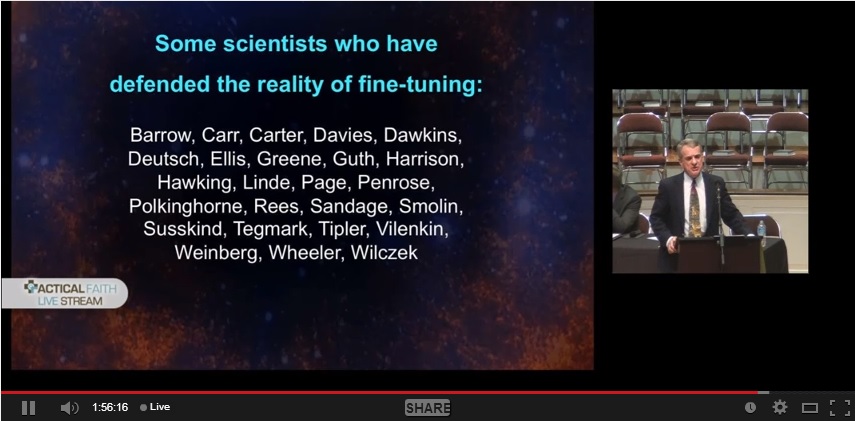
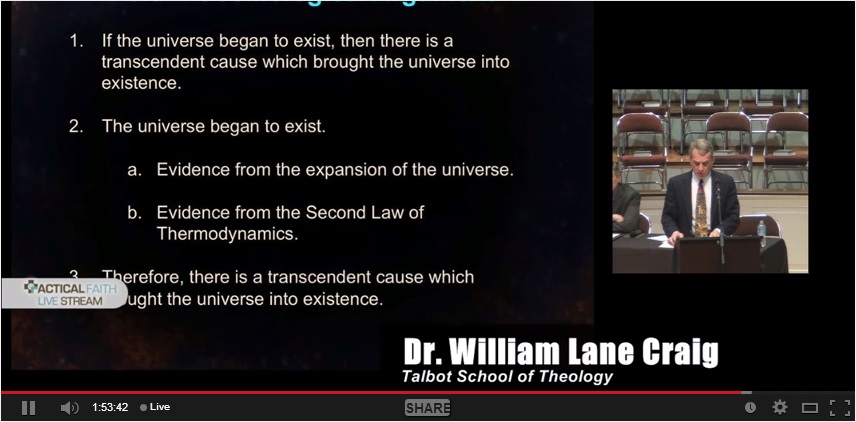
A couple of Craig’s slides: (click for larger images)

Slide 1 of 2:

Dr. Craig slide #1 of 2

Slide 2 of 2:

Dr. Craig slide #2 of 2

Quick summary: (this is not complete, because I couldn’t get everything they were saying noted)

Dr. Craig defended two arguments: 1) the kalam cosmological argument and the fine-tuning argument.

Dr. Craig supported the origin of the universe with 1) the expansion of the universe and 2) the second law of thermodynamics.

Dr. Craig said that the BGV theorem supports a beginning for the universe.

Dr. Craig said that the consensus of scientists did not accept Carroll’s naturalistic cosmology, quoting Stephen Hawking in support.

Dr. Craig said that multiverse models fall victim to the Boltzmann brain problem, where we should observe Boltzmann brains coming into existence and then phasing out again far more probably than embodied minds. But we observe embodied minds, and no Boltzmann brains.

Dr. Carroll said that science cannot study metaphysical questions.

Dr. Carroll said that science is about making models that may or may not be consistent with the experimental data.

Dr. Carroll said that the BGV theorem does not support a beginning for the universe.

Dr. Carroll proposed 17 alternative cosmologies, but did not provide a shred of scientific evidence for any of them, the way that Craig did for the standard model.

Dr. Carroll refuted Dr. Craig’s citation of Stephen Hawking, and Craig yielded the point.

Dr. Carroll speculated that science might progress to the point where the fine-tuning can be explained without an intelligent cause, and he gave an example of where that happened (inflation).

Dr. Craig argued that all 17 of the models suggested by Carroll either conflicted with evidence, had serious problems or did require a beginning.

Dr. Craig argued that Carroll’s own model required a beginning.

Dr. Craig argued that Carroll’s own model fell victim to the Boltzmann brain problem.

Dr. Craig argued that Carroll’s own model violated the second law of thermodynamics.

Dr. Craig re-stated his point that the baby universe spawning in Carroll’s model was speculative and incomplete, and cited Christopher Weaver’s work.

Dr. Carroll denied that things that pop into being out of nothing require a transcendent cause.

Dr. Carroll reiterated that science can only make naturalistic models, and that he did not have to answer questions about ultimate causes.

Dr. Carroll showed a photo of Alan Guth expressing his opinion that the universe is “probably” eternal. No evidence was given for this assertion.

Dr. Carroll said that the fine-tuning was not done in an optimal way, because one fine-tuned value was lower than it needed to be, and it should be exactly what it needed to be if God did it.

Dr. Carroll said that a finely-tuned universe is more probably in naturalism than in theism, because God can do anything he wants and doesn’t need a fine-tuned universe.

Dr. Carroll said he would stop defending his model now, and would instead defend Aguirre-Gratton.

Dr. Craig gave three reasons why the universe popping into being out of nothing requires a transcendent cause.

First, he said that nothing cannot cause anything to happen, because nothing is nothing.

Second, he said that if things pop into being out of nothing, then why don’t we see it happening all the time with other things.

Third, he said that we have no reason to dismiss the causal principle, especially when it is the basis of scientific inquiry and has been so fruitful in the progress of science.

Dr. Craig reiterated that baby universes in Carroll’s model would be dominated by Boltzmann brains, and we don’t observe that.

Dr. Craig said that even on the quantum gravity models that Carroll mentioned, there would still be a beginning.

Dr. Carroll said that Craig mustn’t say “popped into being” but instead that “there was a first moment of time”.

Dr. Carroll said that his model does indeed violate the second law of thermodynamics “YES!”.

At this point Carroll stopped talking about the topic of the debate and started expressing personal opinions about religion. It’s funny how often atheists do this in debates.

Dr. Carroll said that most theists don’t believe in God because of cosmology, but because of community and feelings.

Dr. Carroll said that science had learned a lot in the last 2000 years, so theism was false.

Dr. Carroll said that most philosophers don’t think that God exists, so theism was false.

Dr. Carroll said microscopes and telescopes were absent 2000 years ago, so theism was false.

Dr. Carroll said that religion should be about community and feelings, not about what is true.

Conclusion:

My conclusion was that Carroll lost because he is just satisfied to throw theories out and not to argue that they are true by citing evidence. Carroll never seemed to be interested in finding out what is true, but instead he just wanted to tell a story that didn’t include God, and assert that by Occam’s Razor, his story was a better explanation. I am not impressed with theoretical speculations, although the layperson might be. I kept waiting for him to respond to Craig’s points about how his model was falsified by experimental evidence and observations, e.g. – the Boltzmann brains or the baby universe generation, and he never cited the evidence I wanted him to cite. Craig did have some evidence for his views, but he could have been stronger in making his case. He could have shown the e-mail from Vilenkin that stated that he had understood the BGV theorem, and was using it correctly, for example.

For me the winning side comes down to evidence. The standard model is the standard model because of scientific evidence. Until that evidence is overturned, then speculative models are of no interest to anyone who is evidence-driven. Speculations are not science. A philosophical presupposition of metaphysical naturalism is not science.

If you want to see a good lecture on scientific evidence related to cosmology, then there is the particle physicist Michael Strauss lecture on cosmology and fine-tuning at Stanford University and his more recent lecture at the University of Texas. Note that Strauss is an experimental physicist, not a theoretical physicist like Carroll.

Here’s another review of the debate by Randy Everist of Possible Worlds blog. He explains the back-and-forth over Boltzmann brains and the BGV theorem in more detail.