Tag Archives: Debate

Video of the Geivett/Craig vs. Dawkins/Shermer debate from Mexico

Here is the full debate in English if you missed it.

Doug Geivett wrote a blog post about the recent 3-on-3 debate in Mexico on “Does the universe have a purpose?”.

Usually, a debate question features one side taking the affirmative and the other side taking the negative. Here, the question for debate was “Does the universe have a purpose?”It was obvious from the correspondence I received from the debate organizers that I was to team with two individuals who agreed in taking the affirmative, and that the other three would take the negative—that is, they would deny that the universe has a purpose.

Speakers:

The three of us on the affirmative side—William Lane Craig, David Wolpe, and Doug Geivett—all believe that whether the universe has a purpose depends on whether or not God exists. So we could argue that the universe does have a purpose if God exists, even if time did not allow for detailed arguments that God in fact exists. It would be up to the others—Matt Ridley, Michael Shermer, and Richard Dawkins—to argue that the universe does not have a purpose. Presumably, they would have to include arguments that God does not exist, since that would be crucial to their claim that the universe does not have a purpose. Or, they might argue that even if God exists, the universe does not have a purpose.

Format:

Each of the six of us was allotted exactly six minutes for initial arguments. We were timed and stopped at six minutes. Strict enforcement of time limits is characteristic of debates, but not always understood by observers. I’ve noticed that some who’ve commented on the debate at various blogs have remarked that the moderator should not have interrupted debaters when they were about to make an important point. (The debate was part of a larger conference program.)

And here is a quote to make you click through and read all of Doug’s post:

Richard Dawkins is hero to many atheists today. So his participation and relation to the other two atheists deserves special notice. You’ll find that Dawkins made numerous assertions and almost no arguments. If you disagree, you should be able to reconstruct his arguments by identifying individual premises and specific conclusions. So far, those who have praised Dawkins’s performance in the debate, all of whom have been atheists themselves, have not attempted this reconstruction. I urge them to try. I will gladly address carefully reconstructed arguments in the comments section of this post. Dawkins called religious belief “pathetic” and accused Bill Craig of making an emotional argument. As I stated in my brief closing statement, it was Dawkins, more than anyone else, who made an “emotional argument.” First, he gave no arguments against the existence of God. Second, he offered no rebuttals of the arguments we presented, and third, he dismissed religious belief as pathetic without argument. If I’m wrong about any of this, I would be happy to see evidence of my error and respond to whatever arguments he did present.

I actually am not really paying much attention to this debate since I watched a little and it looked like a music video with a crazy moderator. The speakers made opening speeches of ONLY SIX MINUTES! I can’t watch a debate with speeches that short. You can’t say anything good in six minutes! But I have to post the video in case you guys are interested in it. I think what is worth your time is Doug Geivett’s summary of the debate. Doug is one of my three favorite philosophers, the others being Paul Copan and William Lane Craig.
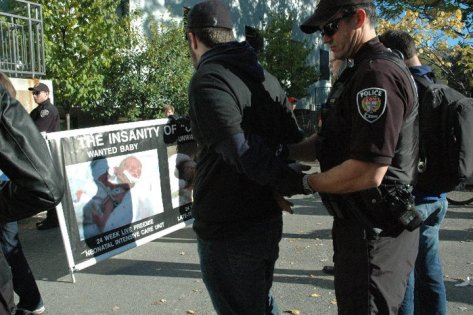
Left-wing fascists at Carleton University ban pro-life club

Armed policeman arrests peaceful pro-life student

Here’s the story from the National Post.

Excerpt:

Carleton University’s official student association has banned the Ottawa institution’s anti-abortion club, offering it just one way to get back into good graces: support abortion rights.

On Monday, the Carleton University Student Association (CUSA), decertified Carleton Lifeline for its anti-abortion views. It told the club that being against abortion violated CUSA’s anti-discrimination policy…

[…]Ruth Lobo, the president of Carleton Lifeline, said CUSA assumes all students are “pro-choice,” which is not necessarily the case. Its policy, she said, smacked of hypocrisy.

“It’s very ironic that they have a discrimination policy that allows them to discriminate against pro-life groups,” she said. “CUSA claims to be representative of all students. As a pro-life student I am not represented by an organization I am forced to pay dues to in my tuition. Either they should create a policy in which students can opt out of fees or get rid of the discrimination policy,” Ms. Lobo said.

“Pro-choice should also mean that a woman has the right to not have an abortion, so I think CUSA is being anti-choice by not allowing people to hear the other side.”

CUSA did not return phone calls on Tuesday.

[…]Carleton Lifeline can no longer promote its views on campus or lobby in any way that would oppose [the pro-abortion] position. It can no longer book space for advocacy or events, nor is it eligible for funding.

[…]On Oct. 4, Ms. Lobo and four other students were arrested on campus by Ottawa police for attempting to display graphic anti-abortion posters. The police were called in by the school administration and the students were charged with trespassing.

Here are some questions to ask about Carleton University:

  • Is Carleton University a fascist organization that criminalizes dissent from Liberal Party policies?
  • Can Canadian taxpayers attend Carleton University without being a member of the Liberal Party?
  • Is Carleton University committed to respect for diversity of opinion?
  • Is Carleton University respectful of open debate and dialog?
  • Is freedom of speech permitted at Carleton University?
  • Is freedom of association permitted at Carleton University?
  • Is Carleton University more or less free than fascist Iran or fascist North Korea?
  • Is Carleton University more or less like the theocratic Taliban?
  • Is there more of less freedom in Canada when compared to the United States?

And keep in mind that it receives funding from pro-life Canadian taxpayers. The money of pro-life taxpayers is good enough for Carleton University, but you don’t have the same rights as pro-abortion taxpayers at Carleton University.

Be careful when traveling in Canada about expressing opinions in public. Canada is not like the United States where free speech is a right. If they don’t like what you say, they may arrest you and put you in prison. Canada is more like North Korea or Iran with respect to free speech.

Take action!

If you do not approve of fascism on Canadian university campuses, please click here to send a message to the fascist university administrators at Carleton University. Notice how the Chancellor is connected to the left-wing Liberal party, which is responsible for the Human Rights Commissions which censor the free speech of Canadians like Ezra Levant and Mark Steyn. The Liberal party is basically similar to the Democrat party in the United States.

Related posts

MUST-READ: Bill Craig on 1 Corinthians 15 and the empty tomb

The best and earliest evidence for the basic facts of the resurrection are in 1 Corinthians 15:3-8. But that early creed, which most historians date to withing 5 years of the crucifixion, does not contain an explicit statement about the empty tomb. The empty tomb is one of the minimal facts in many Christians “minimal facts” cases for the resurrection. Is there a way to argue that the empty tomb is implied by the early creed? Did Paul believe in the empty tomb? Does the concept of resurrection imply an empty tomb?

Here’s an excerpt from the question that was posed to Bill:

First off, you discuss the formula that Paul uses in 1 Cor. 15:3-5, and you claim that it is a very old Christian formula that Paul probably received on his visit to Jerusalem following his conversion. Therefore, you say that this formula can probably be dated back to within five years of Christ’s death. You base your belief that this formula is an old Christian tradition on its “Semitic and non-Pauline characteristics” and on Paul’s claim that this gospel formula is something that he received.

However, in Paul’s epistle to the Galatian (3.11-12, 15-18) he says, “But I certify you, brethren, that the gospel which was preached of me is not after man. For I neither received it of man, neither was I taught it, but by the revelation of Jesus Christ… But when it pleased God who separated me from my mother’s womb, and called me by his grace, To reveal his Son in me that I might preach him among the heathen; immediately I conferred not with flesh and blood; Neither went I up to Jerusalem to them which were apostles before me; but I went into Arabia, and returned again unto Damascus. Then after three years I went up to Jerusalem to see Peter…”

Paul seems to claim that he didn’t receive the gospel which he preached and specifically outlined in 1 Cor. 15:3-5 from man, but from God in some special revelation. Therefore, how do you reconcile your belief that Paul received and consequently preached the old Christian formula of 1 Cor. 15:3-5 with what Paul says in Galatians 3? In addition, what are the Semitic and non-Pauline characteristics that are exhibited in 1 Cor. 15:3-5?

Lastly, you conclude that Paul’s claim that Christ rose “on the third day” is indicative of a physical resurrection and consequently an empty tomb. You say that colloquial usage of the phrase “on the third day” in the formula and within Christian writings is probably “a time indicator for the events of Easter, including the empty tomb, employing the language of the Old Testament concerning God’s acts of deliverance and victory on the third day, perhaps with texts like Jonah 2. 11 and Hos 6. 2 especially in mind.” However, it seems to me that the dating of the resurrection on the third day could also just as easily have been the result of Christ appearing to the disciples (not even necessarily on the third day) and their remembrance numerous claims that He would rise on the third day (e.g. Matt. 12.39-40; 16.21; 17.22-23; 20.17-19; 27.63, etc.). How do you know that the development of the phrase “on the third day” was not the result of many predictions to His disciples and others that He would rise on the third day? Sorry for the long question. I’ve just been studying your arguments for the resurrection, and these are some questions that I can’t seem to resolve.

And you can click here to read Bill’s response. This is a pretty tough question.

I’m inclined to think that Bill will have an answer because I know lots of atheists scholars have a very high opinion of this early creed.

Further study

The top 10 links to help you along with your learning on this issue and related issues.

  1. How every Christian can learn to explain the resurrection of Jesus to others
  2. The earliest source for the minimal facts about the resurrection
  3. The earliest sources for the empty tomb narrative
  4. Who were the first witnesses to the empty tomb?
  5. Did the divinity of Jesus emerge slowly after many years of embellishments?
  6. What about all those other books that the Church left out the Bible?
  7. Assessing Bart Ehrman’s case against the resurrection of Jesus
  8. William Lane Craig debates radical skeptics on the resurrection of Jesus
  9. Did Christianity copy from Buddhism, Mithraism or the myth of Osiris?
  10. Quick overview of N.T. Wright’s case for the resurrection

Or you can listen to my favorite debate on the resurrection.