
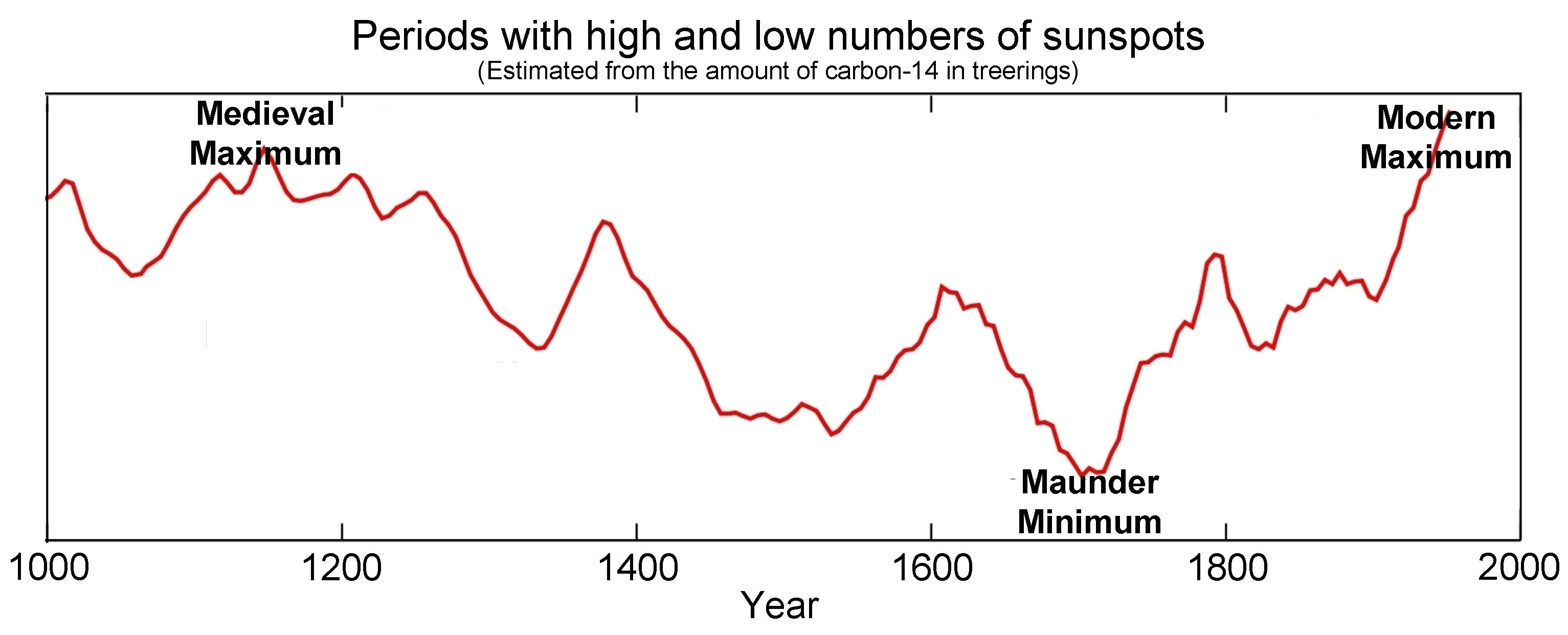
Source: Department of Geosciences, Georgia State University
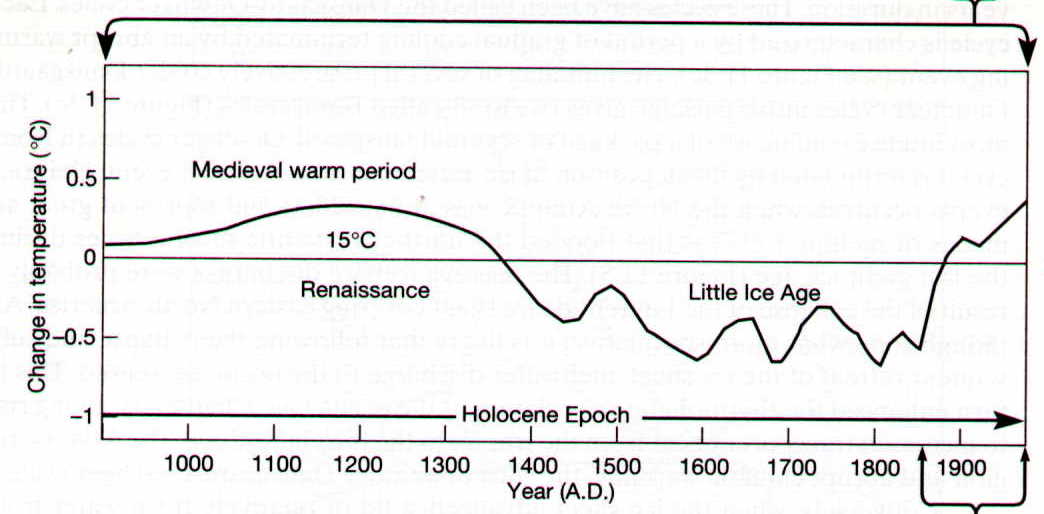
Source: Department of Earth Sciences, University of Southern California
Now, the consensus view among skeptics of global warming has generally been that naturally-occurring solar cycles are responsible for cooling and warming trends. In the medieval era, global temperatures were higher than today, and that cannot have been caused by the emission of greenhouse gases. It makes more sense to attribute that warming period to the sun than to human behaviors. If that’s the case, then it’s possible that solar cycles could also cause us to go into a cooling period.
Here’s an article about global cooling from the Financial Post, a Canadian newspaper that is part of the National Post.
Excerpt:
In the 1960s and 1970s, a growing scientific consensus held that the Earth was entering a period of global cooling. The CIA announced that the “Western world’s leading climatologists have confirmed recent reports of detrimental global climatic change” akin to the Little Ice Age of the 17th and 18th centuries, “an era of drought, famine and political unrest in the western world.” President Jimmy Carter signed the National Climate Program Act to deal with the coming global cooling crisis. Newsweek magazine published a chilling article entitled “The Cooling World.”
In the decades that followed, as temperatures rose, climate skeptics mocked the global cooling hypothesis and a new theory emerged — that Earth was in fact entering a period of global warming.
Now an increasing number of scientists are swinging back to the thinking of the 1960s and 1970s. The global cooling hypothesis may have been right after all, they say. Earth may be entering a new Little Ice Age.
“Real risk of a Maunder Minimum ‘Little Ice Age,’” announced the BBC this week, in reporting startling findings by Professor Mike Lockwood of Reading University. “Professor Lockwood believes solar activity is now falling more rapidly than at any time in the last 10,000 years [raising the risk of a new Little Ice Age] from less than 10% just a few years ago to 25-30%,” explained Paul Hudson, the BBC’s climate correspondent. If Earth is spared a new Little Ice Age, a severe cooling as “occurred in the early 1800s, which also had its fair share of cold winters and poor summers, is, according to him, ‘more likely than not’ to happen.”
[…]Scientists at the Climate and Environmental Physics and Oeschger Centre for Climate Change Research at the University of Berne in Switzerland back up theories that support the Sun’s importance in determining the climate on Earth. In a paper published this month by the American Meteorological Society, the authors demolish the claims by IPCC scientists that the Sun couldn’t be responsible for major shifts in climate. In a post on her website this month, Judith Curry, Chair of the School of Earth and Atmospheric Sciences at the Georgia Institute of Technology, all-but mocked the IPCC assertions that solar variations don’t matter. Among the many studies and authorities she cited: the National Research Council’s recent report, “The Effects of Solar Variability on Earth’s Climate,” and NASA, former home of global warming guru James Hansen.
The Daily Caller picked up on this article and added more: (H/T Letitia)
Earlier this year, Professor Cliff Ollier of the School of Earth and Environmental Studies at the University of Western Australia presented a study that posited that the sun was a major controller of the climate.
“There is a very good correlation of sunspots and climate,” Ollier wrote. “Solar cycles provide a basis for prediction. Solar Cycle 24 has started and we can expect serious cooling. Many think that political decisions about climate are based on scientific predictions but what politicians get are projections based on computer models.”
Last year, Russian scientists also posited that from next year onward the world could expect the start of the another Little Ice Age.
“After the maximum of solar cycle 24, from approximately 2014 we can expect the start of deep cooling with a Little Ice Age in 2055,” wrote Habibullo Abdussamatov of the Russian Academy of Science.
The “Little Ice Age” occurred during the 1600s when winters were harsh all across Europe. The continent-wide cold weather coincided with an inactive sun, called the Maunder solar minimum.
You’re not likely to hear about the Medieval Warming Period or the Maunder minimum in public schools, but they are there in the data.
Of course, if the majority of people begin to understand that the sun is causing cycles of warming and cooling, then we don’t really need government to regulate job creators and control our consumption. What would happen then? So my suspicion is that the government-funded scientific consensus will try to get us to believe that we have always been fighting against global cooling, not global warming. That way, the massive taxation and regulation of private companies and private individuals can continue.
This reminds me of Oceania’s war with Eastasia or Eurasia in the famous distopian novel 1984: (description from leftist Wikipedia)
In 1984, there is a perpetual war among Oceania, Eurasia and Eastasia, the super-states which emerged from the atomic global war. “The book”, The Theory and Practice of Oligarchical Collectivism by Emmanuel Goldstein, explains that each state is so strong it cannot be defeated, even with the combined forces of two super-states—despite changing alliances. To hide such contradictions, history is re-written to explain that the (new) alliance always was so; the populaces accustomed to doublethink accept it. The war is not fought in Oceanian, Eurasian or Eastasian territory but in the arctic wastes and a disputed zone comprising the sea and land from Tangiers (northern Africa) to Darwin (Australia). At the start, Oceania and Eastasia are allies combatting Eurasia in northern Africa and the Malabar Coast.
That alliance ends and Oceania allied with Eurasia fights Eastasia, a change which occurred during the Hate Week dedicated to creating patriotic fervour for the Party’s perpetual war. The public are blind to the change; in mid-sentence an orator changes the name of the enemy from “Eurasia” to “Eastasia” without pause. When the public are enraged at noticing that the wrong flags and posters are displayed they tear them down—thus the origin of the idiom “We’ve always been at war with Eastasia”…
I wonder if we are coming to the point when the global warming alarmists will switch their pro-socialism narrative so that the threat we face is global cooling.
The neat thing about that article is that it’s the Canadians who are among the most skeptical of global warming. Previously, officials in the Canadian government have been extremely critical of the man-made global warming hypothesis. Consider the comments of Conservative MP Joe Oliver and Conservative MP Peter Kent – they are all for developing energy resources and creating jobs. Canadians are practical on the issue of climate change – they would rather have jobs than feelings of moral superiority. But down here in Obamaland, there’s no critical thinking at all on the issue. If you doubt global warming, then you need to be called names, intimidated, fired or worse.
 WINTERY KNIGHT