Tag Archives: College

Republicans propose expansion of 529 college savings plans

I guess by now everyone has heard about Obama’s plan to eliminate college savings plans.

The left-leaning New York Times reported on it:

President Obama is proposing a radical change to the 529 college savings plans held by millions of families, which would require those who use them to rethink their approach to college savings.

As part of his plan to simplify the tax code and help the middle class, one of the 529 plan’s most attractive benefits would be eliminated: Money could no longer be withdrawn tax-free. (The new rules would apply only to new contributions.)

The accounts, many of which are run by the states, allow people to make contributions that grow tax-free. The money can be withdrawn without the paying of capital gains taxes as long as the proceeds are used for education expenses. Many states provide state income tax deductions for contributions as well.

The proposal has now been withdrawn after a huge uproar. The real question is, why would he propose such a stupid thing?

First, it’s important to understand that government raises the cost of higher education with subsidies, which the Democrats favor:

A new study by Dennis Epple, Richard Romano, Sinan Sarpca and Holger Sieg for the National Bureau of Economic Research suggests that the impact of these aid programs is clearly different from what federal policy makers intended. “We show that private colleges game the federal financial aid system,” they conclude. Every dollar in new financial aid to students leads to about 40 cents less spent by the colleges on institutional financial aid — so students benefit far less than federal policy makers intended.

In 1987, Secretary of Education William Bennett argued that more federal aid leads to higher tuitions, enabling schools to increase spending. This seems broadly consistent with the latest research results. The net attendance impact of these federal programs, according to the study for NBER, is “modest.” In short, these programs haven’t substantially spurred student access to colleges, all the while burdening taxpayers and student borrowers.

The ballooning federal aid increases schools’ spending. The researchers don’t analyze changes in university spending, but an examination of other evidence suggests that money isn’t going primarily into improving instruction. Colleges have gone on a building spree (financed in part by amassing large debt — more than $220 billion at schools whose bonds are rated by Moody’s alone), and pay and perquisites for top university administrators has risen sharply.

The Democrats already want higher education to be out of reach – that’s why they keep increasing subsidies. So, eliminating college savings plans is in line with this goal of putting higher education out of reach. It’s another way to cause people to have fewer children, something that Democrats are very passionate about. After all, if you can’t pay for higher education for four kids, you’ll only have two. Democrats have this terrible fear of over-population, and it drives a lot of their policies, including abortion.

But that’s not all – there’s another reason to stop people from saving for college.

Second, it stops people from saving their own money:

Megan McArdle suggests, quite reasonably, that this is a desperate move by those who need to finance ever bigger government and are simply going where the money is: the vast American middle class. You can understand why the champions of big government would be slavering over the very thing that defines the middle class, its savings. As she points out, 529s are not the first target. There have already been trial balloons about raiding 401(k)s and IRAs. The truly committed leftist looks upon our private savings as a vast reserve of capital unfairly withheld from its proper function of servicing the needs of the state.

I think that’s the real explanation. This is not so much a rational calculation about how to finance the behemoth state. This is an admission by a man who has no more election campaigns to run, and therefore no pragmatic constraints, about his real outlook and real preferences. A president who just a few weeks ago hailed the triumph of a supposed “middle-class economics” is revealing his hatred and contempt for the middle class.

Republicans would like to see people saving more and more money so that they are less and less dependent on the government. This is because the more independent you are, the more fre you are – and Republicans are for personal liberty.

This is GOP Congressman Lynn Jenkins:
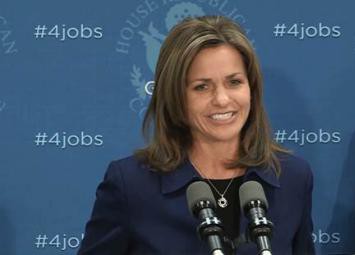
Kansas Congresswoman Lynn Jenkins

Here is her Republican response to Obama’s proposal to eliminate 529s:

Good morning. I’m Lynn Jenkins, Congresswoman from the Second District of Kansas and Vice-Chair of the House Republican Conference.

This is the time of year when high school seniors are putting the final touches on their college applications. That means it’s also the time when families are preparing to start paying for that education — whether it’s a 4-year college, community college, or a technical school. (Scroll down for video of these remarks.)

As a parent with two children in college, I know this can be one of the most rewarding, and at the same time challenging, aspects of being a parent — particularly at a time when costs are going up while wages stay about the same. All told, Americans now owe more than $1 trillion in student loan debt.

And so in the new Congress, Republicans are working to lower costs for middle-class families and empower folks with bottom-up solutions that help prepare you for the future.

That’s why, this week, I introduced a bipartisan plan to expand popular 529 college savings accounts.

As you know, these 529 plans were created to help middle-class families save and plan for college. Many parents open them not long after their children are born. And ever since Congress allowed folks to withdraw from these accounts tax-free for college expenses, 1 million account holders have turned into 12 million.

Unfortunately, instead of expanding 529s, the president recently proposed raising taxes on college savings. If implemented his scheme would have turned back the clock on middle-class families, and taken money from your savings to pay for more government. This would have discouraged families from using 529s, meaning less savings, more debt, and more government dependence.

This proposal increases middle-class independence from the government, and makes people more free to work, earn, save and chart their own course. It’s different from the Democrat proposals which increase dependence on government and reduces liberty.

Young Texan earns $140,000 a year, with a two-year degree and hard work

I love this story from the Wall Street Journal. I’m linking to the free version on Yahoo News, though!

Excerpt:

Justin Friend ’s parents have doctoral degrees and have worked as university lecturers and researchers. So Mr. Friend might have been expected to head for a university after graduating from high school in Bryan, Texas, five years ago.

Instead, he attended Texas State Technical College in Waco, and received a two-year degree in welding. In 2013, his first full year as a welder, his income was about $130,000, more than triple the average annual wages for welders in the U.S. In 2014, Mr. Friend’s income rose to about $140,000.

[…]The risks of a mismatch between costly university degrees and job opportunities have become clearer in recent years. Anthony Carnevale, director of the Center on Education and the Workforce at Georgetown University, said nearly a third of people aged 22 through 26 with a Bachelor of Arts degree either don’t have a job or are working at one that doesn’t require a university degree. The numbers are similar for young people with vocational degrees, but those lower-cost degrees don’t typically lead to heavy debts.

Student loan debt outstanding in the U.S. totaled $1.13 trillion as of Sept. 30, up by $100 billion from a year earlier, according to the Federal Reserve Bank of New York. (Mr. Friend has no debts.)

[…]Mr. Friend, who is single, typically works 72 hours a week, usually including at least one day of the weekend, often on an overnight shift. His base pay is more than $25 an hour, up from about $22 when he started in 2012. He gets overtime after 40 hours a week. Pay is doubled on Sundays and tripled on holidays. He receives health insurance, a 401k retirement plan and paid vacation.

With little free time, expenses are low. He rents a one-bedroom apartment for $1,080 a month in a building with a pool and gym. To stay in shape for mountain-climbing trips, he sometimes runs up and down steps wearing a weighted backpack.

He showed an early inclination to make things. “At three years old, he was using a screwdriver and a hacksaw skillfully,” said Dr. Vaughan, his mother. Later, dyslexia made writing and math a struggle for him.

In junior high school, he took a course in welding. Within a few years, he was earning money repairing fences and doing other welding jobs for neighbors.

A documentary on World War II stirred Mr. Friend’s interest in pulse jet engines, which were used by Germany to propel bombs. He and his father, Ted Friend, a professor of animal science at Texas A&M, together built such an engine. “We used a leaf blower to start it,” pumping in air needed to ignite the engine, the younger Mr. Friend said. “It ran on propane.” When he attached the engine to a golf cart, he said, the vehicle proved difficult to steer after reaching 30 miles an hour.

“Mom didn’t like it,” he said. “She thought I was going to blow myself up.” One of his goals is to put a jet engine on a motorcycle, he says, adding: “I’d try to make it as safe as I could.”

On a recent day, while country music played on a colleague’s radio, Mr. Friend used gas tungsten arc welding techniques to attach two steel parts destined for an oil apparatus. Wearing a T-shirt and Wrangler jeans, he hunched over work requiring the precision of a jewelry maker. After welding, he buffed the part with a wire brush. Colleagues would later X-ray the part to make sure the weld was flawless.

The long hours mean “it’s hard to have a life,” Mr. Friend said. Eventually, he said he may pursue an advanced degree in metallurgy and research welding materials and techniques. For now, he’s building up his savings.

He’s debt-free, and probably didn’t even need student loans for this program. You couldn’t say that about most college students these days – and the ones in non-STEM fields will never be able to pay their loans back. What causes people to go into programs that don’t produce a return on investment? I think I know why. I think that many Americans have the idea that life should be about personal fulfillment, and not about doing things that don’t feel right to them. Hard work doesn’t “feel” right to many young Americans. They want work to make them famous, and to make them happy. Well, work isn’t supposed to be like that. Work is about making money, and very often the most difficult degrees and jobs are the least fame-making, and the least happiness-inducing. This guy is a welder! It’s not glamorous.

I would advise my younger readers, especially my male readers, to take a page out of this welder’s handbook. Make a plan to avoid debt, and stick to it.

How to prepare your kids for the pressure to be “cool”

This is a post from Pastor Matt Rawlings’ blog.

Excerpt:

[…]When any eighteen year old walks on to a secular university (or even many so-called “Christian” ones) they immediately feel pressure.  When a “cool professor” emerges trashing everything the eighteen year old has been taught by his or her parents to hold dear, the pressure intensifies.  If the eighteen year old dares to speak up, the professor will often ridicule the poor kid like a seasoned stand-up comic dealing with a heckler.  The other eighteen year old kids raised in Christian homes will see (or hear about it) and will feel even more pressure to conform.

Here is his recommendation:

We need to continue to train our kids in apologetics but we also need to prepare them spiritually for the battle they will face on college campuses.  They need to know how to engage the spiritual disciplines of prayer, fasting, etc.  They also need to be connected with a community that will have their back.  I would not advise anyone to attend a secular university without making sure there is a strong Christian campus presence.  For example, I live in the Buckeye state and many of the young people I know want to attend Ohio State University (excuse me, The Ohio State University).  I always remind them to check out strong nearby churches like Xenos and groups like Ratio Christi led by the fearless Eric Chabot.

Everybody wants to be liked and everyone has a desire to fit in.  The pressure to be accepted is even stronger when a person is younger.  We need to train our young people to be apologists but we also need to recognize basic human nature including our ability to justify our behavior such as ignoring their training in order to sit at the cool kids’ table.  We need to train and prayerfully prepare.  Let’s get to work.

Pastor Matt had a quote from an article by Paul Vitz in his post, and I found the article. It’s on Leadership University, which is the web site that got me through college with my faith intact.

Here’s a bit of it:

I am not going into this to bore you with parts of my life story, but to note that through reflection on my own experience it is now clear to me that my reasons for becoming and for remaining an atheist-skeptic from about age 18 to 38 were superficial, irrational, and largely without intellectual or moral integrity. Furthermore, I am convinced that my motives were, and still are, commonplace today among intellectuals, especially social scientists.

[…]An important influence on me in my youth was a significant social unease. I was somewhat embarrassed to be from the Midwest, for it seemed terribly dull, narrow, and provincial. There was certainly nothing romantic or impressive about being from Cincinnati, Ohio and from a vague mixed German-English-Swiss background. Terribly middle class. Further, besides escape from a dull, and according to me unworthy, socially embarrassing past, I wanted to take part in, in fact to be comfortable in, the new, exciting, even glamorous, secular world into which I was moving. I am sure that similar motives have strongly influenced the lives of countless upwardly mobile young people in the last two centuries. Consider Voltaire, who moved into the glittery, aristocratic, sophisticated world of Paris, and who always felt embarrassed about his provincial and nonaristocratic origin; or the Jewish ghettos that so many assimilating Jews have fled, or the latest young arrival in New York, embarrassed about his fundamentalist parents. This kind of socialization pressure has pushed many away from belief in God and all that this belief is associated with for them.

I remember a small seminar in graduate school where almost every member there at some time expressed this kind of embarrassment and response to the pressures of socialization into “modern life.” One student was trying to escape his Southern Baptist background, another a small town Mormon environment, a third was trying to get out of a very Jewish Brooklyn ghetto, and the fourth was me.

[…]Another major reason for my wanting to become an atheist was that I desired to be accepted by the powerful and influential scientists in the field of psychology. In particular, I wanted to be accepted by my professors in graduate school. As a graduate student I was thoroughly socialized by the specific “culture” of academic research psychology. My professors at Stanford, however much they might disagree on psychological theory, were, as far as I could tell, united in only two things-their intense personal career ambition and their rejection of religion. As the psalmist says, “. . . The man greedy for gain curses and renounces the Lord. In the pride of his countenance the wicked does not seek him; all his thoughts are, ‘There is no God'” (Psalm 10:3-4).

In this environment, just as I had learned how to dress like a college student by putting on the right clothes, I also learned to “think” like a proper psychologist by putting on the right-that is, atheistic-ideas and attitudes.

I blogged about Paul Vitz before. If you have not seen his lecture on the Psychology of Atheism, you really should watch it.

Natasha Crain at Christian Mom Thoughts had some practical advice for dealing with this, and in a minute I’ll give you my advice, because this peer-pressure thing was never a problem for me.

Excerpt:

[…]I do believe there are things we can do to help lessen our kids’ concern about coolness:

  • Make sure they have Christian friends. No, not just the kids they interact with each Sunday at church. Please don’t assume your kids’ “church friends” are a primary influence just because they rub elbows each week (and don’t assume that church friends are truly Christian friends). Look at who they spend time with on their own. Meaningful peer relationships with other believers make a big difference.
  • Give them perspective. By and large, the most well-grounded Christian kids I’ve encountered have been heavily involved in service. When kids have built houses in Mexico, served their local homeless, or come to the aid of disaster victims, they are more likely to have a level-headed perspective on why the perceived “coolness” of their beliefs doesn’t matter. Faith becomes a living, breathing part of their identity.
  • Be a family that is comfortable living counter-culturally. In the book Revolutionary Parenting, George Barna analyzed years of research data to determine what common factors exist in the child-rearing efforts of parents whose children remained strong in their faith into their adult years (he calls these kids “spiritual champions”). One major finding was this: “Parents are more likely to raise spiritual champions if they accept the fact that from day one their parenting efforts will stray from the norm and will put them at odds with parents who are pursuing a more conventional approach.” When kids are raised in a home where they become comfortable living differently than the world around them, they are prepared to carry that confidence into adulthood.
  • Give them Christian heros and role models. Our kids need to know that the world is filled with amazing people who love the Lord: athletes, scientists, missionaries, actors, writers, government leaders, business owners…the list goes on. Wherever your child’s interests lie, introduce them to Christian role models in that area and the stories of how they’re making a difference for God’s kingdom.

Now my turn. Peer-pressure wasn’t a problem for me growing up. We were poor, so we had much more immediate problems! But I had an answer to the problem of being different from the other kids – I was going to grow up faster than they did and be more mature by out-earning them. I always tried to be working at least one job, and I worked summers too – kept it up through high school and my undergraduate degree. That was my plan. So that’s my recommendation to young people. Get yourself the best job you can get as young as you can. Never let a summer go by when you are not working to earn money.

I also recommend listening to this Veritas Forum lecture called “Giants in the Land“, by the famous professor of mechanical engineering, Dr. Walter Bradley. My favorite lecture of all time. When you are young and it occurs to you that you are not like other people, it’s a wonderful thing to have the words of Dr. Bradley in your mind. Here is my favorite part- he says: “Sometimes we protect our reputation too hard. And what we really need is to get our reputation absolutely destroyed so we don’t worry about it any more… On the other side of a very ruined reputation is real freedom… to do what God wants you to do… It’s the ripping the reputation off that’s a little hard, right? But once it’s gone, it’s gone.  And then you have real freedom.”

I value my freedom and I know that caring what people think of me takes my freedom away! I really recommend that young people read or watch the French “Cyrano de Bergerac” (1990) (or the older black-and-white version) to learn the value of being who you are. If you are being good, you don’t have to care what people think of you – although you may need an alias now, since people on the secular left have gotten so intolerant. You can be yourself and be a hero. And that’s something. That’s a lot!