“The private sector is doing fine,” Obama said at a press conference on Friday. “Where we’re seeing weaknesses in our economy, have to do with state and local government — oftentimes, cuts initiated by governors or mayors who are not getting the kind of help that they have in the past from the federal government and who don’t have the same kind of flexibility as the federal government in dealing with fewer revenues coming in.”
State and local leaders were not the only ones to blame for a bad economy, as the president also blamed Republicans in Congress.
What are the facts? Is Obama right?
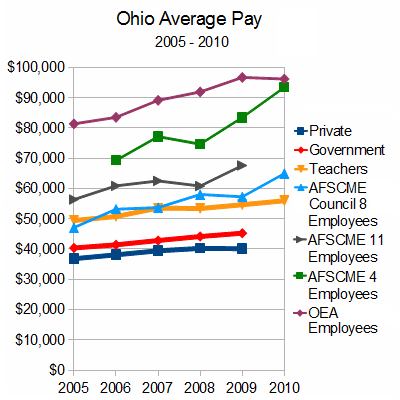
Here is a comparison of public and private pay in Ohio, for example:
Ohio Average Pay: Public vs. Private
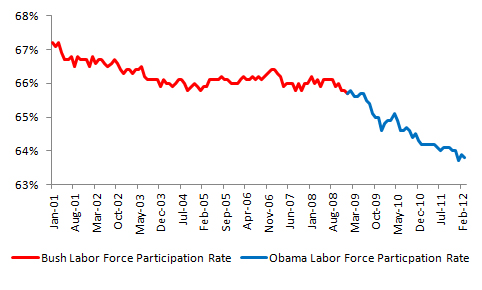
Does Obama know how to create jobs? Let’s compare him to Bush:
Labor Force Participation 2012 (click for larger image)
There is no recovery. We haven’t created any jobs. We’ve actually lost 5 million jobs since the Democrats took over the House and Senate in January 2007.
When George W. Bush was President, we had unemployment around 4 or 5 percent for 8 years, which deficits as low as $160 billion in 2007. Barack Obama has had four budget deficits of a trillion or more in a row, and his unemployment rate has been double Bush’s rate. Bush has an MBA from Harvard and had private sector job creation experience. Obama doesn’t know anything about economics. He’s a lawyer who benefited from affirmative action, and who has never released his grades. You can’t elect an unqualified person and get performance.
As a country that has 2 percent of the world’s oil reserves, but uses 20 percent of the world’s oil — I’m going to repeat that — we’ve got 2 percent of the world oil reserves; we use 20 percent. What that means is, as much as we’re doing to increase oil production, we’re not going to be able to just drill our way out of the problem of high gas prices. Anybody who tells you otherwise either doesn’t know what they’re talking about or they aren’t telling you the truth.
Now let’s find out who doesn’t know what they’re talking about and who isn’t telling the truth.
The Government Accountability Office – a department of the federal government – tells us the facts.
Excerpt:
The Green River Formation, a largely vacant area of mostly federal land that covers the territory where Colorado, Utah and Wyoming come together, contains about as much recoverable oil as all the rest the world’s proven reserves combined, an auditor from the Government Accountability Office told Congress on Thursday.
The GAO testimony said that the federal government was in “a unique position to influence the development of oil shale” because the Green River deposits were mostly beneath federal land.
[…]It also noted that developing the oil would have an environmental impact and pose “socioeconomic challenges,” that included bringing “a sizable influx of workers who along with their families put additional stress on local infrastructure” and “making planning for growth difficult for local governments.”
“The Green River Formation–an assemblage of over 1,000 feet of sedimentary rocks that lie beneath parts of Colorado, Utah, and Wyoming–contains the world’s largest deposits of oil shale,”Anu K. Mittal, the GAO’s director of natural resources and environment said in written testimony submitted to the House Science Subcommittee on Energy and Environment.
“USGS estimates that the Green River Formation contains about 3 trillion barrels of oil, and about half of this may be recoverable, depending on available technology and economic conditions,” Mittal testified.
“The Rand Corporation, a nonprofit research organization, estimates that 30 to 60 percent of the oil shale in the Green River Formation can be recovered,” Mittal told the subcommittee. “At the midpoint of this estimate, almost half of the 3 trillion barrels of oil would be recoverable. This is an amount about equal to the entire world’s proven oil reserves.”
In her oral statement before the subcommittee, Mittal said that developing the shale oil would create wealth and jobs for the country, but also challenges for government.
“Being able to tap this vast amount of oil locked within this formation will go a long way to help to meet our future demands for oil. The U.S. Geological Survey, as you noted, estimates that the formation contains about 3 trillion barrels of oil of which half may be recoverable,” she said.
“As you can imagine having the technology to develop this vast energy resource will lead to a number of important socioeconomic benefits including the creation of jobs, increases in wealth and increases in tax and royalty payments for federal and state governments,” she said.
[…]In her written testimony, Mittal noted that three-fourths of the Green River shale oil is under federal land.
Is Barack Obama a good President? Does he know how to be President? Does he understand economics?
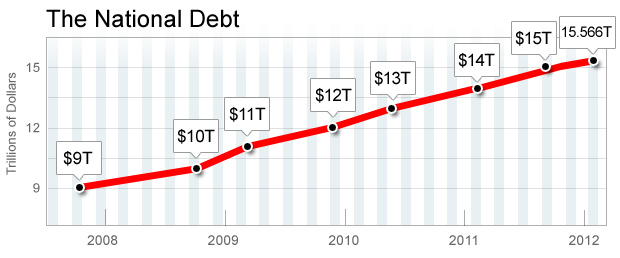
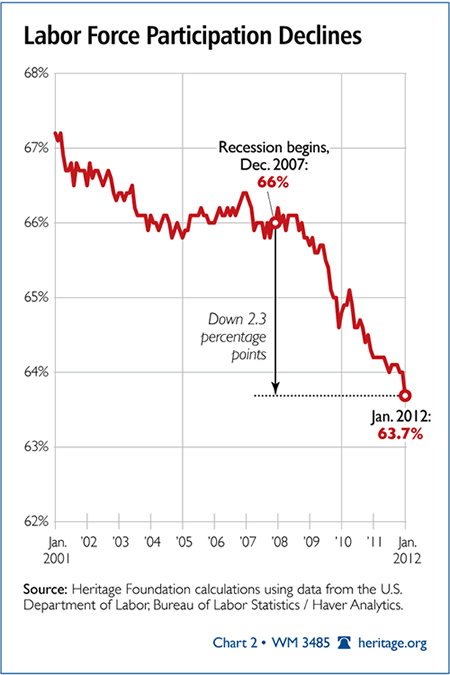
Let’s look at the national debt and the labor force participation rates in Obama’s first term. Recall that the Republicans lost the House and Senate in January of 2007. At the time of the Pelosi/Reid takeover, the national debt was $8 trillion. It is now almost double that at $16 trillion.
Obama added 5 trillion dollars to the debt since he took officeUS Labor Force Participation down 4.9 million people
If these numbers seem bad to you, then I don’t think you should vote for Obama.
The armed forces of Colombia have scored a major battlefield victory. They finally hunted down, confronted, and killed the leader of the narco-terrorist Revolutionary Armed Forces of Colombia (FARC), Guillermo Leon Saenz, widely known by his alias Alfonso Cano.
A guerrilla for decades, Cano assumed the top leadership of the FARC following the natural death of founder Manuel Marulanda (2008) and the elimination of senior figures Raul Reyes (2008) and Jorge Briceno (aka Mono Jojoy, 2010).
Seen by some as a modern-day version of the “good revolutionary,” Cano—a life-long advocate of armed violence and terrorism—fell in combat with the Colombian armed forces as they rappelled their way into his secret jungle hideout. Cano was also indicted in a U.S. court for drug trafficking along with dozens of other FARC leaders and had a $5 million price on his head.
WHEN the figures are finally tallied, Colombia may prove to have weathered the world recession better than any other of the larger Latin American countries. After a slight contraction at the end of 2008, the economy has been growing modestly this year. This resilience stems from continued foreign investment, an increase in government spending on public works and easier money: since December the central bank has cut interest rates by six percentage points, to 4%, a steeper drop than anywhere in the region outside Chile.
[…]President Álvaro Uribe’s security policies have helped to restore confidence. Investment soared, from 15% of GDP in 2002 to 26% last year, says Mr Zuluaga. Private business has retooled. After many delays, the government has issued licences to expand several ports; this month it hopes to award a contract for the first of four big road schemes, costing a total of $7.5 billion over four years. It hopes for investment of up to $50 billion in mining and oil over the next decade.
…Colombia’s revival is benefiting U.S. economic and political rivals as much as or more than the U.S. itself.
The long delay in signing the treaty allowed Latin America’s fourth-largest economy to strengthen ties with China. It also damaged U.S. credibility in the region, says Eric Farnsworth, vice-president of the Council of the Americas in Washington. “The delay in passing this called into question the United States’ reliability as a partner,” Farnsworth says. “There’s a strategic component to this. It’s not just about economics and trade.”
[…]As talks between the U.S. and Colombia dragged on, Colombia and China forged plans for a rail link between the Pacific and Caribbean that could draw freight away from the Panama Canal. Colombian President Juan Manuel Santos aims for a trade deal with South Korea. To tighten his connections to high-growth Asia, he’s also seeking membership in the Asia-Pacific Economic Cooperation group. “While Washington was debating whether the accord with Colombia was opportune, we advanced in our foreign policy strategy,” says Trade Minister Sergio Diaz-Granados.
Santos has cooperated more with his South American neighbors, organizing a meeting of finance ministers to discuss ways to protect their currencies and economies from the debt crisis in the U.S. and Europe. He supports a stock trading platform with Colombia, Chile, and Peru and wants to bring Mexico and Panama on board. Exports to Brazil have surged tenfold. While the U.S. remains Colombia’s biggest export market, with $16.8 billion in 2010 sales, up 30 percent from a year earlier, sales to China more than doubled last year, to $1.2 billion. Sales to the European Union are also rising, to $5.4 billion this year through August, more than in all of 2010. An EU trade accord could come next year.
The government has reduced cocaine cultivation 37 percent and halved the number of insurgents to about 8,000. Improved security has spurred enough growth to win an investment-grade credit rating from Standard & Poor’s as well as investment from billionaires. Colombia’s victories over the guerrillas opened up swathes of countryside to exploration for oil, gold, and coal. Mexican billionaire Carlos Slim’s push into crude has helped fuel foreign investment that the government says may reach a record $12 billion this year. The economy grew 5.2 percent in the second quarter.
The U.S. faces more competition from Colombia’s neighbors and Canada. In 2010, U.S. agricultural exports to Colombia fell more than 50 percent from 2008, to $827 million, as Argentina’s more than doubled, to $1 billion, according to a report by Senator Richard Lugar’s staff. Diaz-Granados attributes the U.S. setback to the delay in the free-trade agreement.
An August accord reduces or ends Colombian tariffs on Canadian wheat, paper, and machinery. Bank of Nova Scotia, Canada’s third-largest lender, agreed in October to buy 51 percent of Banco Colpatria Red Multibanca Colpatria for about $1 billion—Scotiabank’s largest international takeover. “This is not the Colombia of old,” says Brian J. Porter, group head of international banking for Scotiabank. “The more we looked at Colombia, the more excited we got about the economic potential.”
We really should have signed that trade deal 3 years ago – it would have helped out economy a lot. But unions got Obama elected, and the unions decided that the trade deal needed to be held up for 3 years. And that’s one of the reasons why we’ve had over 9% unemployment. Our economic policy is being set by unions, not by economists. But in Colombia, economic policy is set by economists, not unions.

 WINTERY KNIGHT